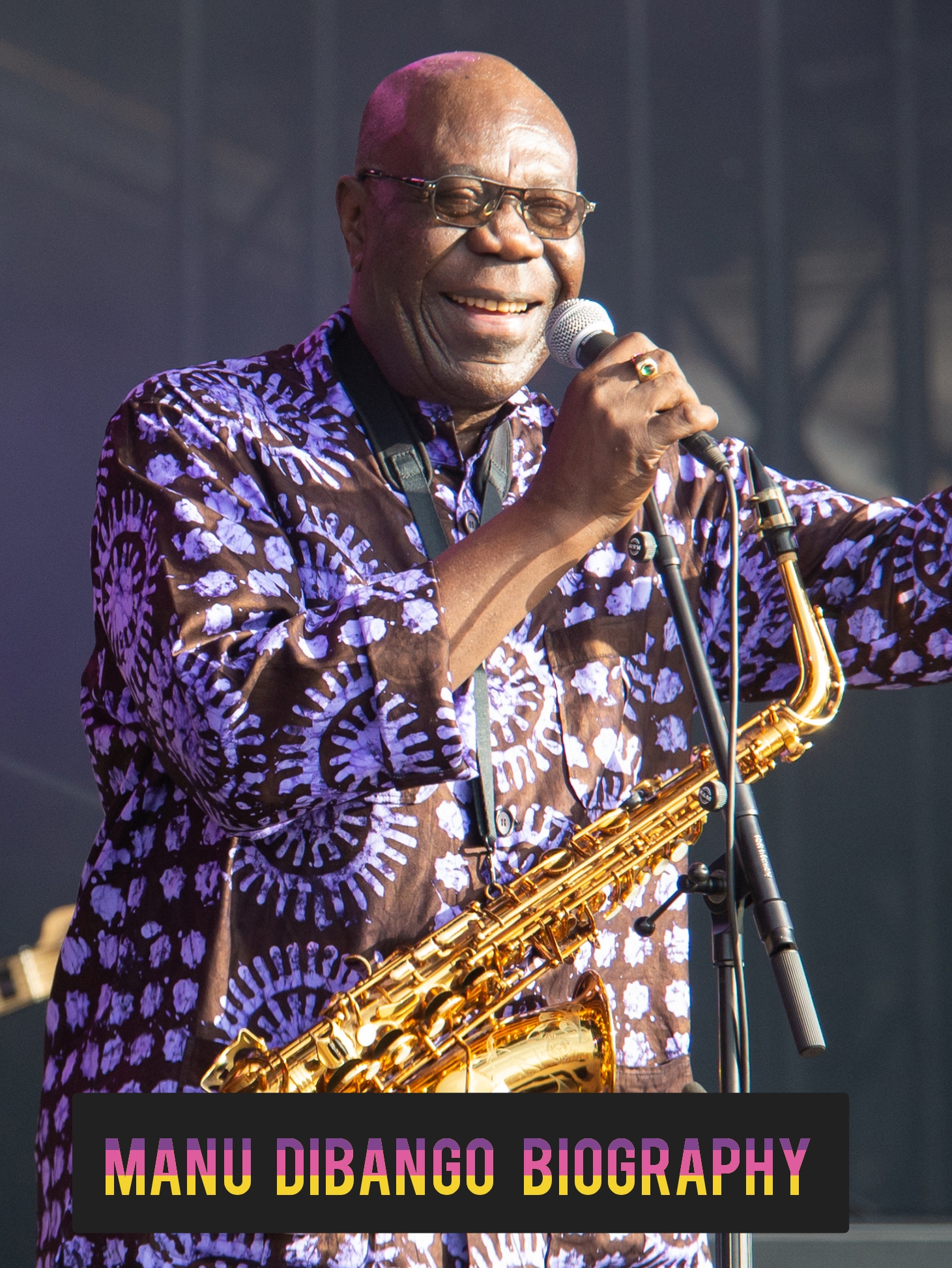
Manu Dibango Biography
Manu Dibango was a Cameroonian saxophonist, vibraphonist, composer and bandleader whose music crossed continents and styles for more than six decades. He fused jazz, funk, Cameroonian makossa and other African rhythms into a distinctive sound that reached audiences far beyond Africa. His 1972 recording Soul Makossa became one of the most influential and widely sampled African songs in popular music history.
This biography follows the full course of his life from his childhood in Douala through his years of study and performance in Europe, his breakthrough on the world stage, the challenges he faced, and the lasting mark he left on global music. It is written in clear language so that every reader can follow the story of a musician who always insisted that he was first a musician and only then an African artist.
Manu Dibango Intro
Few African musicians of the twentieth century opened as many doors for the music of their continent as Manu Dibango. In 1972 a song he recorded almost as an afterthought, the B side of a football anthem, found its way into the hands of a New York disc jockey and then onto dance floors across the United States. That track, Soul Makossa, helped shape the early sound of disco and later became one of the most sampled recordings in popular music. Michael Jackson, Rihanna and countless others drew from its famous chant, yet the original voice and saxophone belonged to a Cameroonian who had grown up singing in a Protestant church choir.
What makes the story compelling is the long path that led to that moment. Dibango spent years playing in small clubs, accompanying other artists and experimenting with different styles before the world suddenly noticed him. He never stopped exploring. Until the final months of his life he continued to tour, record and blend classical, jazz and African forms. His career shows how curiosity, persistence and an open ear can turn a local musician into a global ambassador of sound.
Manu Dibango Early Life
Manu Dibango was born Emmanuel N’Djoké Dibango on 12 December 1933 in Douala, the largest city of Cameroon, which was then under French colonial administration. His father, Michel Manfred N’Djoké Dibango, belonged to the Yabassi ethnic group and worked as a civil servant. His mother came from the Duala people and worked as a fashion designer while also leading the choir at the local Protestant church. The marriage of partners from two different ethnic groups was not always welcomed by the families around them, yet the household remained stable and musical.
Young Emmanuel grew up hearing church hymns every evening. His mother directed the choir, and an uncle played guitar. A rare gramophone in the home brought records of French, American and Cuban music into the house. The boy sang in the church and learned the basics of melody and harmony there. He later said that he caught the magical virus of music in that temple. At the same time he absorbed the traditional sounds of the Douala region and the lively popular music that arrived with sailors in the busy port city.
He first attended a village school and then a colonial school where he learned French. In 1949, at the age of fifteen, his parents sent him to France to continue his education. He travelled by boat for nearly a month and arrived in Marseille carrying three kilos of coffee, a valuable gift meant to help pay for his first months of lodging. He lived with a host family in the small town of Saint-Calais and later studied in Chartres, Reims and Paris. He began classical piano lessons at seventeen. A friend, the future Cameroonian musician Francis Bebey, introduced him to jazz. Captivated by the recordings of Duke Ellington, Sidney Bechet and Louis Armstrong, Dibango turned to the saxophone and made rapid progress.
His father expected him to become a professional man, a lawyer or doctor. When Dibango failed the second part of his baccalaureate examinations in 1956 and continued to play in nightclubs and country dances, his father cut off financial support. The young man left formal studies and moved to Brussels, where a lively African and Caribbean music scene offered work. The decision marked the true beginning of his life as a professional musician.
Manu Dibango Personal Life
In Brussels Manu Dibango met Marie-Josée, a Belgian actress, model and photographer known as Coco. They married in 1957. Coco became his closest companion, manager and what he later called his guardian angel. The couple stayed together until her death in 1995. They had several children. Sources name Georgia, Michel, Marva and James, who later performed under the name James BKS. Georgia, who had worked closely with her father, died in 2023. Dibango also recognised other children from later relationships.
Family life moved with his career. In the early 1960s the couple lived for a time in Léopoldville, later Kinshasa, in the Congo, where Dibango managed nightclubs and performed. Later they settled mainly in France. After Coco’s death Dibango found the loss heavy. He released a reflective album, Lamastabastani, that drew inspiration from her memory. In later years he remarried, though the second marriage did not produce children and the public record of it remains limited.
Away from the stage Dibango was known for his calm presence, bald head, dark glasses and ready smile. Friends and colleagues called him Papy Groove. He enjoyed the company of musicians from many backgrounds and preferred conversation about sound and rhythm over personal display. He remained connected to Cameroon even while living in Europe and often spoke of the need for African artists to claim their place without being reduced to exotic labels. He once remarked that a person is a musician first and only afterwards an African. That outlook shaped both his private attitude and his public work.
Manu Dibango Rise to Prominence
In Brussels Dibango found steady work in clubs that catered to African and Caribbean communities. He met the Congolese bandleader Joseph Kabasele, known as Grand Kallé, leader of African Jazz. Dibango joined the group as saxophonist and travelled with them. In 1960 he took part in the recording of Indépendance Cha Cha, a song that became an unofficial anthem of African independence movements. The band spent time in Léopoldville, and Dibango and Coco remained there for a period, running clubs including the Tam-Tam and introducing the twist to local dancers with a hit called Twist à Léo.
By the mid-1960s Dibango had returned to France. He worked as a sideman with popular French artists such as Dick Rivers and Nino Ferrer, playing saxophone and Hammond organ. He also recorded Latin-tinged sessions that mixed Congolese, Cuban and European elements. In 1969 he released his first major solo album, Saxy Party, which presented jazz interpretations of various material. The record found an audience in Cameroon and helped establish his name at home.
The decisive turning point came in 1972. Dibango was commissioned to write an anthem for the Africa Cup of Nations football tournament hosted by Cameroon. The A side of the single was that official hymn. On the B side he placed a track he had already developed, a mixture of Cameroonian makossa rhythm, jazz phrasing and a strong funk pulse. He called it Soul Makossa. Makossa means “I dance” in the Duala language. The song featured a memorable chanted refrain and Dibango’s distinctive stuttering saxophone lines.
At first the record received modest attention in Europe and Africa. Then a New York disc jockey, David Mancuso, discovered an imported copy and began playing it at his private club, the Loft. Dancers demanded the track again and again. Radio stations followed. Atlantic Records licensed the original version. In 1973 Soul Makossa entered the American charts, an almost unheard-of achievement for an African artist at that time. Cover versions multiplied. Dibango suddenly found himself in demand across the United States, performing at the Apollo Theater and sharing stages with major acts. The B side had become the song that defined his international career.
Manu Dibango Major Achievements
Soul Makossa remains Manu Dibango’s most famous recording. It is widely regarded as one of the foundational tracks of disco and is often described as the most sampled African song in history. Its chant was adapted by Michael Jackson on Wanna Be Startin’ Somethin’ from the album Thriller and later by Rihanna on Don’t Stop the Music. Dibango pursued legal recognition for the use of his material and reached settlements that acknowledged his contribution. The song opened doors for African music on Western dance floors and radio.
Over a career that produced more than forty albums, Dibango continued to experiment. He recorded Afro-funk, reggae-inflected tracks, classical collaborations and pure jazz. Notable later works include Electric Africa, Afrijazzy with Hugh Masekela, and Wakafrica, which brought together many leading African artists. He collaborated with Herbie Hancock, Fela Kuti, the Fania All-Stars, Sly and Robbie, Peter Gabriel, Angélique Kidjo, Youssou N’Dour and many others. Each partnership expanded the range of his sound while keeping the saxophone at the centre.
Official recognition followed. In 1986 the French Ministry of Culture awarded him the Médaille des Arts et des Lettres. In 2004 UNESCO named him an Artist for Peace. He received the Legion of Honour in France and other distinctions that marked his role as a cultural bridge. He served as the first chairman of the Cameroon Music Corporation and spoke often about the rights of African musicians. Until 2019 he continued to perform, including a Symphonic Safari project that joined his band with classical orchestras. His final major appearance took place in early 2020 with the Orchestre National Montpellier Occitanie.
Through these achievements Dibango demonstrated that African popular music could stand on equal terms with jazz, funk and electronic styles. He showed that a musician from Douala could command the respect of New York, Paris and Kinshasa without abandoning the rhythms of home.
Manu Dibango Challenges Setbacks
The early years were marked by family pressure and financial uncertainty. When Dibango chose music over the professional career his father wanted, support was withdrawn. He had to earn a living in clubs while still learning his craft. Moving between France, Belgium and the Congo required constant adaptation to new scenes, languages and expectations.
Racial and cultural barriers existed in the European music industry of the 1950s and 1960s. Black musicians were often confined to certain clubs or expected to play only “exotic” material. Dibango refused to be limited. He played classical pieces for ballet, jazz standards for American servicemen and Congolese rumba for African audiences. The effort demanded both musical skill and personal resilience.
Even after the success of Soul Makossa, maintaining momentum was not automatic. Later albums sometimes received less attention than the breakthrough single. Legal disputes over sampling required time and energy. The death of his wife Coco in 1995 was a profound personal blow that affected his emotional life for years. Health challenges appeared in old age, yet he continued to work. The final obstacle came in 2020 when the COVID-19 pandemic reached France. Dibango contracted the virus and died on 24 March 2020 in a hospital in Melun, near Paris, at the age of eighty-six. He was one of the first internationally known artists to lose his life to the disease.
In every difficulty he returned to music. The same curiosity that led him from church hymns to jazz clubs and then to global stages also helped him recover from setbacks and keep creating.
Manu Dibango Legacy Current Status
Manu Dibango died in 2020, yet his music continues to travel. Soul Makossa is still played in clubs, sampled by new producers and taught in courses on the history of disco and world music. Younger African artists cite him as proof that a local sound can reach the world without losing its identity. His collaborations remain reference points for musicians who work across genres.
In Cameroon he is remembered as a national figure who carried the country’s music abroad while staying connected to its roots. In France he is honoured as a long-time resident who enriched the cultural life of Paris and beyond. UNESCO and other institutions continue to recognise the example he set as an Artist for Peace. His children and former collaborators keep parts of his repertoire alive through performances and reissues.
The bald head, dark glasses and warm smile remain familiar images. More lasting still is the sound of his saxophone and the idea that music can build bridges between continents, styles and generations. Dibango once said that the gift of music has no race. His long career proved the truth of that statement.
Conclusion
Manu Dibango’s life shows what can happen when a musician refuses to stay inside one category. From the church choir in Douala to the dance floors of New York and the concert halls of Europe, he treated every style as material to be explored rather than a boundary to be respected. Soul Makossa was only the most visible result of that approach. The deeper achievement was a lifetime of curious listening and generous collaboration. His story reminds us that the most lasting music often grows from the meeting of different worlds and from the simple decision to keep playing.
FAQs
Who was Manu Dibango?
Manu Dibango was a Cameroonian saxophonist, vibraphonist and composer who blended jazz, funk and traditional Cameroonian music. He is best known for the 1972 hit Soul Makossa and for a career that lasted more than sixty years.
When and where was Manu Dibango born?
He was born on 12 December 1933 in Douala, Cameroon.
What is Soul Makossa and why is it important?
Soul Makossa is a 1972 recording that mixed Cameroonian makossa rhythm with jazz and funk. It became a major hit in the United States, helped shape early disco, and is one of the most sampled African songs in popular music history.
Was Manu Dibango married and did he have children?
He married Marie-Josée, known as Coco, in 1957. She died in 1995. They had children including Georgia, Michel, Marva and James BKS. He later remarried.
How did Manu Dibango die?
He died on 24 March 2020 in Melun, near Paris, France, from complications of COVID-19 at the age of eighty-six.
What instruments did Manu Dibango play?
He was primarily known for the saxophone and also played vibraphone, piano and other instruments.
Did Manu Dibango receive any major awards?
Yes. He was named a UNESCO Artist for Peace in 2004, received the Médaille des Arts et des Lettres in France, and was awarded the Legion of Honour among other distinctions.
Why is Manu Dibango still important today?
His music continues to be played and sampled. He showed that African popular styles could influence global genres while remaining rooted in their origins, and he inspired generations of musicians who work across cultural and stylistic borders.