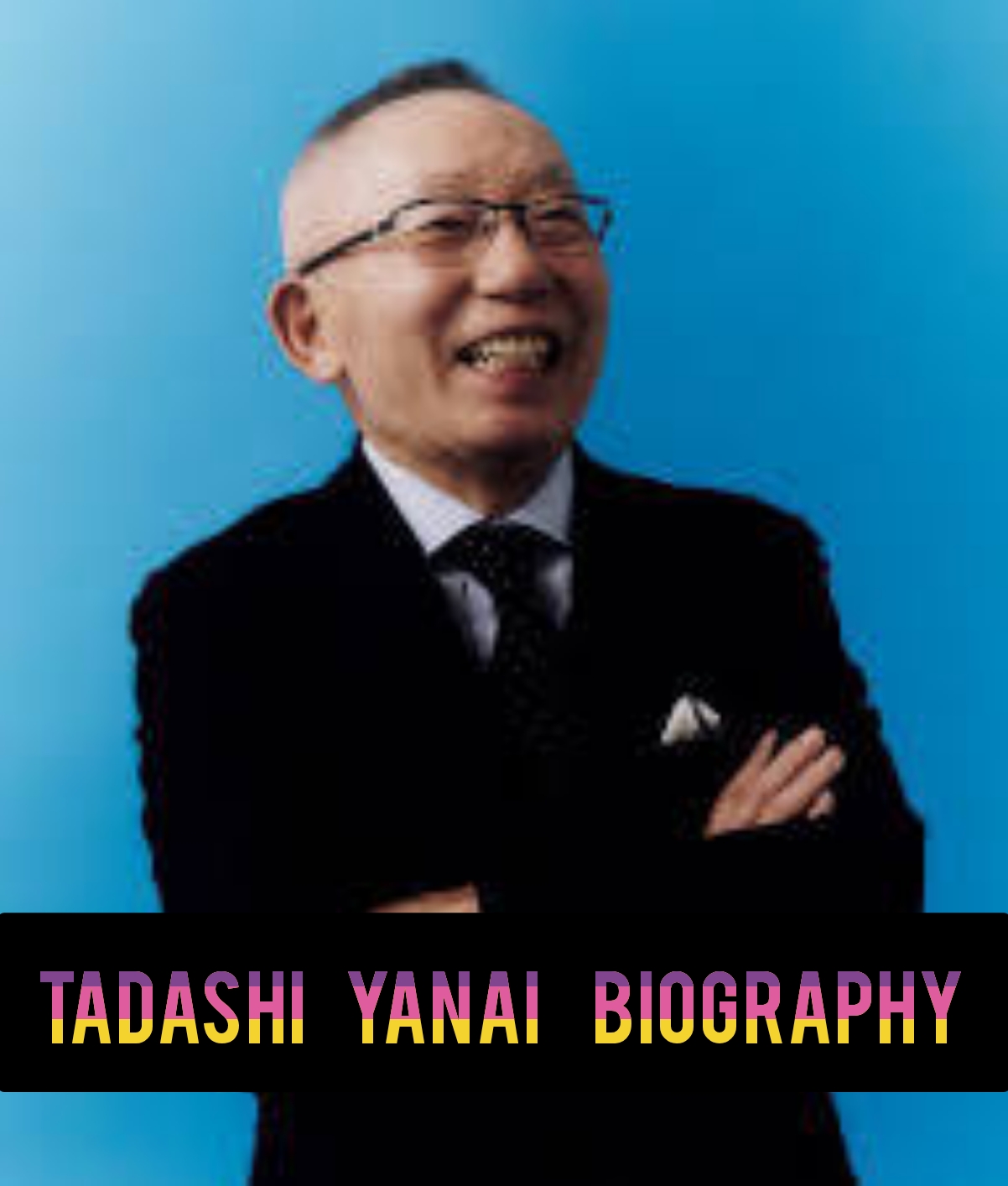
Tadashi Yanai Biography
Tadashi Yanai stands as one of the most influential figures in modern global retail. As the founder, chairman, president, and chief executive officer of Fast Retailing, the parent company of Uniqlo, he transformed a modest family menswear shop in provincial Japan into an international apparel powerhouse. His vision of high quality, functional clothing at accessible prices has reshaped how millions of people around the world dress for everyday life. Through decades of determined expansion, product innovation, and a philosophy that treats failure as essential learning, Yanai built a business that operates thousands of stores across more than two dozen countries and generates tens of billions of dollars in annual revenue. He has consistently ranked as Japan’s richest person and ranks among the world’s wealthiest individuals, yet he remains known for a disciplined, relatively understated personal style that mirrors the practical clothing his company sells.
This biography explores the full arc of his life and career. It begins with the formative years that shaped his outlook, moves through the personal foundations that supported his work, traces the key moments that elevated Uniqlo from a regional experiment to a global brand, examines the achievements that define his impact, confronts the setbacks that tested his resolve, and considers the lasting influence he continues to exert. The account draws on verified public records, company histories, and contemporary reporting to present a clear and complete portrait of a business leader whose story continues to unfold.
Tadashi Yanai An Interesting Fact That Draws the Reader In
Imagine a man who could afford any luxury yet prefers to wear the same affordable merino wool sweater and simple suit produced by his own company. Tadashi Yanai, whose personal fortune has reached tens of billions of dollars, begins many days in clothing that costs only a fraction of what most executives spend on a single outfit. He wakes early, answers emails before most people rise, and returns home in the afternoon when possible so he can spend time on the golf course. This quiet consistency sits at the heart of his approach to business. He has repeatedly said that success comes only after many failures, and that people take their losses too seriously. The same man who once saw nearly all his early staff quit because of his demanding style later built one of the world’s largest clothing retailers by learning from every misstep. That combination of personal simplicity and professional resilience offers an immediate window into the character that shaped Uniqlo and Fast Retailing.
Tadashi Yanai Early Life
Tadashi Yanai was born on February 7, 1949, in Ube, an industrial city in Yamaguchi Prefecture on the western tip of Japan’s main island of Honshu. The year of his birth coincided with the opening of his father’s small menswear shop, Men’s Shop Ogori Shoji. The family lived above the store, so the rhythms of retail formed the background of his childhood. Customers came seeking quality suits for bank and securities employees, and the young Yanai observed the daily work of measuring, selling, and managing stock. His father, often identified as Hitoshi Yanai, was a traditional merchant who worked long hours and spent evenings networking. Yanai has described him as a difficult man with a coarse disposition, someone who wanted his only son to grow strong. Sandwiched between an older sister and two younger sisters, Yanai experienced a household that valued hard work yet offered limited emotional ease. He has spoken of trying to stay away from his father and of developing an early habit of going to bed early as a result of the late nights common in the household.
The broader family background included relatives engaged in the clothing trade across Kyushu and Yamaguchi. One uncle was known as an activist for the Burakumin, a minority group that has faced historical discrimination in employment and marriage in Japan. This connection to social advocacy formed part of the wider environment in which Yanai grew up, though he himself focused on business rather than public activism. Postwar Japan was still recovering, and Ube offered a modest industrial setting far from the commercial centers of Tokyo or Osaka. Living above the shop meant Yanai shared meals with live-in staff and absorbed the practical details of retail without any formal decision to enter the trade.
He attended local schools, including Ube Municipal Shinkawa Elementary School, Ube City Momoyama Middle School, and Yamaguchi Prefectural Ube High School. After high school he enrolled at Waseda University in Tokyo, one of Japan’s leading private institutions and a traditional training ground for business and political leaders. There he studied economics and political science, graduating in 1971 with a bachelor’s degree. University life exposed him to wider ideas and to American culture. He listened to jazz, played mahjong, and developed a lasting interest in the English language that would later shape company policy at Fast Retailing. Despite the family business waiting at home, Yanai did not immediately plan a career in clothing. The combination of a provincial upbringing, observation of small-scale retail, and a formal education in economics and politics prepared him for the long transformation that would follow.
Tadashi Yanai Personal Life
Tadashi Yanai is married to Teruyo Nagaoka, also known as Teruyo Yanai. Before their marriage she worked as an interpreter and, according to some accounts, earned more than he did at the time. The couple has two sons, Kazumi and Koji. Both sons have been involved in aspects of the family business. Kazumi has held senior roles connected to Uniqlo, while Koji has pursued creative and cultural projects alongside business interests. In 2018 Koji launched the Tokyo Toilet Project, commissioning prominent architects and designers to create public toilets across the city. The project later inspired the film Perfect Days directed by Wim Wenders. The family maintains a relatively private profile compared with many other ultra-wealthy households. Yanai and his wife live in Tokyo, where they occupy a substantial residence that includes recreational facilities. He also owns property in Hawaii, including two golf courses that reflect one of his principal leisure interests.
Golf occupies a significant place in his personal routine. He plays regularly on weekends, maintains a respectable handicap, and has used the sport as both recreation and networking. In earlier years he contracted golfer Adam Scott as a brand ambassador for Uniqlo. Beyond golf, Yanai is known for disciplined daily habits. He rises early, often around five in the morning, handles correspondence before seven, and prefers to return home in the afternoon when business allows. He has declared English the official company language at Fast Retailing, a decision that underscores his international outlook and the linguistic interest he developed in university. His personal wardrobe remains simple. He frequently wears Uniqlo products, including inexpensive merino sweaters and suits developed in collaboration with designers, demonstrating consistency between the brand message and his own choices.
Philanthropy forms another quieter dimension of his private life. After the 2011 Tōhoku earthquake and tsunami he donated one billion yen to relief efforts. He later established the Yanai Tadashi Foundation, which provides full scholarships and living support for Japanese high school students admitted to selective universities in the United States and the United Kingdom. Hundreds of students have benefited from the program. These activities, together with the family’s low public profile and emphasis on practical living, present a picture of personal stability that has underpinned decades of demanding corporate leadership. Lesser-known details include his early exposure to American cultural influences and the family connection to Burakumin advocacy through an uncle, both of which sit in the background of a life otherwise defined by retail and global expansion.
Tadashi Yanai Rise to Prominence
After graduating from Waseda University in 1971, Tadashi Yanai began his working life at a JUSCO supermarket, where he sold kitchenware and men’s clothing. The experience lasted less than a year. His demanding management style led most of the staff he hired to resign. Only one colleague remained and continued to work with him for many years afterward. The episode taught an early lesson about leadership that he would later acknowledge openly. In 1972 he joined the family company, then still known as Ogori Shoji. He gradually assumed greater responsibility for the existing stores, which focused on men’s formal and casual wear.
By the early 1980s he was ready to reshape the business. In 1984 he opened a new store in Hiroshima under the name Unique Clothing Warehouse. The concept was deliberately different from traditional Japanese menswear shops. Inspired by American warehouse-style retailing, it offered decent quality casual clothing at accessible prices in a self-service environment with minimal visible branding. An administrative transcription error turned the intended “Uniclo” into “Uniqlo,” and the shorter name stuck. That same year Yanai became president of the company. In 1991 he formally changed the corporate name to Fast Retailing, signaling a shift toward a broader, faster-moving retail model.
The true breakthrough arrived in 1998. Uniqlo opened its first store in Tokyo’s Harajuku district and launched a lightweight fleece jacket priced at roughly 1,900 yen, about fifteen dollars at the time. Japan was still recovering from the collapse of its asset bubble, and consumers sought value. One in four Japanese buyers purchased the fleece. Sales surged, and the company expanded rapidly across the domestic market. By the mid-1990s the store count had already grown substantially; the fleece success accelerated that growth and established Uniqlo as a household name in Japan. The company listed on the Tokyo Stock Exchange, providing capital for further expansion. Yanai’s early career had moved from a failed supermarket venture through the inherited family shops to a new retail format that combined function, quality, and price. The Hiroshima opening and the 1998 Tokyo breakthrough marked the decisive turning points that lifted him from regional merchant to national business figure.
Tadashi Yanai Major Achievements
Under Tadashi Yanai’s leadership Fast Retailing grew from a regional Japanese retailer into one of the world’s largest apparel groups. Uniqlo, the flagship brand, operates nearly 2,500 stores across approximately 25 countries and generates the majority of group revenue. Other brands under the Fast Retailing umbrella include GU, Theory, Helmut Lang, and J Brand, among others. Annual revenue has reached more than 20 billion dollars in recent fiscal years, with net profits in the billions. Yanai has repeatedly stated the ambition for Fast Retailing to become the world’s largest clothing retailer, surpassing competitors such as Inditex and H&M.
Product innovation has been central to the achievement. HeatTech, a heat-retaining fabric developed in partnership with Toray Industries, became a signature line that sold tens of millions of units and helped redefine functional casual wear. AIRism moisture-wicking fabric and other proprietary materials followed, reinforcing the brand’s focus on performance clothing suitable for daily life. The company has invested heavily in supply-chain efficiency, store design, and digital sales channels. Yanai introduced English as the official company language and emphasized a culture of continuous improvement drawn from his own experience of repeated failure.
Recognition has followed the commercial success. In 2010 the National Retail Federation in the United States named him International Retailer of the Year, only the fourth Japanese recipient and the first since 1998. Japanese corporate surveys ranked him among the best company presidents in consecutive years. In 2012 he appeared on Bloomberg Markets’ list of the 50 most influential people. Time magazine included him among the 100 most important people in the world in 2013. In October 2025 he received the Malcolm S. Forbes Lifetime Achievement Award at the Forbes Global CEO Conference in Jakarta. Steve Forbes presented the award, citing Yanai’s role in reshaping global apparel through simplicity, quality, and affordability. Philanthropic contributions, including the scholarship foundation and disaster relief, form an additional dimension of his public impact. Collectively these achievements demonstrate how a provincial family shop evolved under focused leadership into a multinational enterprise that influences both consumer habits and industry standards.
Tadashi Yanai Challenges and Setbacks
The path was never smooth. Early in his career Yanai’s impatient management style caused nearly all the staff at his first independent venture to resign. He later admitted he had shown too little consideration for others. When he took greater control of the family business, he still had to persuade traditional stakeholders that casual, warehouse-style retailing could succeed where formal menswear had long dominated.
International expansion brought sharper lessons. In 2001 Uniqlo opened its first stores in the United Kingdom with ambitious plans for rapid growth. Within two years most of the 21 stores had closed. Yanai has described the experience as a costly failure that taught him the dangers of assuming domestic success would transfer automatically. A similar miscalculation occurred in China, where initial pricing and product strategies underestimated local perceptions of quality and value. The company eventually adjusted and achieved strong results, particularly after success in Hong Kong, but the early losses were real. Domestically, rapid store expansion in Japan led to market saturation and periods of declining same-store sales in the early 2000s. Yanai responded by shifting emphasis toward product innovation and higher quality rather than pure volume.
He has repeatedly framed these setbacks as necessary. In interviews he states that success requires many failures and that people take losses too seriously. The philosophy appears in his books, including One Win, Nine Losses, and in public remarks that stress learning from the gap between expectation and reality. By treating failure as data rather than defeat, he guided the company through the difficult early international years and the domestic corrections that followed. The same willingness to change course after setbacks later supported recovery from broader economic pressures and the challenges of global supply chains. The obstacles therefore became integral to the eventual scale of the business rather than permanent barriers.
Tadashi Yanai Legacy and Current Status
Tadashi Yanai remains actively engaged as chairman, president, and chief executive officer of Fast Retailing well into his seventies. The company continues to expand, with particular attention to North America, Europe, and digital channels while maintaining strength in Asia. Recent fiscal results have shown record profits and revenue growth, keeping the long-term goal of becoming the world’s largest apparel retailer in view. Uniqlo’s emphasis on functional, high-quality basics has influenced competitors and consumer expectations worldwide. The brand’s collaborations with designers and its investment in proprietary fabrics have further extended its cultural reach.
His personal wealth places him among the richest individuals globally and consistently at the top of Japanese rankings. Beyond numbers, the institutional legacy includes a management culture that values speed of decision and continuous improvement, the elevation of English as a corporate language in a Japanese company, and a foundation that supports educational opportunity for young Japanese students abroad. The Tokyo Toilet Project associated with his son has added a distinctive cultural note to the family’s public presence. Yanai’s own books and interviews continue to circulate his views on failure, leadership, and the purpose of clothing. At a time when many founders step back, he maintains operational involvement and public visibility through awards and strategic commentary. The enterprise he built from a single Hiroshima store now shapes daily wardrobes across continents and stands as a case study in patient, adaptive global expansion.
Conclusion
Tadashi Yanai’s life demonstrates that enduring business success often grows from ordinary beginnings refined by relentless attention to learning. From a childhood above a provincial menswear shop to the leadership of a global retail group, he turned observation, education, and repeated setbacks into a coherent philosophy of practical clothing and resilient management. The result is a company that has made functional, well-made apparel available to millions while generating substantial economic value. His story remains relevant because it shows how clarity of purpose, willingness to adjust after failure, and consistency between personal habits and corporate message can sustain long-term achievement. As Fast Retailing continues to pursue its ambitions, the example of its founder offers a clear reminder that the most lasting influence often belongs to those who keep refining their craft rather than those who claim early perfection.
FAQs
What is Tadashi Yanai’s date of birth and place of birth?
Tadashi Yanai was born on February 7, 1949, in Ube, Yamaguchi Prefecture, Japan.
What company did Tadashi Yanai found and what is its main brand?
He founded Fast Retailing, the parent company of Uniqlo, along with other brands such as GU, Theory, and Helmut Lang.
Who is Tadashi Yanai married to and how many children does he have?
He is married to Teruyo Nagaoka and the couple has two sons, Kazumi and Koji.
What was the breakthrough moment for Uniqlo under Tadashi Yanai?
The 1998 launch of an affordable fleece jacket at the first Tokyo store in Harajuku created a massive sales surge during Japan’s post-bubble period and established the brand nationally.
What major award did Tadashi Yanai receive in 2025?
He received the Malcolm S. Forbes Lifetime Achievement Award at the Forbes Global CEO Conference in Jakarta in October 2025.
How has Tadashi Yanai approached failure in business?
He has consistently stated that success requires many failures and that people should not take losses too seriously, using setbacks in the United Kingdom, China, and domestic markets as opportunities to adjust strategy.
What philanthropic activities is Tadashi Yanai known for?
He donated one billion yen after the 2011 earthquake and tsunami and established the Yanai Tadashi Foundation, which provides scholarships for Japanese students to attend universities in the United States and the United Kingdom.