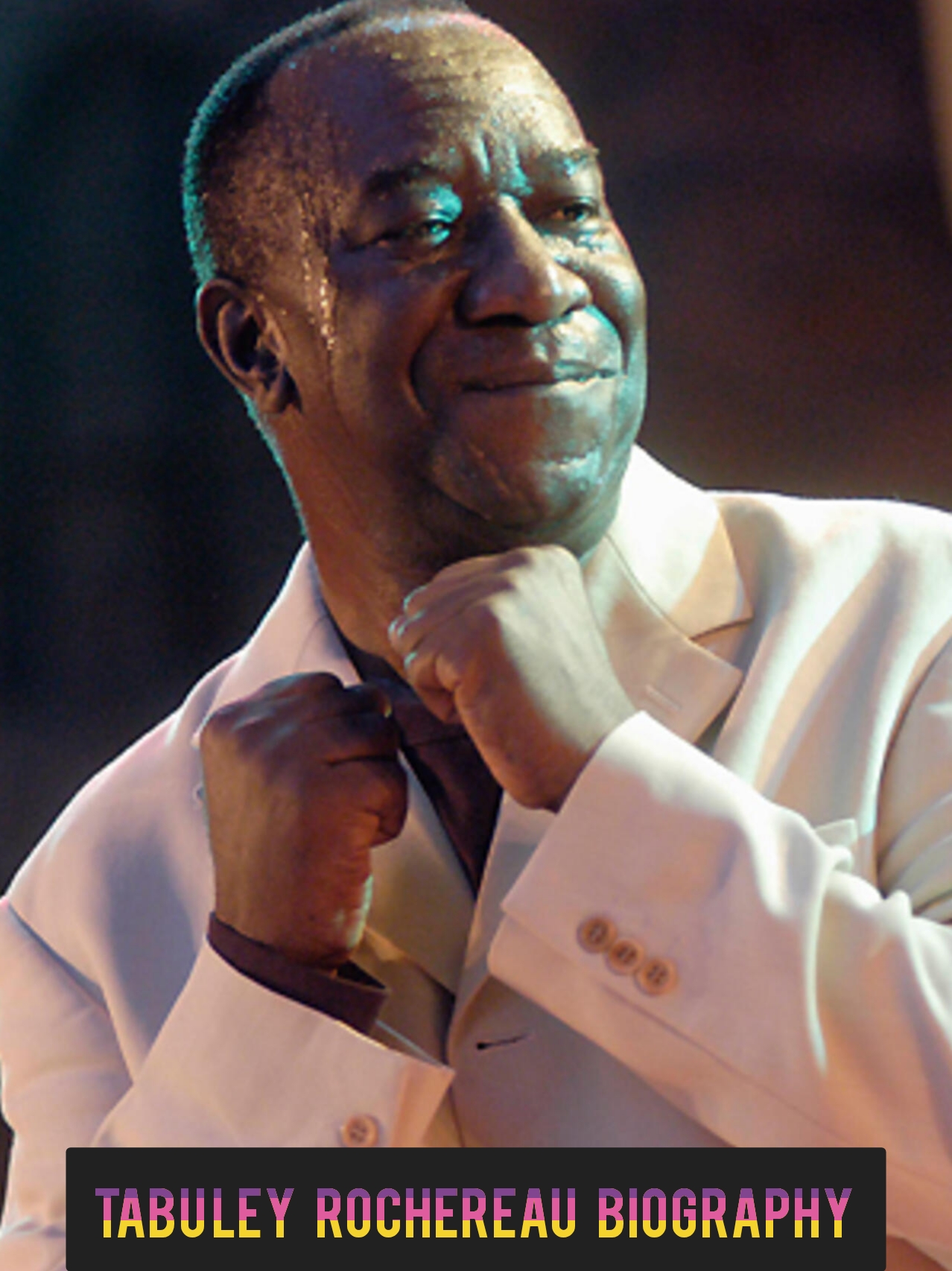
Tabu Ley Rochereau Biography
Tabu Ley Rochereau stands as one of the towering figures in the history of African popular music. Known as Le Seigneur Rochereau and sometimes called the African Elvis, he helped shape Congolese rumba into a vibrant, international sound that danced across the continent and beyond. Through his clear baritone voice, endless stream of songs, and energetic stage presence, he brought African rhythms to global stages while remaining deeply rooted in the culture of the Congo.
This biography traces the journey of a man who began as a shy schoolboy with a talent for singing and rose to become a bandleader, innovator, entrepreneur, and later a political figure. His career stretched across more than five decades and left a lasting mark on music that still influences artists today.
Tabu Ley Rochereau Early Life
Tabu Ley Rochereau was born Pascal Emmanuel Sinamoyi Tabu on 13 November 1940 in Bagata, in the Bandundu region of what was then the Belgian Congo, now the Democratic Republic of the Congo. Some accounts place his birth near the river port town once known as Banningville. He grew up in a family where music held a natural place. His mother had been a griot, a traditional storyteller and singer who carried cultural memory through voice and song. This early exposure to performance and oral tradition shaped his path from the beginning.
As a child he moved with his family to Léopoldville, the bustling capital that would later become Kinshasa. There he sang in the choir of the parish of Saint Pierre and in school choirs. These settings gave him his first training in harmony, stage presence, and the power of the human voice. Western films and the emerging Congolese music scene filled the city, and young Pascal absorbed it all. Cuban son, French popular songs, local ethnic music of the Bayanzi people, and the new urban rumba mixed in his ears.
At school he earned the nickname Rochereau. During a history lesson about the Franco Prussian War, he was the only student who could name the French officer who defended Belfort, Colonel Pierre Philippe Denfert Rochereau. Classmates began calling him by that name, and he kept it. The shy boy who once preferred the background of the choir gradually found confidence through performance. In 1955, while still a teenager, he took part in a singing competition held to mark the opening of a new stadium in Léopoldville. He won in front of a huge crowd that included Belgian dignitaries. The victory was broadcast on radio and made him locally known overnight. Newspapers sought interviews, and established musicians began to notice him.
He completed secondary education and for a short time worked as a civil servant, first as an administrative secretary and later in a financial role at the Athénée de Kalina. Yet music pulled stronger. By the late 1950s he was writing songs and performing as an amateur. His clear voice and gift for melody caught the attention of Joseph Kabasele, known as Grand Kallé, leader of the influential band African Jazz. Tabu Ley joined the group and soon became a full time member after the band returned from travels related to Congo’s independence negotiations.
Tabu Ley Rochereau Personal Life
Tabu Ley Rochereau lived a full and complex personal life that reflected both traditional Congolese family patterns and the demands of a traveling musician’s existence. He married Georgette Mowana, known as Tété, and they had five children together: Blackson Matthieu, Mireille Esther, Colette, Gisèle, and Isabelle. He also shared a significant relationship with Jeanne Mokomo, who had been crowned Miss Zaire in 1969. With her he had six more children, among them Carine, Laty, Bob, Abel, Pegguy, and Flore.
Later he formed a celebrated musical and personal partnership with the singer and dancer Mbilia Bel. She rose from the ranks of his dance troupe, the Rocherettes, to become a star in her own right. They married and had a daughter named Mélodie Tabu. Their professional collaboration produced several successful albums and made them one of Africa’s most popular vocal duos for a time. The relationship eventually ended, as did other partnerships in his life.
Estimates of the total number of his children vary widely, ranging from more than sixty to as high as one hundred in some reports. Among the many sons and daughters who have pursued creative paths are the French rapper Youssoupha, the singer and composer Pegguy Tabu, Abel Tabu, and others active in music and related fields. Belgian rapper Shay is among his grandchildren. Despite the size of his family and the demands of constant travel, accounts from those close to him describe a man who took pride in his children and sought to provide for their education and welfare.
Away from the stage he showed interest in business and later in public service. He opened a nightclub in Kinshasa and established his own record label. In quieter moments he remained connected to the cultural life of his country even during periods of political tension and exile. His personal story, like his music, was marked by energy, generosity, and a larger than life presence.
Tabu Ley Rochereau Rise to Prominence
Tabu Ley Rochereau’s professional breakthrough came with African Jazz. In 1959 he made an official debut with the band at the Vis à Vis dance hall in Kinshasa. His early songs, including the popular “Kelya,” displayed a gift for melody and lyrical storytelling that set him apart. The band’s greatest early success arrived with “Indépendance Cha Cha,” written by Grand Kallé to celebrate Congo’s independence from Belgium in 1960. Tabu Ley’s contribution to the recording helped make the song a pan African anthem that still echoes today.
In 1963 he and guitarist Dr. Nico Kasanda left African Jazz to form African Fiesta. The new group quickly became one of the most important bands on the continent. Artistic differences later led to a split, and Tabu Ley continued with African Fiesta National, sometimes called African Fiesta Flash. By the late 1960s the band had sold more than a million records and produced classics such as “Afrika Mokili Mobimba.” Young talents including Sam Mangwana and Papa Wemba passed through the ranks, gaining experience under his leadership.
In 1970 he reorganized his musical forces into Orchestre Afrisa International, a name that combined Africa with his own Éditions Isa label. That same year he achieved a historic milestone. From 12 December 1970 he performed a series of concerts at the Olympia Hall in Paris. He became the first sub Saharan African artist and only the second African overall, after Egypt’s Umm Kulthum, to appear at the prestigious venue. The shows featured sophisticated horn arrangements, choreographed movement, and the Rocherettes dance troupe. The engagement was extended because of public demand and opened European doors for Congolese music.
During this period he also introduced innovations that pushed Congolese rumba toward the faster, more guitar driven style later known as soukous. He experimented with new rhythms such as soum djoum and expanded the visual spectacle of live performance. His rivalry with Franco Luambo and TPOK Jazz defined an era of creative competition that raised the standard of Congolese music for everyone.
Tabu Ley Rochereau Major Achievements
Over a career spanning more than fifty years, Tabu Ley Rochereau composed as many as three thousand songs and released around two hundred fifty albums. His output was extraordinary in both quantity and quality. Hits such as “Sorozo,” “Kaful Mayay,” “Aon Aon,” “Mose Konzo,” “Sarah,” and many others became standards across Africa and in diaspora communities. He recorded in Lingala, French, and other languages, reaching audiences far beyond the Congo.
His 1970 Olympia performances remain a landmark in the internationalization of African music. He later toured the United States, performing in major cities and introducing American audiences to the richness of Congolese sound. In 1974 his band appeared at the Zaire 74 music festival that preceded the famous Rumble in the Jungle boxing match between Muhammad Ali and George Foreman. The event placed Congolese music on a global stage alongside international stars.
He founded his own record label and production structures, including Genidia, giving greater independence to African artists. He trained and promoted many musicians, most notably helping Mbilia Bel become the first widely acclaimed female star of soukous. His bands served as schools for successive generations of Congolese talent.
Recognition came from several countries. He received the title of Honorary Knight of Senegal and was named Officer of the National Order by the Republic of Chad. In later years he was decorated in other African nations as well. In 2023 Rolling Stone magazine included him at number 178 on its list of the 200 Greatest Singers of All Time, confirming his lasting place among the world’s vocal greats. His work helped establish Congolese rumba as a major force in world music and contributed to its eventual recognition by UNESCO as an intangible cultural heritage.
Tabu Ley Rochereau Challenges and Setbacks
Success brought its own difficulties. The competitive music scene in Kinshasa was intense, and the split with Dr. Nico Kasanda after the African Fiesta years required him to rebuild his band and artistic direction. Political conditions under Mobutu Sese Seko created further pressure. When the regime demanded authentic African names, Pascal Tabu became Tabu Ley. At times he found himself at odds with the government. Critical songs and the general climate of the dictatorship led to periods of exile in Europe and the United States.
Personal relationships sometimes became public drama. The end of his partnership with Mbilia Bel was complicated by professional and private tensions. Managing a large family while maintaining a demanding international career required constant effort. Business ventures, including a nightclub and record operations, faced the usual uncertainties of the industry and the unstable economic environment of the country.
In 2008 he suffered a serious stroke that left him partially paralyzed and ended his performing career. The long recovery period tested his resilience. He continued limited creative work and remained a respected public figure, yet the physical limitations marked a painful close to the stage life that had defined him for so long. Through all these obstacles he retained his commitment to music and to the cultural identity of the Congo.
Tabu Ley Rochereau Legacy and Current Status
Tabu Ley Rochereau died on 30 November 2013 at the Saint Luc hospital in Brussels, Belgium, at the age of seventy three. Complications related to the earlier stroke and diabetes ended his life. His body was returned to Kinshasa, where an official mourning ceremony took place at the Palais du Peuple before burial at the Cimetière Acropolic de la N’sele. Artists, politicians, and ordinary fans gathered to honor him.
His musical legacy continues through reissues, anthologies such as The Voice of Lightness, and the ongoing popularity of his classic recordings. Younger Congolese artists still draw on the melodic and rhythmic foundations he helped establish. His sons and other family members carry creative work forward in various genres, keeping the family name present in contemporary music. Congolese rumba itself has received renewed international attention and formal cultural recognition in recent years, a development that rests in part on the foundations laid by Tabu Ley and his generation.
Politically he served as a minister and later as vice governor of Kinshasa after the fall of Mobutu, using his stature to support cultural and civic causes. Although his political career was secondary to his artistic one, it reflected a lifelong engagement with the destiny of his country. Today he is remembered as a pioneer who expanded the reach of African music while remaining faithful to its roots, a prolific creator whose songs still fill dance floors and family gatherings across the continent and the diaspora.
FAQs
Who was Tabu Ley Rochereau?
Tabu Ley Rochereau was a Congolese singer, songwriter, and bandleader widely regarded as one of the most important figures in African popular music. Born Pascal Emmanuel Sinamoyi Tabu in 1940, he helped develop and internationalize Congolese rumba and the related style known as soukous through his work with African Jazz, African Fiesta, and Orchestre Afrisa International.
What is Congolese rumba and how did Tabu Ley contribute to it?
Congolese rumba is a dance music style that blends local Congolese rhythms with influences from Cuban and Caribbean music. Tabu Ley Rochereau modernized the form by adding sophisticated arrangements, faster tempos, choreographed performances, and strong melodic songwriting. His innovations helped the music spread across Africa and reach audiences in Europe and North America.
When did Tabu Ley Rochereau perform at the Olympia in Paris?
He performed a landmark series of concerts at the Olympia Hall in Paris beginning on 12 December 1970. The engagement made him the first sub Saharan African artist to appear at the famous venue and marked a major breakthrough for African music on the international stage.
How many songs did Tabu Ley Rochereau write?
Estimates place the number of songs he composed at around three thousand. He also released approximately two hundred fifty albums over the course of his long career, making him one of the most prolific recording artists in African music history.
Did Tabu Ley Rochereau have a political career?
Yes. After the end of the Mobutu era he returned to the Democratic Republic of the Congo and entered politics. He served in government positions, including as a cabinet minister, and was later appointed vice governor of Kinshasa. He also held cultural responsibilities at the provincial level.
When and where did Tabu Ley Rochereau die?
Tabu Ley Rochereau died on 30 November 2013 at the Saint Luc hospital in Brussels, Belgium. He was seventy three years old. He had suffered a stroke in 2008 from which he never fully recovered.
Conclusion
Tabu Ley Rochereau’s life offers a powerful example of artistic vision combined with determination. From a childhood marked by church choirs and a single school competition victory, he built a career that carried Congolese music onto the world’s great stages. He faced political pressure, personal challenges, and the physical limits that eventually ended his performing days, yet he never abandoned the creative impulse that defined him.
His songs continue to move people because they speak of love, independence, daily life, and the shared experience of a continent in transition. In an age when music travels instantly across borders, the foundation he helped create remains solid. Tabu Ley Rochereau showed that African artists could command international respect without losing their cultural identity. That lesson, and the beautiful body of work he left behind, ensure that Le Seigneur Rochereau will be remembered for generations to come.