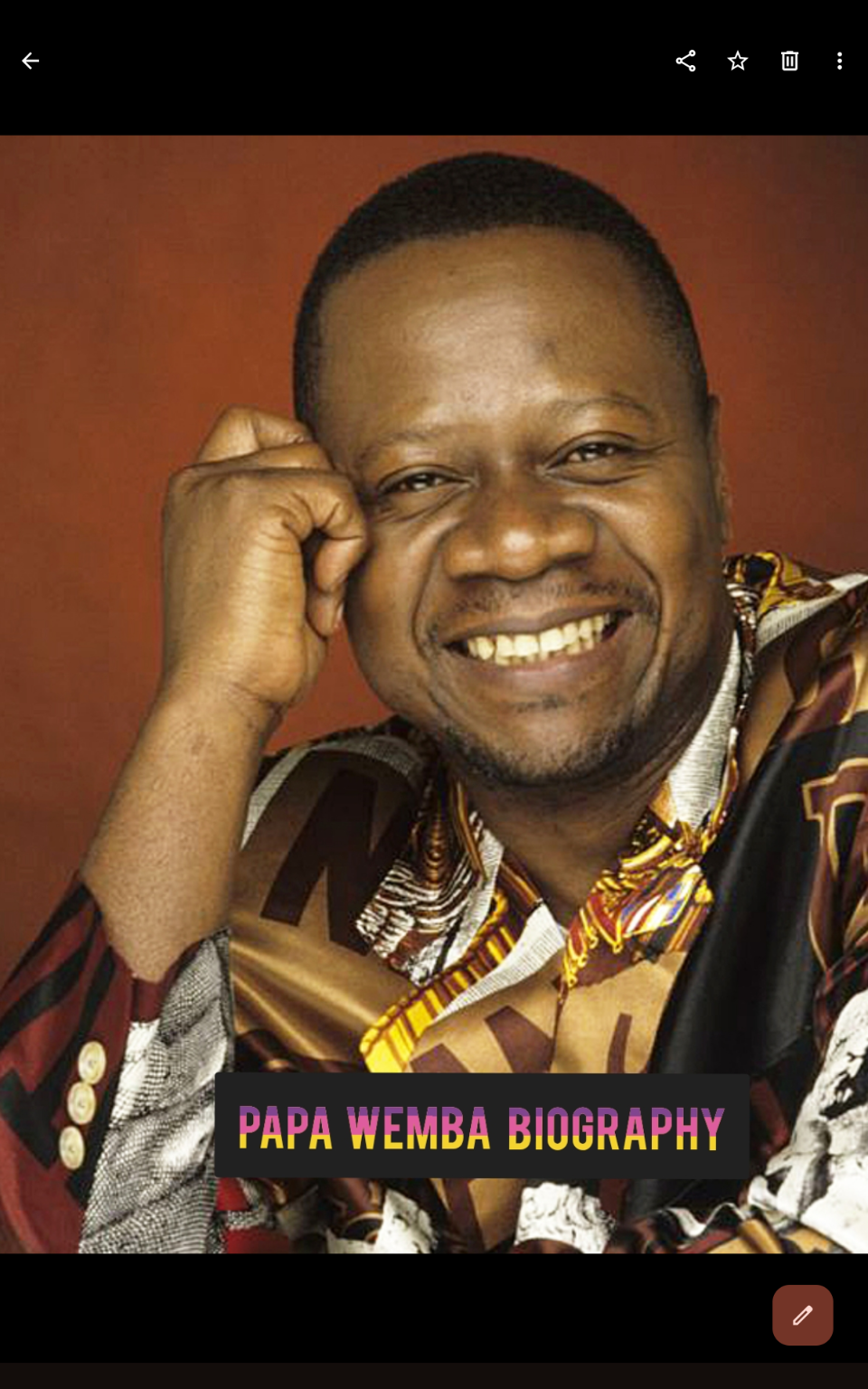
Papa Wemba Biography
Papa Wemba stands as one of the most influential figures in African popular music, a Congolese artist whose voice, stage presence, and style reshaped the sound of an entire continent and carried it far beyond its borders. Known widely as the King of Rumba Rock, he blended traditional Congolese rhythms with rock, soul, and Caribbean influences to create a vibrant form of soukous that danced its way into hearts across Africa, Europe, and beyond. His career spanned nearly five decades, marked by innovation, resilience, and a flair for both music and fashion that made him a cultural force.
This biography explores the life of Jules Shungu Wembadio Pene Kikumba, the man behind the legend. From his roots in a rural Congolese village to global stages and the challenges that tested him, it offers a full portrait of an artist who lived fully through song, style, and family. Readers will find a clear and engaging account of how Papa Wemba rose, faced obstacles, and left a lasting mark that continues to inspire.
Papa Wemba Intro
Few artists have ever fulfilled their own wish so completely as Papa Wemba did on a stage in Abidjan. He once said he hoped to leave this world while performing, surrounded by the music and the energy of the crowd. On 24 April 2016 that wish came true. In the early hours of the morning, during a festival performance broadcast live on television, the 66 year old singer collapsed mid song. The band played on for a moment before realizing what had happened. He was rushed away and later confirmed dead of heart failure. That final scene captured the essence of a man who had spent his life giving everything to the stage. Papa Wemba was never just a performer. He was a voice of Congolese identity, a fashion pioneer who turned elegant dressing into a movement, and a mentor who opened doors for countless younger artists. His story begins far from the bright lights, in a quiet village where song was already part of daily life.
Papa Wemba Early Life
Jules Shungu Wembadio Pene Kikumba was born on 14 June 1949 in Lubefu, a rural area in the Sankuru district of the Kasai region in what was then the Belgian Congo. The place is now part of the Democratic Republic of the Congo. He belonged to the Tetela people and came from a line of Ba Tetela warrior chieftains. As the first son of his mother, he was called Papa from an early age, a title that reflected both birth order and the responsibilities that would later fall to him.
His father, a former soldier who had served with the Belgian forces during the Second World War, later worked as a customs official and hunter. The family moved to the capital, then called Léopoldville and later Kinshasa, when Jules was about six years old. Life in the growing city exposed him to new sounds and energy. His mother, Marie Nyondo, worked as a professional mourner, a pleureuse who sang traditional laments at funerals and wakes. Young Jules often accompanied her. He later said she was his first teacher and his first audience. From her he learned the power of a voice that could carry emotion, the use of the minor key, and the skill of turning sorrow into song. Those early lessons shaped the rich tenor that would one day fill stadiums.
After his father died in 1966, Jules joined the choir at a Roman Catholic church in Kinshasa. The disciplined singing sharpened his technique. Yet he was already drawn to the popular music of the streets. As a teenager he formed small groups with friends, using homemade instruments and singing American style R and B. He even took the nickname Jules Presley for a time because of his admiration for Elvis Presley. When President Mobutu Sese Seko launched his authenticity campaign, Western first names were discouraged. Jules became known simply as Papa Wemba, a name that combined his family title with a shortened form of his surname.
He attended school in Kinshasa, including time at the École Pigier, but formal education took second place to music. By his late teens he was already performing in the vibrant Matonge neighbourhood, the heart of Congolese nightlife. The independence of the Congo in 1960 and the turbulent years that followed formed the backdrop of his youth. Music offered both escape and expression. Those early experiences of family loss, church harmony, and street performance prepared him for a life on stage.
Papa Wemba Personal Life
Papa Wemba’s personal world centred on family even as his public life grew larger. He met Marie Rose Luzolo, known as Amazone or Mama Marie, when he was about twenty and she was fourteen. They began a relationship that lasted nearly fifty years. Although formal marriage records sometimes list a later date, they lived as husband and wife from the early 1970s onward. Together they had six children. Marie Rose raised many of the other children he fathered outside the marriage, a common arrangement in the cultural context of the time. Papa Wemba himself spoke of having more than thirty children in total. He described himself as a good African man who took pride in providing for a large family.
Despite the demands of constant travel, he kept close ties to Kinshasa and later maintained homes in both the Congo and Europe. Education for the children was important to the couple. Several of them spent time studying in France. One daughter, Orphée, later followed a path into music. Papa Wemba often spoke of his wife with affection, recalling how he took her and one of their children on his first long trip to Japan so they could share the experience.
Away from the stage he enjoyed the rituals of elegant living that became central to his public image. He loved fine clothes, carefully chosen scents, and the art of presentation. These interests were not mere vanity. They formed part of a philosophy of dignity and self respect that he encouraged in young people. He also maintained a deep connection to his Tetela heritage. In later years clan elders granted him full chieftain status in recognition of his contributions to culture. Faith remained a quiet thread. After a period of imprisonment he returned more strongly to the Catholicism of his youth and spoke of a spiritual encounter that changed his outlook.
Lesser known sides of his character included a sense of humour and a willingness to mentor younger artists. He opened his home and compound in Kinshasa, known as the Village of Molokai, as a gathering place for musicians. The compound functioned almost like a traditional village with its own codes and sense of community. Through all the fame and the complications of a public life, the core of his personal world remained family, music, and a belief in living with style and purpose.
Papa Wemba Rise to Prominence
Papa Wemba’s professional path began in earnest in December 1969 when, still a young man of twenty, he helped found the band Zaiko Langa Langa in Kinshasa. The group broke from older Congolese rumba traditions. They reduced the use of wind instruments, emphasised electric guitars, and speeded up the tempo. Multiple singers shared the lead, creating rich vocal harmonies. Hits such as Pauline, C’est la Vérité, Chouchouna, and Liwa Ya Somo made Zaiko one of the most popular youth bands of the early 1970s. Papa Wemba’s high clear tenor and charismatic presence quickly made him a standout.
In December 1974, at the height of the band’s success and only weeks after the famous Rumble in the Jungle boxing match in Kinshasa, he left Zaiko with several other members to form Isifi Lokole. The name stood for Institut de Savoir Idéologique pour la Formation des Idoles. The new group continued the modern sound but added more traditional elements from the Kasai region, including the lokole drum. After further changes the ensemble became Yoka Lokole. Internal tensions and a brief period of imprisonment in 1976 for an alleged relationship with the daughter of an army general disrupted progress. Those difficulties, however, only strengthened his resolve to lead his own project.
In 1977 he founded Viva La Musica. The name came from a Johnny Pacheco album he admired. With this band he fully established his signature style, a lively fusion later called rumba rock or soukous. Songs such as Moku Nyon Nyon, Nyekesse Migue’l, and Cou Cou Dindon became huge hits across Africa. He created the Village of Molokai in Matonge as both a home base and a creative community. Young talents, including a then unknown Koffi Olomide, passed through the ranks. By the early 1980s Papa Wemba was a continental star. His 1980 song Ana Lengo, sung in his native KiTetela language, sold hundreds of thousands of copies.
The move toward international recognition accelerated in the mid 1980s. He began touring Europe and recorded in Paris. Collaborations and appearances on world music stages followed. A breakthrough moment came when he connected with Peter Gabriel’s Real World label. Albums such as Le Voyageur, Emotion, and Molokai introduced his music to audiences in Europe, North America, and Japan. Emotion alone sold more than one hundred thousand copies, a remarkable figure for African music at the time. Parallel to the music, his fashion sense turned him into a style leader. He helped popularise La Sape, the Société des Ambianceurs et des Personnes Élégantes, a movement that celebrated elegant European designer clothes worn with African confidence and flair. Young men in Kinshasa and Brazzaville copied his look of sharp suits, polished shoes, and careful grooming. Papa Wemba had risen from church choir and street groups to become both a musical innovator and a cultural icon.
Papa Wemba Major Achievements
Papa Wemba’s achievements stretch across music, film, fashion, and cultural influence. He is widely credited with helping modernise Congolese rumba and spreading soukous across Africa and into the global world music scene. As a founding member of Zaiko Langa Langa he helped create a new generation of Congolese popular music that rejected older conventions and spoke directly to urban youth. With Viva La Musica he refined that sound into a polished, danceable form that dominated airwaves and dance floors for decades.
His recordings number more than thirty original albums and many more singles and collaborations. Key releases include the early Zaiko hits, the Viva La Musica classics of the late 1970s and 1980s, and the internationally distributed albums on Real World Records. He toured extensively, performing in Europe, Japan, North America, and throughout Africa. Appearances with Peter Gabriel and other Western artists helped open doors for African musicians on major stages. In 1996 he received a Kora Award for best artist at the All Africa Music Awards, recognising his standing across the continent.
Beyond music he acted in the 1987 film La Vie Est Belle, directed by Benoît Lamy and Mweze Ngangura. The movie, in which he played a young man chasing musical dreams in Kinshasa, won the Georges Delerue Prize at the Ghent International Film Festival and brought Congolese stories to wider cinema audiences. He later appeared in other films and documentaries, including a cameo in Kinshasa Kids.
His contribution to fashion may be equally lasting. By elevating La Sape from a local style into an international phenomenon, he gave young Africans a language of dignity and self expression through clothing. The movement continues today in the streets of Kinshasa and Brazzaville and has been celebrated in films, advertisements, and exhibitions around the world. In 2015 the Democratic Republic of the Congo knighted him in the Order of National Heroes Kabila Lumumba. After his death he was posthumously raised to the rank of Grand Officer. These honours reflected official recognition of a lifetime spent carrying Congolese culture onto the world stage.
Papa Wemba Challenges/Setbacks
Success never came without difficulty. In 1976 Papa Wemba spent a short time in Kinshasa Central Prison after being accused of a relationship with the daughter of a powerful army general. The episode disrupted his band at the time and forced him to rebuild. A serious road accident in 1983 left him badly burned by scalding water from a burst radiator. He recovered in hospital and later turned the experience into the song Bukavu Dawa, thanking the medical staff who treated him.
The most public crisis came in 2003. French authorities arrested him and his wife in Paris on charges related to illegal immigration. Investigators claimed that on European tours he had listed large numbers of Congolese people as musicians or dancers so they could obtain visas, a practice known locally as ngulu. He spent more than three months in pre trial detention. In 2004 a French court convicted him, imposed a fine, and handed down a suspended prison sentence. A similar case in Belgium later resulted in another fine and suspended sentence. Papa Wemba maintained that any help he gave was humanitarian rather than commercial and that the practice was widespread. The legal battle interrupted his career, strained his finances, and damaged his public image for a time.
He responded by returning more deeply to faith. In prison he experienced what he described as a spiritual visit that renewed his outlook. Upon release he recorded the song Numéro d’écrou, reflecting on the episode. He continued performing, rebuilt his European and African activities, and gradually restored his standing. Political instability in the Congo, the demands of supporting a large extended family, and the constant pressure of managing bands on two continents added further strain. Yet each setback seemed to sharpen his determination. He kept creating music, mentoring younger artists, and appearing on stage until the very end.
Papa Wemba Legacy
Papa Wemba died on 24 April 2016 after collapsing during a performance at the Festival des Musiques Urbaines d’Anoumabo in Abidjan, Ivory Coast. His body was returned to Kinshasa for a state funeral. Thousands of fans lined the streets. The Congolese government awarded him its highest national honour posthumously. Tributes poured in from across Africa and the diaspora. Fellow musicians, political leaders, and ordinary listeners spoke of the loss of a cultural giant.
His influence remains strong. Younger Congolese artists still draw on the rhythmic drive and vocal style he helped popularise. The Sape movement continues to thrive as a living expression of elegance and pride. His recordings are reissued and streamed by new generations discovering the joyful energy of soukous. Documentaries and books keep his story alive. In Kinshasa the Village of Molokai and the neighbourhood of Matonge still carry the memory of the community he built around music.
Ten years after his death, festivals and radio stations mark the anniversary with special programmes. His wish to be remembered simply as a singer has been more than fulfilled. He is remembered as a singer, a style setter, a father figure to many artists, and a symbol of Congolese creativity that refused to stay within national borders. The music still plays, the clothes still shine, and the voice still echoes.
Conclusion
Papa Wemba’s life shows how talent, determination, and a sense of style can lift a person from a rural village to the centre of a continent’s culture. He faced loss, legal trouble, and the pressures of fame, yet he continued to create and to share. His story reminds us that art can carry identity across distances and that living with dignity matters as much as the songs themselves.
FAQs
Who was Papa Wemba?
Papa Wemba was the stage name of Jules Shungu Wembadio Pene Kikumba, a Congolese singer, songwriter, bandleader, and fashion icon. He is remembered as the King of Rumba Rock and one of the most important figures in African popular music.
When and where was Papa Wemba born?
He was born on 14 June 1949 in Lubefu in the Kasai region of what is now the Democratic Republic of the Congo.
What musical style is Papa Wemba known for?
He is best known for modern Congolese rumba and soukous, often called rumba rock. The style mixes traditional African rhythms with electric guitars, rock energy, and danceable tempos.
What is La Sape and how is Papa Wemba connected to it?
La Sape stands for Société des Ambianceurs et des Personnes Élégantes. It is a fashion movement that celebrates elegant, colourful, carefully chosen clothing. Papa Wemba helped popularise the style and became one of its most visible leaders.
Did Papa Wemba act in films?
Yes. He starred in the 1987 film La Vie Est Belle and appeared in other films and documentaries later in his career.
What legal problems did Papa Wemba face?
In 2003 he was arrested in France and later convicted in connection with helping Congolese people obtain visas by listing them as members of his musical entourage. He served time in pre trial detention and received a suspended sentence and fine.
How did Papa Wemba die?
He collapsed on stage during a concert in Abidjan, Ivory Coast, on 24 April 2016 and died of heart failure at the age of 66.
What is Papa Wemba’s lasting influence?
He modernised Congolese popular music, helped spread it internationally, inspired the Sape fashion movement, and mentored many younger artists. His recordings and style continue to influence African music and culture today.