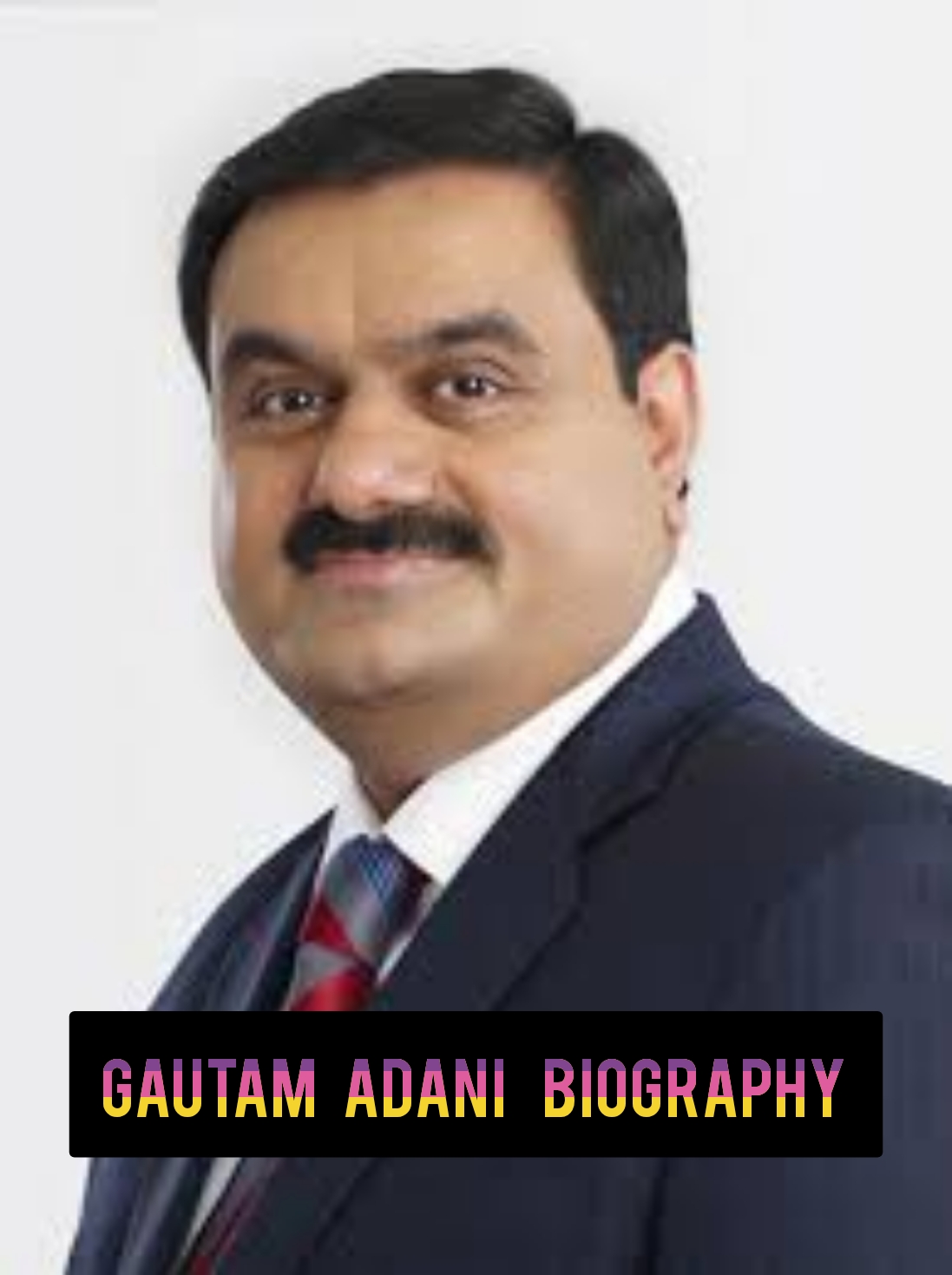
Gautam Adani Biography
Gautam Adani known as one of the most influential industrialists of modern India. From sorting diamonds as a teenager in Mumbai to building a vast infrastructure empire that shapes the nation’s ports, energy, airports, and green power, his path reflects determination, sharp business sense, and a focus on large-scale nation-building projects. This biography traces his journey with clarity and care, offering readers a full picture of the man behind the Adani Group.
In the late 1970s a sixteen-year-old from Ahmedabad boarded a train to Mumbai with almost no money and a strong desire to create something of his own. Within a few years he had earned his first significant commission in the diamond trade. Decades later that same young man would oversee India’s largest private port and stand among the world’s wealthiest individuals. That early leap into an unknown city remains one of the most striking starting points in contemporary Indian business history.
Gautam Adani Early Life
Gautam Shantilal Adani was born on 24 June 1962 in Ahmedabad, Gujarat, into a Jain family. His parents, Shantilal and Shantaben Adani, had moved from the town of Tharad in northern Gujarat in search of better opportunities. Shantilal ran a modest textile trading business, and the household of eight children lived a simple middle-class life. Gautam was one of five sons and three daughters. The values of hard work, trust in spoken commitments, and frugality shaped his earliest years. His father often conducted forward trades based on oral agreements that were always honoured, and these lessons in reliability left a lasting mark.
He attended Sheth Chimanlal Nagindas Vidyalaya school in Ahmedabad. Formal studies never held strong appeal for him. At the age of sixteen he left formal education and later enrolled for a Bachelor of Commerce degree at Gujarat University, only to discontinue after the second year. He has spoken openly about regretting the incomplete college education, yet he has also described the decision as driven by an uncontainable teenage desire for independence and a different path from the family textile shop. In 1978 he boarded the Gujarat Mail to Mumbai with very little money, determined to build something on his own rather than join the family business.
In Mumbai a cousin helped him secure a position as a diamond sorter at Mahendra Brothers in the busy Zaveri Bazaar area. He quickly learned the trade, sorting stones by quality and value. After about three years he started his own small diamond brokerage. By the early 1980s he had earned his first substantial commission and become a young millionaire in local terms. The experience taught him practical trading skills, attention to detail, and the importance of relationships in business. These early years in the diamond markets formed the foundation of the commercial instincts that would later guide much larger ventures.
Gautam Adani Personal Life
In 1986 Gautam Adani married Priti Vora, a qualified dentist. Priti later stepped away from clinical practice to lead the Adani Foundation, the group’s philanthropic arm established in 1996. The couple have two sons, Karan and Jeet. Karan serves as Managing Director of Adani Ports and Special Economic Zone and has been closely involved in the ports and cement businesses. Jeet, a graduate of the University of Pennsylvania’s School of Engineering and Applied Science and a trained pilot, leads the airports business and digital initiatives. Both sons hold senior operational roles and are part of the planned succession framework. Karan is married to Paridhi, a lawyer, and the couple have a daughter. Jeet married Diva Shah in a private ceremony in Ahmedabad in early 2025.
Gautam Adani maintains a relatively private personal life despite his public profile. He has described waking early for exercise, spending extended morning time with family at the dining table, and playing rummy with his wife in the evenings. He is a vegetarian, practices yoga, and reads books on history, philosophy, and biographies. Friends have sometimes called him by the nickname Toofani, reflecting a dynamic personality, though he has gently downplayed the label. He values family gatherings and has spoken of the grounding influence of his wife, whom he credits as a steady moral compass. The family has made substantial philanthropic pledges, including a major commitment of sixty thousand crore rupees on his sixtieth birthday for healthcare, education, and skill development, and further contributions linked to family milestones.
Gautam Adani Rise to Prominence
The return to Ahmedabad in the early 1980s marked a decisive shift. His elder brother Mahasukhbhai had acquired a small plastics manufacturing unit and invited Gautam to manage operations. The factory faced shortages of raw materials under the then restrictive import regime. Gautam began importing polyvinyl chloride and other polymers, turning scarcity into opportunity. The liberalisation of import policies under Prime Minister Rajiv Gandhi in 1985 gave the business its first major boost. By 1988 he had founded Adani Exports, later renamed Adani Enterprises, focusing on trading agricultural commodities and power-related products. The firm grew steadily through the early years of economic liberalisation that began in 1991.
A pivotal moment arrived in the mid-1990s. The Gujarat government invited private participation in port development. Adani secured the opportunity to develop a facility at Mundra on the state’s coast. What others saw as marshy and barren land, he viewed as a canvas for transformation. The first jetty was established in 1995. Mundra Port and Special Economic Zone grew into India’s largest private sector port, handling more than two hundred million tonnes of cargo annually and becoming a cornerstone of the group’s logistics strength. The success at Mundra demonstrated the power of long-term infrastructure bets and opened the door to further expansion in power generation, transmission, and related sectors.
Throughout the late 1990s and 2000s the group diversified carefully. It entered thermal power, built transmission networks, and later moved into renewable energy. Acquisitions and greenfield projects expanded the footprint across India. The ports business acquired additional facilities along the coastline, while the energy side scaled both conventional and clean power. These steps transformed a trading company into a multi-sector infrastructure conglomerate whose assets became critical to India’s economic growth.
Gautam Adani Major Achievements
Under Gautam Adani’s leadership the Adani Group has become India’s largest private multi-port operator, a major power producer, the country’s largest private airport operator, and a significant player in renewable energy, cement, and data centres. Mundra Port stands as the flagship achievement, handling a substantial share of the nation’s cargo. The group operates a network of ports that together account for a meaningful portion of India’s port capacity. In power, Adani Power ranks among the largest private thermal generators, while Adani Green Energy has built one of the world’s largest renewable energy portfolios, with ambitious targets including a massive park at Khavda in Gujarat aiming for tens of gigawatts of capacity.
The group expanded into airports by acquiring Mumbai International Airport and other facilities, becoming the largest private airport operator in India and handling a large share of passenger and cargo traffic. In cement, the acquisition of Ambuja Cements and ACC from Holcim made the group a major domestic producer. Internationally the ports business has secured interests in facilities in Israel, Sri Lanka, and Tanzania. The group has also invested heavily in green hydrogen, solar manufacturing, and transmission infrastructure.
Philanthropy forms another important chapter. The Adani Foundation, chaired by Priti Adani, works across education, healthcare, livelihoods, and community development in multiple states. Large commitments have supported hospitals planned in partnership with institutions such as the Mayo Clinic, schools in collaboration with GEMS Education that reserve seats for underserved children, and skill academies. Gautam Adani has received recognition including inclusion in Time magazine’s list of the one hundred most influential people and leadership awards from business councils. The group’s market presence and infrastructure contributions have made it a central player in India’s development story.
Gautam Adani Challenges and Setbacks
The path has not been free of difficulty. In 1998 Gautam Adani was abducted in Ahmedabad and held for a short period before release without payment of ransom. In 2008 he was present at the Taj Mahal Palace hotel in Mumbai during the terrorist attacks and escaped unharmed. Business challenges have included the risks inherent in large infrastructure projects, debt levels associated with rapid expansion, and regulatory scrutiny.
The most public test came in January 2023 when the short-selling firm Hindenburg Research published a report alleging accounting irregularities, stock manipulation, and governance issues. Adani Group companies lost substantial market value in the following weeks. The group firmly denied the allegations and maintained that its accounts and practices were sound. Share prices later recovered significantly after regulatory and judicial processes. In late 2024 United States authorities filed charges related to alleged bribery in connection with certain power contracts. The group denied wrongdoing. Subsequent settlements of civil matters and the eventual dropping of criminal charges by the Department of Justice in 2026 marked a clearing of that legal cloud, though the episodes highlighted the intense scrutiny that accompanies high-profile growth.
Environmental concerns have also arisen around certain coal and mining projects, including opposition in Australia to the Carmichael mine. The group has responded by accelerating investments in renewable energy and committing substantial capital to clean power and green hydrogen. Allegations of excessive proximity to political power have been a recurring theme in public debate. Adani has consistently framed the group’s work as nation-building through infrastructure that supports economic growth. These challenges tested resilience, prompted stronger governance focus, and reinforced the importance of transparent communication with markets and the public.
Gautam Adani Legacy and Current Status
As of 2026 Gautam Adani remains chairman of the Adani Group and ranks among India’s richest individuals, with family wealth placing him at or near the top of national rich lists after recovering from earlier volatility. The group continues to invest heavily in ports, airports, power, renewables, cement, and emerging areas such as data centres and artificial intelligence infrastructure. Plans for succession involve a gradual transition to the next generation, with sons Karan and Jeet and other family members taking larger operational responsibilities. Adani has indicated a desire to step back around the age of seventy while ensuring an orderly handover.
The Adani Group’s assets form part of the backbone of India’s logistics and energy systems. Mundra and other ports facilitate trade, power plants supply electricity, airports handle millions of passengers, and renewable projects contribute to the country’s clean energy goals. Philanthropic initiatives in healthcare and education aim to extend impact beyond commercial operations. Recent activities include large capital expenditure programmes, expansion of green energy capacity, and contributions to knowledge and cultural projects such as support for Indology research.
Gautam Adani’s influence lies in the scale of infrastructure he has helped create and in the demonstration that determined private enterprise can deliver projects of national importance. The story continues to unfold through ongoing investments and the preparation of the next generation of leadership.
Conclusion
Gautam Adani’s life illustrates how vision, persistence, and the willingness to take calculated risks can transform modest beginnings into institutions that serve a nation. From a diamond sorter in Mumbai to the builder of ports and power plants that move goods and light homes across India, his journey offers a powerful example of entrepreneurial drive. The challenges he has faced underscore that large ambitions invite scrutiny, yet the ability to recover and keep building remains central to lasting impact. His story encourages readers to look beyond immediate obstacles and to pursue work that creates lasting value for society.
FAQs
What is Gautam Adani’s date of birth and place of birth?
Gautam Adani was born on 24 June 1962 in Ahmedabad, Gujarat, India.
What is Gautam Adani’s educational background?
He studied at Sheth Chimanlal Nagindas Vidyalaya in Ahmedabad and enrolled for a commerce degree at Gujarat University but left formal education early to pursue business.
Who is Gautam Adani’s wife and what are the names of his children?
He is married to Priti Adani, a dentist who chairs the Adani Foundation. They have two sons, Karan Adani and Jeet Adani.
How did Gautam Adani start his business career?
He began as a diamond sorter in Mumbai in 1978, later managed a plastics unit, entered polymer imports, and founded Adani Exports in 1988, which grew into the Adani Group.
What is the significance of Mundra Port in Gautam Adani’s career?
Mundra Port, developed from the mid-1990s, became India’s largest private sector port and served as the foundation for the group’s expansion into logistics and infrastructure.
What major challenges has Gautam Adani faced?
He has faced a kidnapping in 1998, the 2008 Mumbai attacks, the 2023 Hindenburg report that caused sharp market declines, and later United States legal proceedings that were subsequently resolved.
What is the Adani Foundation and what does it do?
The Adani Foundation, established in 1996 and chaired by Priti Adani, focuses on education, healthcare, livelihoods, and community development across multiple Indian states.
What is Gautam Adani’s current role and the status of the Adani Group?
He continues as founder and chairman of the Adani Group, which operates major ports, power plants, airports, renewable energy projects, and other infrastructure assets, with plans for gradual succession to the next generation.