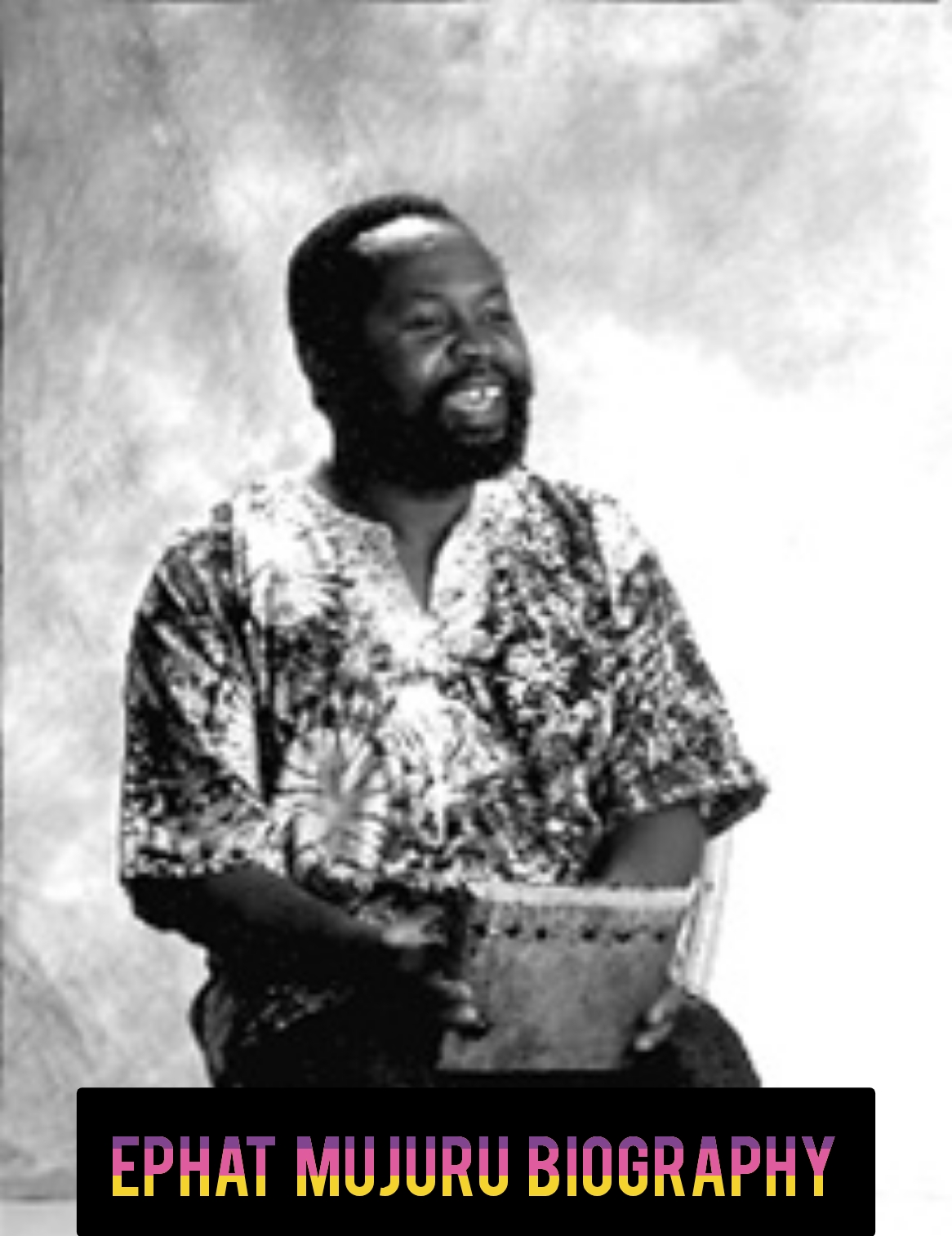
Ephat Mujuru Biography
Ephat Mujuru stands among the finest masters of the mbira in the twentieth century. A Zimbabwean musician of deep traditional knowledge and modern vision, he brought the sacred Shona thumb piano to international stages while keeping its spiritual roots alive. His playing connected the world of ancestors with the living present and helped restore cultural pride after years of colonial suppression.
This biography explores the life of a man who learned the mbira from his grandfather, a powerful spirit medium, and carried that knowledge through war, independence, and global travel. Ephat Mujuru became both a guardian of ancient tradition and a teacher who shared Zimbabwean music with the world.
Ephat Mujuru Early Life
Ephat Mujuru was born in 1950 in the small village of Dewedzo in the Manicaland region of what was then Southern Rhodesia, near the border with Mozambique. Some records give the date as 6 August 1950. He grew up in a rural Shona community where traditional religion, ancestor veneration, and music were tightly interwoven. His grandfather, Muchatera Mujuru, was a respected spirit medium linked to Chaminuka, one of the most important ancestral figures in Shona cosmology. Muchatera was also a master of the mbira dzavadzimu, the large mbira used in ceremonies to call the spirits.
From earliest childhood Ephat was immersed in the sounds and rituals of the bira, the all night ceremonies that feature continuous mbira music, singing, dancing, and the offering of beer and animals. Under his grandfather’s guidance he began learning the complex interlocking patterns of the mbira. The instrument demands precise coordination of the thumbs and a deep understanding of cyclical structures that can last for hours. Ephat showed exceptional talent. By the age of ten he was already skilled enough to play at possession ceremonies, a responsibility usually reserved for more mature musicians.
Formal schooling brought conflict. At the Catholic mission school he attended, teachers condemned the mbira as sinful and opposed to Christian teaching. This attitude reflected the wider colonial effort to suppress African spiritual and cultural practices. His grandfather was so angered by this that he withdrew Ephat from the school and arranged for him to continue his education in an African township near Salisbury, the capital that later became Harare. Despite the disruption, the young musician never abandoned the instrument. A quiet inner conviction told him that his path lay with the mbira. He sought out other master players, including the respected Bandambira and Simon Mashoko, and deepened his knowledge through further apprenticeship.
Ephat Mujuru Personal Life
Ephat Mujuru was a family man who balanced the demands of traditional ceremonial life with the practical needs of raising children. He was married and became the father of several children. Among them, his son James Mujuru later emerged as a respected mbira player in his own right, continuing the family tradition. Other relatives, including cousins such as Fradreck Mujuru, also became important figures in the mbira community as performers and instrument makers.
Those who knew him described a man of quiet intensity, generous with his knowledge, and gifted as a storyteller. Beyond music he carried a deep sense of responsibility to the spiritual traditions of his people. He viewed the mbira not merely as an instrument but as a bridge between the living and the ancestors. In interviews he often spoke of the philosophy of unity, healing, and respect that the music embodied. He worked to bring together people of different backgrounds, whether Shona and Ndebele within Zimbabwe or African and non African musicians abroad.
He lived simply even as his international reputation grew. Teaching, performing, and recording took him far from home for long periods, yet he remained rooted in Zimbabwean soil and returned regularly to play at ceremonies and to record. His personal life was marked by the same quiet determination that defined his art: a steady commitment to cultural continuity in a rapidly changing world.
Ephat Mujuru Rise to Prominence
In 1972, while the war of liberation against the Rhodesian government intensified, Ephat formed his first group, named Chaminuka after the great ancestral spirit. The ensemble performed throughout the difficult years of the struggle. Traditional music itself became political. Songs that spoke of ancient Africa or of crossing rivers carried coded messages of resistance and hope. One of his pieces, “Guruswa,” gained national radio play despite its subtle political meaning.
After Zimbabwe achieved independence in 1980, the cultural atmosphere changed. African traditions that had been suppressed under colonial rule experienced a powerful revival. Ephat renamed his group Spirit of the People and in 1981 recorded his first album. The recording used only traditional instruments: mbira, hand drums, hosho rattles, and voices. The songs spoke of brotherhood and healing at a time when the country was working to overcome ethnic divisions between Shona and Ndebele.
Independence opened new institutional doors. Ephat helped establish the National Dance Company of Zimbabwe and became the first African musician to teach at the Zimbabwe College of Music, an institution previously dominated by Western classical traditions. In 1982 he travelled to the United States for the first time. He studied, lectured, and taught mbira and marimba at the University of Washington in Seattle. From that point onward he divided his time between Zimbabwe and international teaching and performance circuits, introducing countless students and audiences to the depth of Shona music.
Ephat Mujuru Major Achievements
Ephat Mujuru mastered all five main types of Zimbabwean mbira but specialised in the mbira dzavadzimu. He maintained a large repertoire of traditional pieces while also composing original works and creating distinctive interpretations of classic songs. His recordings include the early traditional albums with Spirit of the People, the hand drumming collection Rhythms of Life released in the United States, the solo album Ancient Wisdom, and the important collaboration Shona Spirit with fellow Zimbabwean master Dumisani Maraire.
He performed in major venues, including Carnegie Hall, and shared stages or sessions with musicians from widely different backgrounds. His teaching reached universities and community groups across the United States and elsewhere. By formalising methods of instruction he helped make the complex art of mbira playing accessible to new generations of both Zimbabwean and international students. He received recognition for his role in preserving and promoting African cultural heritage, including a Pan African award presented in Ghana.
Through his work with the National Dance Company and the Zimbabwe College of Music he contributed to the institutional rebuilding of the arts after independence. His electric albums in the early 1990s, such as Hapana Mutorwa and Musiyano, showed that traditional roots could engage successfully with popular tastes. In all these activities he remained a cultural ambassador who presented Shona music with dignity and spiritual seriousness.
Ephat Mujuru Challenges and Setbacks
Colonial education and religious authorities tried to discourage the very tradition that defined him. Teachers told him the mbira was sinful. The liberation war brought violence and loss; his grandfather Muchatera was killed during the conflict, a heavy personal blow. Performing traditional music during the war years carried risks, yet he continued.
After independence new challenges appeared. The commercial music industry favoured electric pop styles, and purely traditional mbira recordings became less common. Balancing international travel with family and ceremonial obligations at home required constant adjustment. Health issues arose in later years. On 5 October 2001, while travelling through London on his way to a teaching residency at Grinnell College in the United States, he suffered a massive heart attack at the airport and died on the way to hospital. He was only fifty one years old. The sudden loss shocked the mbira community in Zimbabwe and abroad.
Ephat Mujuru Legacy and Current Status
Ephat Mujuru died on 5 October 2001 in London. His passing was mourned by musicians, students, and cultural workers who had been touched by his playing and teaching. Several of his children and relatives continued the family tradition. His cousin Fradreck Mujuru became a leading mbira maker and performer. His son James Mujuru carried forward the musical lineage.
Recordings such as Ancient Wisdom and Shona Spirit remain available and continue to introduce new listeners to the beauty of the mbira. The pedagogical approaches he developed influence how the instrument is taught in universities and community workshops around the world. In Zimbabwe he is remembered as a key figure in the post independence cultural renaissance, a musician who helped restore dignity to traditions once condemned by colonial authorities.
His life demonstrated that deep traditional knowledge and openness to the wider world can exist together. The mbira he played still sounds in ceremonies in rural Zimbabwe and in concert halls far away. Through the students he taught and the recordings he left, the bridge he built between ancestors and the present remains open.
FAQs
Who was Ephat Mujuru?
Ephat Mujuru was a Zimbabwean master of the mbira, the traditional Shona thumb piano. Born in 1950, he became one of the most important players and teachers of the instrument in the late twentieth century and helped introduce it to international audiences.
What is the mbira dzavadzimu?
The mbira dzavadzimu is a large mbira used in Shona spiritual ceremonies to communicate with ancestral spirits. It was the instrument in which Ephat Mujuru specialised, although he played all major types of Zimbabwean mbira.
How did Ephat Mujuru learn to play?
He was taught from childhood by his grandfather Muchatera Mujuru, a respected spirit medium and mbira master. By the age of ten he was already performing at possession ceremonies.
What groups did Ephat Mujuru lead?
In 1972 he formed the group Chaminuka. After independence in 1980 he renamed it Spirit of the People. With this ensemble he recorded traditional albums and later experimented with electric instrumentation.
When and where did Ephat Mujuru die?
Ephat Mujuru died on 5 October 2001 in London after suffering a heart attack at the airport while travelling to a teaching residency in the United States. He was fifty one years old.
Why is Ephat Mujuru still important?
He preserved and transmitted a sacred musical tradition, helped restore cultural pride after colonialism, and opened the mbira to the world through teaching and recording. His work continues to influence musicians and students today.
Conclusion
Ephat Mujuru’s life shows how one dedicated artist can keep an ancient tradition alive while allowing it to speak to new times and places. From a childhood spent learning at the side of his grandfather in a rural Zimbabwean village, he carried the mbira through war, independence, and across oceans. He faced cultural suppression, personal loss, and the challenges of a changing music industry, yet he never abandoned the deep spiritual purpose of his art.
His playing and teaching remind us that music can heal divisions, honour the past, and build bridges between peoples. The notes of the mbira that he loved still ring out, connecting the world of the ancestors with the world of today. In that continuing sound, Ephat Mujuru’s gift endures.