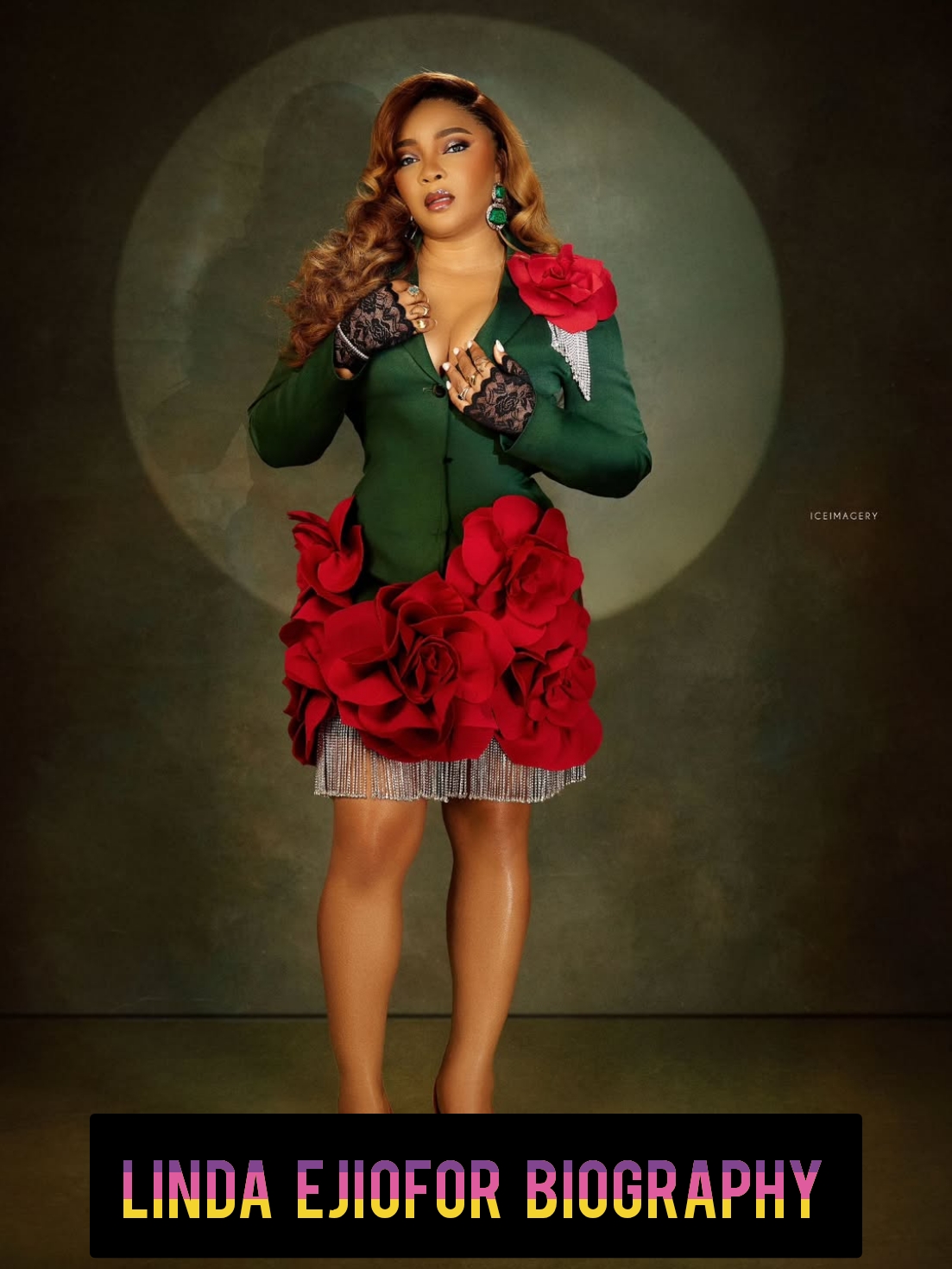
Linda Ejiofor Biography
Linda Ejiofor stands as one of Nollywood’s most respected and consistent talents, a performer whose quiet determination and emotional depth have earned her a lasting place in Nigerian entertainment. From her early days as a model to her breakthrough on television and her historic achievements on the big screen, she has built a career defined by authenticity, resilience, and a deep commitment to storytelling that resonates with audiences across Africa and beyond.
What many do not know is that Linda Ejiofor once spent an entire year secretly filming a major television series while completing her National Youth Service Corps assignment hundreds of kilometres away, travelling overnight by bus between Lagos and Jigawa State so that her father would not discover she had entered the very industry he had forbidden her to join.
Linda Ejiofor Early Life
Linda Ihuoma Ejiofor was born on 17 July 1986 in Lagos, Nigeria. Although she grew up in the bustling commercial capital of the country, her roots lie in Isuikwuato in Abia State in the southeastern region. She is the second of five children in a close-knit Christian family that valued education, discipline, and strong moral principles.
Her childhood in Surulere was happy and secure. Her father often returned from work and gathered the children to tell folk tales drawn from Igbo oral tradition, stories of the tortoise, the lion, and other animals that carried life lessons. Her mother was the stricter parent, ensuring the children stayed indoors for safety at a time when concerns about kidnapping were already present in Lagos. The family lived in a middle-class neighbourhood, and the siblings remained close, sharing both the joys and the ordinary challenges of growing up in a large household.
Linda began her formal education at Ilabor Memorial Nursery and Primary School in Surulere. For secondary school she was sent to Federal Government Girls’ College in Onitsha, Anambra State, one of Nigeria’s well-regarded federal unity schools known for academic standards and discipline. After completing secondary education she briefly enrolled for a short diploma course in Theatre Arts at the University of Ibadan. She had barely settled into the programme when her father discovered her plans. He immediately withdrew her, declaring that no child of his would enter the entertainment industry. He insisted she pursue a more conventional degree.
She therefore proceeded to the University of Port Harcourt in Rivers State, where she studied Sociology and graduated in 2007. The shift from the arts to the social sciences was not her first choice, yet it later proved useful. Understanding human behaviour, social structures, and relationships gave her a thoughtful foundation for interpreting characters. After graduation she served in the National Youth Service Corps in Jigawa State in northern Nigeria. While waiting for her posting and during service she supported herself through commercial modelling, appearing in billboards and television advertisements. At that stage she still hoped for a career in advertising, a field she felt would allow her creative expression without the risks her father associated with acting.
Linda Ejiofor Personal Life
Linda Ejiofor is married to fellow actor Ibrahim Suleiman. The two met on the set of the long-running television series Tinsel, where they worked as colleagues for several years before their relationship developed into romance. On 4 November 2018 she publicly announced their engagement. Four days later they were married in both traditional and white wedding ceremonies. The couple have maintained a private yet visibly supportive partnership. They share a son, Keon Iman Suleiman, born on 9 July 2020.
Family remains central to her life. She has spoken of the importance of separating work from home life and of the mutual understanding that comes from being married to someone in the same profession. When she is not filming she prioritises time with her husband and son. A typical day away from set often begins with taking her son to school, followed by a session at the gym. She values rest, reading, and quiet evenings at home. She enjoys watching films, particularly Korean dramas, and has long been fond of travelling and cooking. In earlier years she also mentioned volleyball as a recreational interest.
Linda has described herself as sometimes shy, unpretentious, and direct. Friends and family call her Ihuoma, a name she interprets as meaning “God’s good thing.” She is careful about the public image she presents, guided by the values her parents instilled and by a desire to leave a clean legacy for her child. She has no interest in generating controversy for publicity, believing that the internet never forgets and that future generations should not find damaging stories when they search her name. Faith plays a quiet but consistent role in her life; she has spoken of turning to prayer during periods of professional uncertainty and of gratitude for the support of her husband during those times.
Lesser-known aspects of her personality include a love of comfortable yet elegant fashion and an appreciation for classic rather than fleeting trends. She has cited Eva Longoria as a style influence for dressing well for her body type. She also enjoys shoes, particularly well-made heels, though comfort remains her priority. Despite her public career she prefers low-key socialising and would rather stay home watching movies than attend loud parties.
Linda Ejiofor Rise to Prominence
Linda’s entry into acting was almost accidental. After university she continued modelling while waiting for her youth service posting. A friend told her about an audition for a new M-Net television series. At first she refused, remembering her father’s firm opposition. The financial incentive eventually persuaded her to try. She attended the audition and was selected to play Bimpe Adekoya in Tinsel. The callback did not come immediately. A full year later, while serving in Jigawa, she received the call. She took a night bus back to Lagos for a further audition and secured the role.
For the next year she balanced filming in Lagos with her youth service obligations in the north, travelling back and forth so that only her mother and siblings knew of her new career. When her father finally learned the truth he was preparing to subscribe to DStv and would have seen her on screen. Instead of the anger she expected, he offered measured advice: she had already worked for a year without negative publicity, and she should never forget her family values. That conversation became a guiding principle for the rest of her career.
Tinsel gave her national visibility. Bimpe was a bold, sometimes dramatic character quite different from Linda’s own quieter personality, and the role required her to stretch beyond her natural shyness. The series ran for many years and established her as a familiar face in Nigerian homes. Her first major feature film opportunity came in 2012 with The Meeting, directed by Mildred Okwo and starring Rita Dominic and Nse Ikpe-Etim. She played Ejura, a supporting role that earned her a nomination for Best Actress in a Supporting Role at the 9th Africa Movie Academy Awards. Industry observers began to take notice. In 2013 The Sun newspaper listed her among the ten fastest-rising Nollywood stars of the year.
Subsequent television work included the series Dowry and the Ndani TV web series Rumour Has It opposite Jemima Osunde. Each project expanded her range and strengthened her professional reputation. She has spoken of learning on every set, observing more experienced actors, and treating each role as an opportunity to improve. Her early ambition to work in advertising gradually faded as acting claimed her full attention, though she has expressed a long-term interest in directing films one day.
Linda Ejiofor Major Achievements
Linda Ejiofor’s body of work spans television, feature films, and streaming projects. After The Meeting she appeared in Secret Room, Out of Luck, Heaven’s Hell, A Soldier’s Story, Suru L’ere, Ojukokoro, Knockout Blessing, Chief Daddy and its sequel, 4th Republic, Kpali, Palava, Shina, and many others. Her performances have been noted for emotional authenticity and the ability to inhabit characters from different social backgrounds and emotional states.
Her first major award came in 2015 when she won Best Supporting Actress at the Africa Magic Viewers’ Choice Awards for The Meeting. Nominations followed at various ceremonies, including the Africa Movie Academy Awards for Out of Luck, Knockout Blessing, and 4th Republic. She also received recognition at the ELOY Awards and other industry events.
The pinnacle of her recognition arrived at the 12th Africa Magic Viewers’ Choice Awards in May 2026. On that night she became the first actress in the history of the awards to win both Best Actress in a Lead Role and Best Supporting Actress at the same ceremony. She received the lead award for her portrayal of Ijeoma Sylvanus in The Serpent’s Gift, an Igbo-language drama exploring grief, widowhood, and family inheritance. She won the supporting award for her role as Adama in The Herd, a crime thriller directed by Daniel Etim-Effiong that examines the human cost of kidnapping and insecurity. The double victory placed her in rare company internationally and confirmed the depth of her craft after more than fifteen years of steady work.
Beyond awards she has contributed to the visibility of Nigerian stories that address real social issues. The Serpent’s Gift brought attention to the experiences of widows navigating cultural expectations, while The Herd highlighted the trauma of abduction and its effects on families. She has also appeared in projects that reach international audiences through streaming platforms and festival screenings. Her consistency without scandal has made her a trusted presence in an industry that often rewards noise over substance.
Linda Ejiofor Challenges and Setbacks
Linda’s path was never straightforward. The earliest and most significant obstacle was her father’s strong opposition to any involvement in entertainment. He withdrew her from a Theatre Arts programme and made clear that acting was not an acceptable career. For a full year she worked on Tinsel in secret, risking family conflict if discovered. When the truth emerged, the conversation that followed, though ultimately supportive, left her with a lasting sense of responsibility to uphold the family’s reputation.
Entering the industry as a relative outsider without formal drama training meant she had to learn on the job. Portraying the outspoken Bimpe while remaining naturally reserved required deliberate effort. Early in her film career she faced the common Nollywood challenges of limited budgets, long shooting hours, and the need to prove herself repeatedly. There were periods when roles were scarce and she wondered whether her career had stalled. About three years before her 2026 double win she experienced a particularly low point, feeling that opportunities were no longer coming and that she might become irrelevant. She turned to prayer and to conversations with her husband, who continued to affirm her talent even when she doubted herself.
Balancing motherhood with a demanding profession brought its own pressures. She has spoken of the emotional weight of certain roles, especially those involving grief or trauma, and of the need to recover after intense scenes. The public nature of celebrity life in Nigeria, where controversy can be manufactured for attention, presented another challenge. She chose a quieter path, accepting that it might mean fewer headlines but protecting her long-term reputation and her family’s privacy.
Through each difficulty she relied on discipline, faith, family support, and a commitment to continuous improvement. She has repeatedly stated that talent alone is never enough; humility, patience, and professionalism matter more. The historic night at the 2026 AMVCA served as public confirmation that the years of steady, often understated work had not been wasted.
Linda Ejiofor Legacy and Current Status
Linda Ejiofor continues to work actively. In recent years she has taken on roles that stretch her range, including a part as a female smuggler in a project filmed in Abeokuta. She remains open to both lead and supporting parts provided the story feels meaningful and the schedule allows full commitment. She has expressed interest in eventually moving into directing, a long-held ambition that would allow her to shape stories from the other side of the camera.
Her influence extends beyond individual performances. Younger actors see in her an example of how to build a durable career without sacrificing personal values. Her marriage to Ibrahim Suleiman is often cited as one of Nollywood’s more stable and mutually supportive partnerships. The couple’s decision to keep family life relatively private while remaining professional colleagues has offered a model of balance in an industry that can be intrusive.
As Nigerian cinema gains greater international attention, Linda’s body of work contributes to the depth and variety of stories reaching global audiences. Her ability to move between English-language and indigenous-language projects, and between television and theatrical films, demonstrates the flexibility required of contemporary African performers. She has also participated in advocacy-oriented conversations around family values and mental health within the entertainment community.
At present she balances ongoing film and television work with the everyday responsibilities of motherhood and marriage. She continues to train, to read scripts carefully, and to choose projects that challenge her. Recognition from peers and from the public has increased since 2026, yet she has spoken of remaining grounded by remembering her beginnings and the principles her parents taught her.
Conclusion
Linda Ejiofor’s journey from a sociology graduate who once dreamed of advertising to a historic double award winner illustrates the power of persistence, self-respect, and quiet excellence. She entered an industry her father once forbade, navigated secrecy and doubt, and emerged as one of its most respected voices. Her story reminds audiences that lasting success is rarely the product of sudden fame. It is built through years of preparation, the courage to keep working when recognition is slow, and the wisdom to protect one’s character along the way. In an age that often celebrates the loudest voices, her career stands as evidence that integrity and craft can still command attention and admiration.
FAQs
Who is Linda Ejiofor?
Linda Ejiofor, also known as Linda Ejiofor-Suleiman, is a Nigerian actress and model best known for her long-running role as Bimpe Adekoya in the television series Tinsel and for her historic double win at the 2026 Africa Magic Viewers’ Choice Awards.
When and where was Linda Ejiofor born?
She was born on 17 July 1986 in Lagos, Nigeria, and hails from Isuikwuato in Abia State.
What is Linda Ejiofor’s educational background?
She attended Ilabor Primary School in Surulere and Federal Government Girls’ College in Onitsha before earning a degree in Sociology from the University of Port Harcourt.
Is Linda Ejiofor married?
Yes, she married actor Ibrahim Suleiman in November 2018. The couple have a son named Keon Iman Suleiman, born in 2020.
What are some of Linda Ejiofor’s most notable films?
Her notable works include The Meeting, A Soldier’s Story, Knockout Blessing, 4th Republic, The Herd, and The Serpent’s Gift.
What historic achievement did Linda Ejiofor accomplish in 2026?
She became the first actress to win both Best Actress in a Lead Role and Best Supporting Actress at the same Africa Magic Viewers’ Choice Awards ceremony, for The Serpent’s Gift and The Herd respectively.
How did Linda Ejiofor begin her acting career?
She was encouraged by a friend to audition for Tinsel while modelling and waiting for youth service. She secured the role of Bimpe Adekoya and balanced filming with her service year in Jigawa State.
Does Linda Ejiofor have any interest beyond acting?
She has expressed a desire to direct films in the future and values time spent with family, reading, watching movies, and maintaining personal fitness.