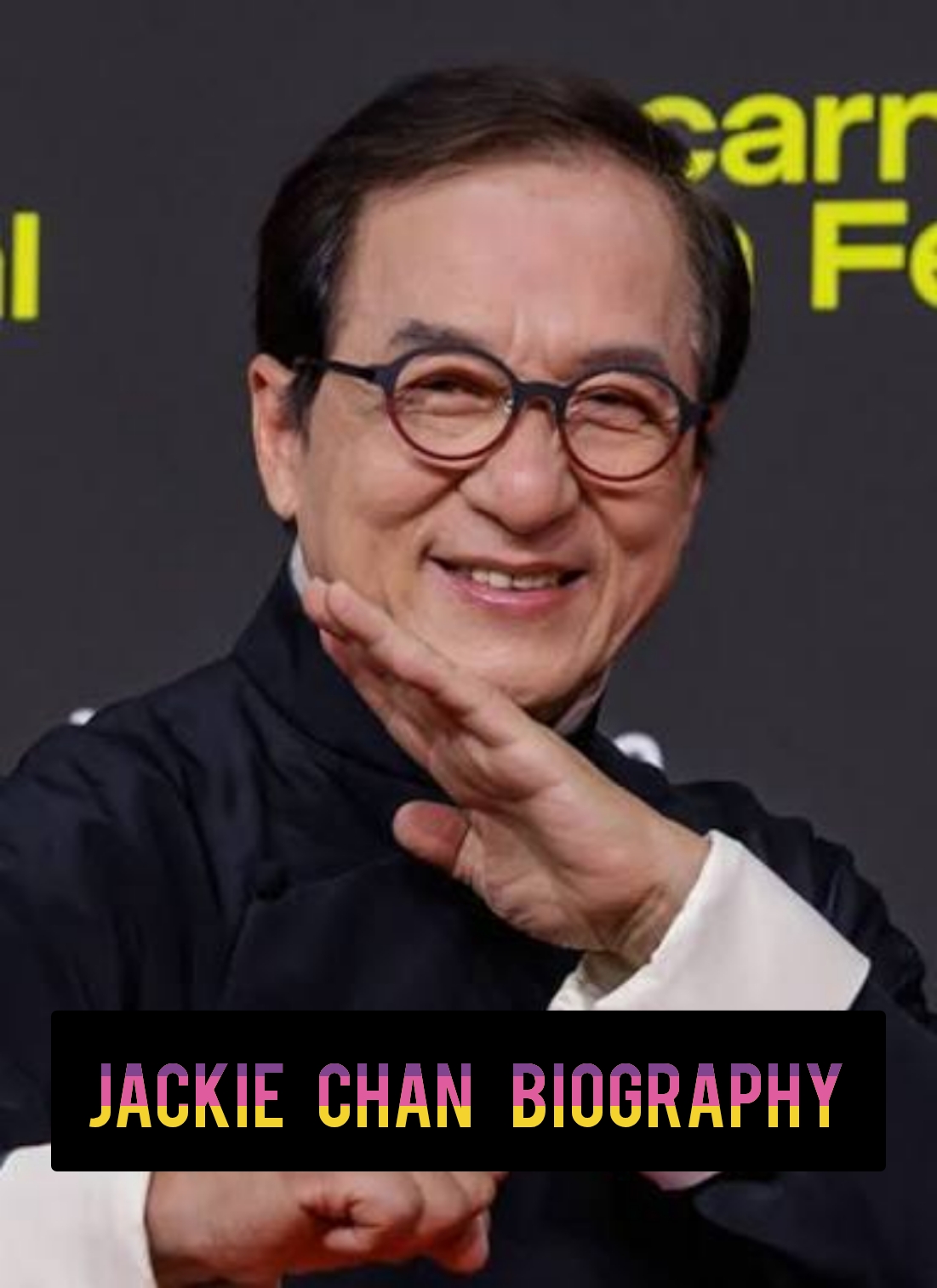
Jackie Chan Biography
Jackie Chan stands as one of the most recognizable figures in global cinema, a performer whose blend of martial arts mastery, daring physical comedy, and relentless determination has entertained audiences for more than six decades. From the crowded streets of Hong Kong to the bright lights of Hollywood, his journey reflects a rare combination of talent, discipline, and an unbreakable spirit. This biography explores the full arc of his life, from humble beginnings to lasting influence, offering a clear and complete picture of the man behind the legendary stunts and smiling face that millions know so well.
Few people realize that Jackie Chan once weighed nearly twelve pounds at birth, a fact that already hinted at the remarkable physical strength he would later display on screen. That sturdy start marked the beginning of a life filled with extraordinary challenges and even greater triumphs.
Jackie Chan Early Life
Jackie Chan was born on April 7, 1954, in Hong Kong. His parents, Charles Chan and Lee-Lee Chan, were refugees who had fled the turmoil of the Chinese Civil War. They worked for the French embassy on Victoria Peak, where Charles served as a cook and Lee-Lee worked as a housekeeper. The family lived in modest conditions despite the prestigious location of their home. Jackie’s birth required surgery, and his parents had to borrow money from friends to pay the doctor’s bill. They nicknamed their energetic baby Pao Pao, meaning cannonball, because of the way he rolled and tumbled about as an infant.
When Jackie was still a young child, his father began teaching him basic kung fu exercises early each morning. Charles believed these lessons would build patience, strength, and courage in his son. Jackie attended Nah-Hwa Primary School on Hong Kong Island, but he struggled with traditional academic studies and failed his first year. In 1960, when Jackie was about six or seven years old, his father accepted a position as head cook at the American embassy in Canberra, Australia. The family decided that Jackie should remain in Hong Kong to learn a useful skill. They enrolled him at the China Drama Academy, a strict boarding school that trained students for the Peking Opera.
At the academy, Jackie lived under the rigorous guidance of Master Yu Jim-yuen. For the next ten years, from roughly age seven to seventeen, he trained from early morning until late at night in acrobatics, martial arts, singing, dancing, mime, and acting. The daily routine was demanding and often harsh. Students slept on thin mats, faced corporal punishment for mistakes, and received almost no formal education in reading, writing, or arithmetic. Jackie later recalled that the experience was far from enjoyable, yet it shaped his extraordinary physical abilities and work ethic. He excelled in the program and became a member of the Seven Little Fortunes, a performing troupe made up of the school’s most talented students. There he formed lifelong friendships with fellow students Sammo Hung and Yuen Biao, who would later become known alongside him as the Three Brothers in Hong Kong cinema. During these years Jackie also appeared in several films as a child actor, beginning with Big and Little Wong Tin Bar in 1962 when he was only eight years old.
When Jackie graduated from the academy around 1971, the popularity of traditional Peking Opera had declined. He and his classmates had to seek other work. Jackie found employment as a stuntman and acrobat in the growing Hong Kong film industry. He performed dangerous falls and fights in movies, including minor roles in Bruce Lee films such as Fist of Fury and Enter the Dragon. The training he had endured at the drama academy gave him the skills that would soon set him apart from other performers.
Jackie Chan Personal Life
Jackie Chan married Taiwanese actress Joan Lin, also known as Lin Feng-jiao, in December 1982. The couple held a simple ceremony in a coffee shop in Los Angeles. Their son, Jaycee Chan, was born the following day. Joan retired from acting after the marriage to focus on family life, though she later made a brief appearance in one of Jackie’s films. Jackie has spoken openly about the challenges of balancing his demanding career with family responsibilities. He has admitted that long periods of work often kept him away from home and that he was not always the present husband and father he wished to be.
In 1999 Jackie publicly acknowledged an extramarital relationship that resulted in the birth of a daughter, Etta Ng Chok Lam. He expressed regret for the pain the situation caused his family and has largely kept details of that part of his personal life private. Jackie has described himself as imperfect in family matters while emphasizing his ongoing sense of duty toward those closest to him. He remains married to Joan Lin, and the couple has maintained a long partnership spanning more than four decades.
Outside of family, Jackie is known for his wide range of interests and quiet habits. He speaks several languages, including Cantonese, Mandarin, English, Japanese, Korean, and others. He is an avid football fan who supports teams such as Manchester City and the Hong Kong national side. In recent years he has spoken about living with attention deficit hyperactivity disorder. He maintains a large household of pets that has included dogs, cats, horses, and even pandas at different times. Jackie is also a practicing Buddhist and has long supported charitable causes focused on education, disaster relief, and youth development. He founded the Jackie Chan Charitable Organization to provide scholarships and assistance to young people in Hong Kong and beyond. He has served as a UNICEF goodwill ambassador, using his fame to draw attention to the needs of children around the world.
Lesser-known aspects of his character include a deep respect for the silent film comedians who influenced his physical style, particularly Buster Keaton and Charlie Chaplin. He has often said that he never wanted to become the next Bruce Lee but instead sought to create his own unique path. Despite the fame and wealth he has earned, Jackie continues to approach his work with the same discipline that began in the drama academy, viewing every project as an opportunity to improve and to entertain.
Jackie Chan Rise to Prominence
After leaving the China Drama Academy, Jackie Chan spent several years working as a stuntman and taking small roles in Hong Kong films. The early 1970s were a difficult period. The film industry was competitive, and opportunities for young performers were limited. When Bruce Lee died in 1973, producers searched for a successor who could carry the martial arts film boom. Jackie was cast in a series of movies intended to mold him into a similar serious action hero. Films such as New Fist of Fury tried to place him in the same style, but the results were disappointing. Audiences and critics found the performances unconvincing, and several projects either failed at the box office or were never widely released. Jackie later described this period as one in which he was considered box office poison.
A turning point arrived in 1978 when Jackie was loaned to Seasonal Film Corporation. Director Yuen Woo-ping allowed him greater creative freedom. In Snake in the Eagle’s Shadow, Jackie introduced a lighter, more comedic approach to fight scenes. He combined martial arts with physical humor, falls, and playful reactions that made the action feel fresh and accessible. The film was a success. Later that same year he starred in Drunken Master, a story about a young fighter who becomes more skilled after drinking. The movie became a major hit across Asia and established Jackie’s distinctive style of kung fu comedy. Audiences responded to the blend of danger, skill, and laughter.
Jackie quickly followed these successes by directing and starring in The Fearless Hyena in 1979. He then signed with Golden Harvest, one of Hong Kong’s leading production companies, and took full creative control of projects such as The Young Master in 1980. During this period he also spent time in Australia with his parents, working construction jobs and briefly attending college. It was on a construction site that coworkers began calling him Jackie because they found his Chinese name difficult to pronounce. The nickname stuck and became the name the world would know.
By the early 1980s Jackie had become a major star in Asia. Films such as Project A and the Police Story series showcased increasingly elaborate stunts that he performed himself. His reputation for inventiveness and courage grew with every release. Hollywood interest followed, though early American projects met mixed results. The true international breakthrough came in the mid-1990s with Rumble in the Bronx, which introduced his style to wider Western audiences, followed by the massive success of Rush Hour in 1998 opposite Chris Tucker. That film and its sequels cemented Jackie Chan as a global star.
Jackie Chan Major Achievements
Jackie Chan’s body of work includes more than two hundred films across acting, directing, producing, writing, and choreography. His Hong Kong films of the 1980s and early 1990s, including the Police Story series, Project A, and Armour of God, set new standards for action choreography. He transformed everyday objects into weapons and turned ordinary locations into elaborate playgrounds for stunts. His insistence on performing his own stunts, often without safety wires, became a signature that distinguished him from other action stars.
In Hollywood, Rush Hour became a cultural phenomenon and launched a successful franchise. Shanghai Noon and its sequel further expanded his reach. Later roles in The Karate Kid remake and its sequel, as well as voice work in the Kung Fu Panda films, introduced him to new generations of viewers. He has also released numerous music albums in Cantonese, Mandarin, and other languages, performing theme songs for many of his own movies and enjoying popularity as a singer across Asia.
Recognition has followed his achievements. In 1989 he was made a Member of the Order of the British Empire for his contributions to entertainment. He received a star on the Hollywood Walk of Fame. In 2016 the Academy of Motion Picture Arts and Sciences presented him with an honorary Oscar, making him the first Chinese actor to receive the honor. The Academy recognized his distinctive international career and the way his films brought martial arts cinema to mainstream audiences worldwide. He holds Guinness World Records related to the number of stunts performed by a living actor and the number of credits in a single film. Awards from film festivals across Asia, lifetime achievement honors, and popular audience awards further mark the breadth of his impact.
Beyond entertainment, Jackie has used his platform for philanthropy. The Jackie Chan Charitable Organization supports education and community projects. His work as a UNICEF ambassador has focused attention on children’s welfare. He has donated to disaster relief efforts and spoken publicly about environmental and social issues. His influence extends to the creation of the Jackie Chan Action Movie Awards, which celebrate excellence in the genre he helped define.
Jackie Chan Challenges and Setbacks
Jackie Chan’s path was never free of obstacles. The strict environment of the China Drama Academy left him with limited formal education and lasting physical discipline, but also with memories of hardship. Early in his film career he faced repeated commercial failures when producers tried to force him into the mold of Bruce Lee. The criticism he overheard during dubbing sessions left him discouraged, yet he continued working and eventually discovered his own voice through comedy.
The greatest physical challenges came from the stunts he insisted on performing himself. Over the years he has suffered a long list of injuries that include broken bones, dislocations, burns, and more serious trauma. During the filming of Armour of God in the mid-1980s, a stunt involving a jump onto a tree branch went wrong on a second take. The branch snapped, and Jackie fell, striking his head on a rock. The impact fractured his skull and drove a piece of bone into his brain. Emergency surgery saved his life, but he was left with permanent effects including a depression in his skull and partial hearing loss. He returned to work relatively quickly, determined not to let the injury stop him.
Other setbacks included nearly losing an eye during a fight scene in Drunken Master, neck injuries from a clock tower fall in Project A, burns and pelvic injuries from a shopping mall pole slide in Police Story, and countless lesser fractures and bruises. He has spoken about periods of personal difficulty, including struggles with temper, the demands of constant travel, and the strain on family relationships caused by his career focus. Early attempts to break into the American market met with limited success and creative frustration. Through each difficulty Jackie responded with persistence, adapting his methods when necessary while remaining committed to the style that defined him. He has often said that the pain and risk were part of the job, and that the audience’s enjoyment made the sacrifices worthwhile.
Jackie Chan Legacy and Current Status
Jackie Chan’s influence on action cinema remains profound. He showed that martial arts films could combine high-level skill with humor, inventiveness, and emotional warmth. Generations of filmmakers and performers have drawn inspiration from his approach to choreography and his willingness to take physical risks for authentic results. His films have grossed billions of dollars worldwide and continue to find new audiences through streaming and re-releases.
At more than seventy years of age, Jackie remains active. Recent projects include the action thriller The Shadow’s Edge, which earned strong critical and audience responses, and work on Armour of God IV: Ultimatum, with filming completed in locations such as Kazakhstan. He has appeared in public events, including NBA-related gatherings, and continues to engage with fans and charitable causes. He has reflected on his long career with gratitude, noting that the broken bones and long hours were ultimately rewarded by the chance to entertain people around the world. His honorary Oscar stands as formal recognition of a body of work that spans cultures and generations.
Jackie Chan is remembered not only for the spectacular stunts but for the spirit of resilience and joy that runs through his performances. He transformed personal hardship into universal entertainment and proved that originality and hard work can create a lasting place in popular culture.
Conclusion
The story of Jackie Chan reminds us that extraordinary achievement often grows from ordinary beginnings and sustained effort. From a childhood of strict training and limited resources to a career that reached every corner of the globe, he built something unique by staying true to his own vision. His life encourages others to face difficulties with determination, to find humor even in struggle, and to keep moving forward no matter how many times one falls. In an industry that constantly changes, Jackie Chan’s example of creativity, courage, and generosity continues to inspire.
FAQs
What is Jackie Chan’s real name?
Jackie Chan was born Chan Kong-sang. He later adopted the Chinese name Fang Shilong and became widely known by the English name Jackie Chan.
When and where was Jackie Chan born?
Jackie Chan was born on April 7, 1954, in Hong Kong.
How did Jackie Chan get his English name?
While working on a construction site in Australia, coworkers found his Chinese name difficult to pronounce and began calling him Jackie. The name stayed with him throughout his career.
Is Jackie Chan married?
Yes, Jackie Chan has been married to Taiwanese actress Joan Lin since 1982.
Does Jackie Chan have children?
Jackie Chan has a son, Jaycee Chan, with his wife Joan Lin, and a daughter, Etta Ng Chok Lam.
What are some of Jackie Chan’s most famous movies?
Some of his best-known films include Drunken Master, Police Story, Project A, Rush Hour, Shanghai Noon, and The Karate Kid.
Has Jackie Chan ever won an Oscar?
Jackie Chan received an honorary Academy Award in 2016 in recognition of his distinctive international career.
Does Jackie Chan still do his own stunts?
Jackie Chan has performed the majority of his own stunts throughout his career, though in later years he has adjusted the level of risk according to age and safety considerations while remaining closely involved in the action design.
What charitable work is Jackie Chan involved in?
Jackie Chan founded the Jackie Chan Charitable Organization to support education and youth programs. He has also served as a UNICEF goodwill ambassador and contributed to disaster relief and other humanitarian efforts.