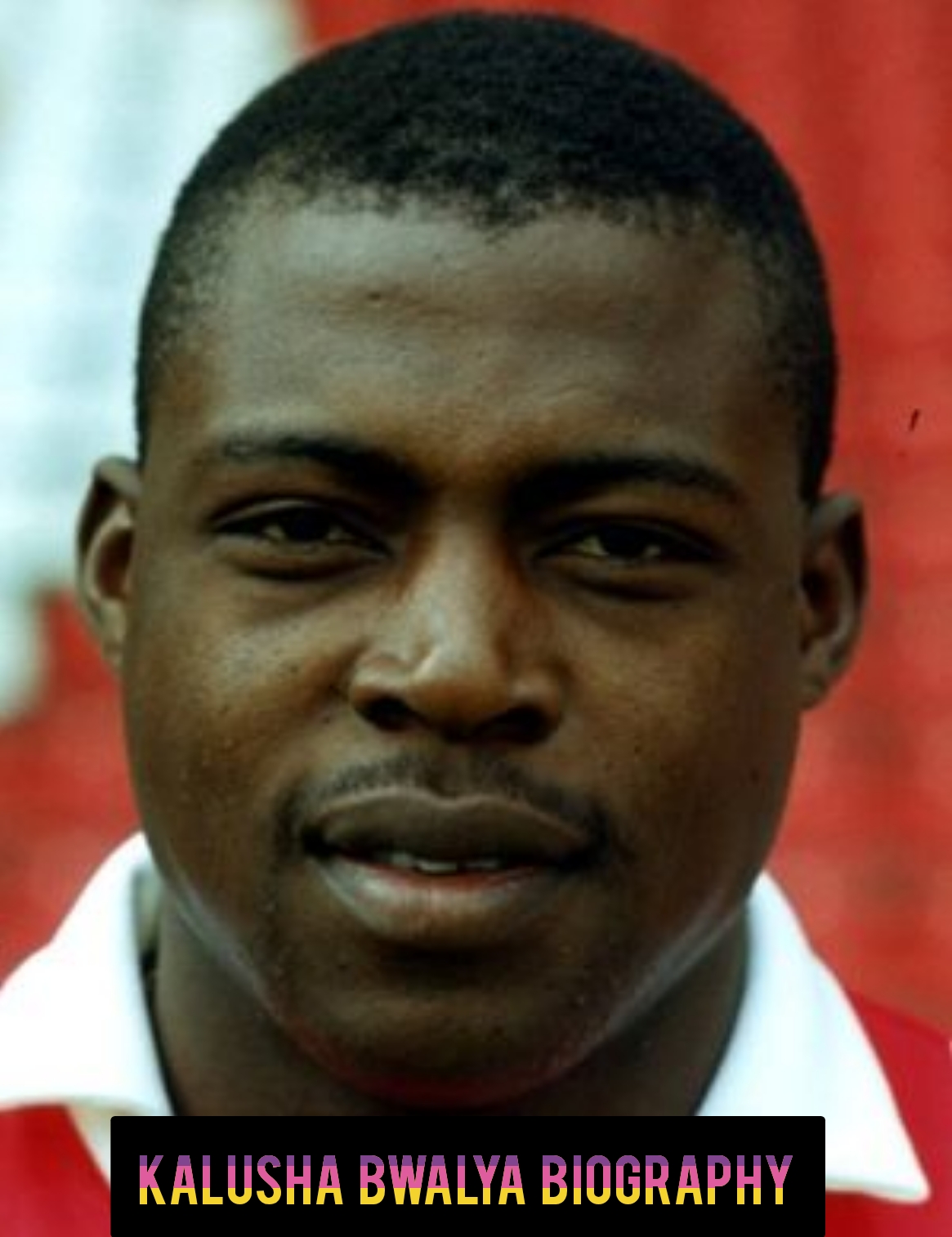
Kalusha Bwalya Biography
Kalusha Bwalya stands as one of the most celebrated figures in African football history. Known across Zambia and beyond as Great Kalu or King Kalu, he rose from the mining towns of the Copperbelt to become a symbol of skill, resilience, and leadership on the global stage. His journey as a player, coach, and administrator has left a lasting mark on Zambian sport and inspired generations of young athletes.
What makes his story particularly compelling is a single afternoon in Seoul in 1988. Facing a strong Italian Olympic side packed with future stars, the young Zambian forward scored three goals in a stunning 4-0 victory. That performance announced him to the world and remains one of the most memorable moments in Olympic football.
Kalusha Bwalya Early Life
Kalusha Bwalya was born on 16 August 1963 in Mufulira, a bustling mining town in what was then Northern Rhodesia. The Copperbelt region pulsed with industrial energy and a deep passion for football. His father, Benjamin Lemba Bwalya, served as an executive committee member of the Football Association of Zambia and chaired the local club Mufulira Blackpool. This environment immersed young Kalusha in the game from his earliest days. His mother, Elidah Bwalya, provided steady support at home while the family navigated life in the mining community.
Growing up in Kamuchanga Township, Kalusha and his brothers played barefoot on gravel roads. They used simple rubber balls and improvised goalposts, competing for hours until sunset. Fatigue rarely stopped them. Football was not merely recreation. It formed the center of daily life and social connection. His older brother Benjamin showed early talent and later played professionally, while his younger brother Joel would also represent Zambia at international level. The family connection to the sport ran deep. A cousin, Robert Earnshaw, later became a noted striker for Cardiff City and the Welsh national team.
Education began at Perseverance Primary School in Ndola. There Kalusha first took on a leadership role as captain of the under-10 team. School football competitions were fierce and highly valued. He progressed through secondary school with consistent performances on the pitch. Academic study existed alongside the game, though the pull of football often dominated. At sixteen he attended trials with Mufulira Blackpool after his brother Benjamin was called up to the army. Selected and registered, he began his senior career in 1979. Pressure from his father’s employers at the copper mines soon led to a move to the more prestigious Mufulira Wanderers. At Shinde Stadium, packed with passionate crowds, the teenage forward began to flourish under coaches who recognized his left-footed skill, instinctive movement, and free-kick technique.
Those formative years in Mufulira shaped both his playing style and his character. The streets taught improvisation and toughness. The family link to administration taught respect for the structures of the game. By the early 1980s he had already worn the national team jersey while still a teenager, setting the foundation for a career that would take him far beyond Zambia’s borders.
Kalusha Bwalya Personal Life
Away from the pitch Kalusha Bwalya has maintained a relatively private family life while remaining connected to those closest to him. He married Emmy Cassalleti in 2009 after several years together. The ceremony was intimate, attended by family and close friends. Emmy has been a steady presence, and the couple has spoken of the warmth of their blended household. Kalusha is father to three daughters: Tamela, Olivia, and Sarah. Tamela, born during his peak playing years with a previous partner who worked in broadcasting, was married in a ceremony her father proudly attended. Sources also mention a son from an earlier relationship, reflecting the complexities of life lived across continents during a long professional career.
Family remains central. His brothers shared the same footballing passion, and the loss of older brother Benjamin was felt deeply. Kalusha has spoken with quiet pride of Joel’s contributions to the national team. Languages form another important part of his personal world. Raised speaking Bemba, he studied French at high school and later became fluent in Dutch during his time at PSV Eindhoven and in Spanish while playing in Mexico. Italian improved through family connections. These skills proved useful both on the international circuit and in later administrative roles.
Lesser-known aspects include his early love of material rewards that came with sudden professional success. Upon receiving his first significant paycheck in Belgium he bought a black Golf GTI, a symbol of arrival at the time. He has openly reflected that in those early European years he spent freely without planning for the future, a common experience for young players thrust into new wealth. Later he valued education more highly, noting how clubs assigned language tutors and how those abilities continue to serve him. He has also shown personal loyalty to older sporting heroes in Zambia, visiting and supporting figures such as boxing legend Lottie Mwale in later years. Hobbies beyond football appear modest. Family gatherings, quiet reflection on the game’s history, and ongoing engagement with grassroots development occupy much of his attention. He maintains an active presence on social media, sharing moments with Emmy and the children while keeping a dignified public profile.
Kalusha Bwalya Rise to Prominence
The path from Mufulira streets to European stadia unfolded steadily yet with clear turning points. After establishing himself at Mufulira Wanderers and winning the Zambian Challenge Cup, Kalusha attracted attention beyond Zambia. In 1985, at age twenty-two, he signed for Belgian club Cercle Brugge. He became the first African player to join the club on a professional contract. In his first season he finished as leading scorer and twice earned the supporters’ player of the year award. Over four seasons he made ninety-five appearances and scored thirty goals, refining his technique against European defenses.
The decisive breakthrough arrived in 1988. Selected for Zambia’s Olympic squad in Seoul, he produced a performance that still resonates. Against Italy he scored a hat-trick in a 4-0 victory that stunned observers. He finished the tournament with six goals, second only to Brazil’s Romário. Later that year France Football named him African Footballer of the Year, the first Zambian to receive the honor. The recognition opened the door to a move to Dutch giants PSV Eindhoven in 1989. At PSV he shared dressing rooms with elite talents and competed at the highest level of European club football. He contributed to consecutive Eredivisie titles in 1990-91 and 1991-92, added a KNVB Cup and Dutch Super Cup, and recorded more than one hundred appearances with twenty-five league goals. Room-sharing with players of Romário’s caliber accelerated his development. By the early 1990s Kalusha Bwalya had become a recognized name across the continent and a leader for Zambia on the international stage.
Kalusha Bwalya Major Achievements
The list of accomplishments stretches across club, country, and later administration. At club level the PSV years delivered major silverware and experience in European competition. Spells in Mexico with Club América, Necaxa, León, Irapuato, Veracruz, and Correcaminos added further chapters and exposed him to a different football culture. A brief period in the United Arab Emirates with Al Wahda rounded out a career that spanned more than two decades.
Internationally he earned eighty-seven caps and scored thirty-nine goals for Zambia between 1983 and 2004. He featured in six Africa Cup of Nations tournaments. In 1994, mere months after national tragedy, he captained a rebuilt side to the final, where they fell to Nigeria. In 1996 in South Africa he claimed the Golden Boot with five goals and helped Zambia secure third place. That same year he finished twelfth in the FIFA World Player of the Year voting, the first player nominated after spending an entire season outside Europe. He continued representing Zambia into his forties, scoring a free-kick winner against Liberia in 2004 at the age of forty-one and becoming one of the oldest international goalscorers in history.
As coach of the national team from 2003 to 2006 he guided the side through qualification campaigns before stepping down after the 2006 Africa Cup of Nations. Elected president of the Football Association of Zambia in 2008, he held office until 2016. During that period Zambia achieved its greatest triumph, winning the 2012 Africa Cup of Nations in Gabon under coach Hervé Renard. The victory carried deep emotional weight, dedicated in part to the players lost in 1993. Kalusha also served on FIFA and CAF standing committees, bringing a former player’s perspective to governance. Individual honors include the African Footballer of the Year award, inclusion in Africa Cup of Nations teams of the tournament, and lasting recognition as Zambia’s greatest footballer by many observers.
Kalusha Bwalya Challenges and Setbacks
No career of this length escapes difficulty. The most profound challenge came on 27 April 1993. A military aircraft carrying the Zambian national team and officials crashed into the Atlantic Ocean off Gabon after a refueling stop. All thirty people on board perished. Kalusha was not among them because club duties at PSV required him to travel separately from Europe. He learned of the disaster while preparing to join the squad. The loss of teammates, friends, and the coaching staff left a permanent scar. Families opened their homes to mourners. Recovery took months. Rather than withdraw, he accepted the responsibility of helping rebuild the national team. Captaining a patched-together side to the 1994 Africa Cup of Nations final stands as one of the most remarkable responses to tragedy in modern football history.
Professional transitions also tested him. Moving from the familiarity of Zambian football to Belgium required cultural and linguistic adjustment. Later moves to the Netherlands and Mexico demanded further adaptation. Financial management in the early professional years taught hard lessons about planning beyond the present. After retirement, coaching the national team brought pressure and eventual resignation following a group-stage exit in 2006. Administrative life proved equally demanding. In 2016 he lost the Football Association of Zambia presidency in a close election. In 2018 FIFA’s Ethics Committee imposed a two-year ban from football-related activity and a fine after finding breaches related to gifts and confidentiality. The ruling damaged his standing at the time, yet he accepted the decision and continued contributing in other capacities once the period ended. Each setback reinforced a pattern of persistence. Whether recovering from collective grief or navigating institutional challenges, Kalusha Bwalya consistently returned to the game that defined him.
Kalusha Bwalya Legacy and Current Status
Today Kalusha Bwalya remains a living link between Zambia’s football past and its present. The 2012 Africa Cup of Nations triumph under his presidency is remembered as both a sporting peak and an act of remembrance for the 1993 generation. Young players still study his free-kick technique and movement. Documentary films have recorded portions of his playing, coaching, and administrative journey. He continues to appear at commemorative events and speaks about the enduring spirit of that lost team.
In recent years he has maintained involvement through advisory and committee roles within African and international football structures. Social media allows him to share family moments and reflections with supporters. At more than sixty years of age he is regarded as an elder statesman of the game in Zambia. His influence extends beyond statistics. He demonstrated that talent from the Copperbelt could succeed in Europe’s top leagues. He showed that a nation could rebuild after unimaginable loss. He proved that a player could transition into leadership and deliver tangible results. Controversies and electoral defeats form part of the record, yet they do not erase the goals, the trophies, or the quiet determination that carried him through decades of service.
Conclusion
The story of Kalusha Bwalya is ultimately one of grace under pressure and loyalty to a sport and a nation. From gravel roads in Mufulira to Olympic glory, European titles, and the rebuilding of a shattered team, he has lived the full arc of a football life. His example reminds us that greatness is measured not only in awards but in the ability to rise after the darkest days and continue contributing. For every young player kicking a ball in a Zambian township, the path he walked remains both inspiration and invitation.
FAQs
Who is Kalusha Bwalya?
Kalusha Bwalya is a former Zambian professional footballer widely regarded as the country’s greatest player. He later served as national team coach and president of the Football Association of Zambia.
When and where was Kalusha Bwalya born?
He was born on 16 August 1963 in Mufulira, then part of Northern Rhodesia and now Zambia.
What is Kalusha Bwalya’s most famous achievement?
Scoring a hat-trick against Italy at the 1988 Olympic Games in Seoul and being named African Footballer of the Year the same year stand among his most celebrated moments.
Did Kalusha Bwalya survive the 1993 Zambia plane crash?
Yes. He was playing for PSV Eindhoven in the Netherlands and traveled separately, so he was not on the aircraft that crashed off the coast of Gabon.
How many goals did Kalusha Bwalya score for Zambia?
He scored 39 goals in 87 international appearances according to the most consistent records.
What clubs did Kalusha Bwalya play for in Europe?
He played for Cercle Brugge in Belgium and PSV Eindhoven in the Netherlands.
Was Kalusha Bwalya involved in Zambia’s 2012 Africa Cup of Nations win?
Yes. As president of the Football Association of Zambia he oversaw the period that culminated in the historic victory.
Is Kalusha Bwalya married?
Yes. He married Emmy Cassalleti in 2009 and they have a family that includes three daughters.
What languages does Kalusha Bwalya speak?
In addition to Bemba he is fluent in English, Dutch, Spanish, and French, with knowledge of Italian.
What is Kalusha Bwalya doing now?
He remains an influential figure in Zambian football circles, appears at commemorative events, and continues to share reflections on the game and its history.