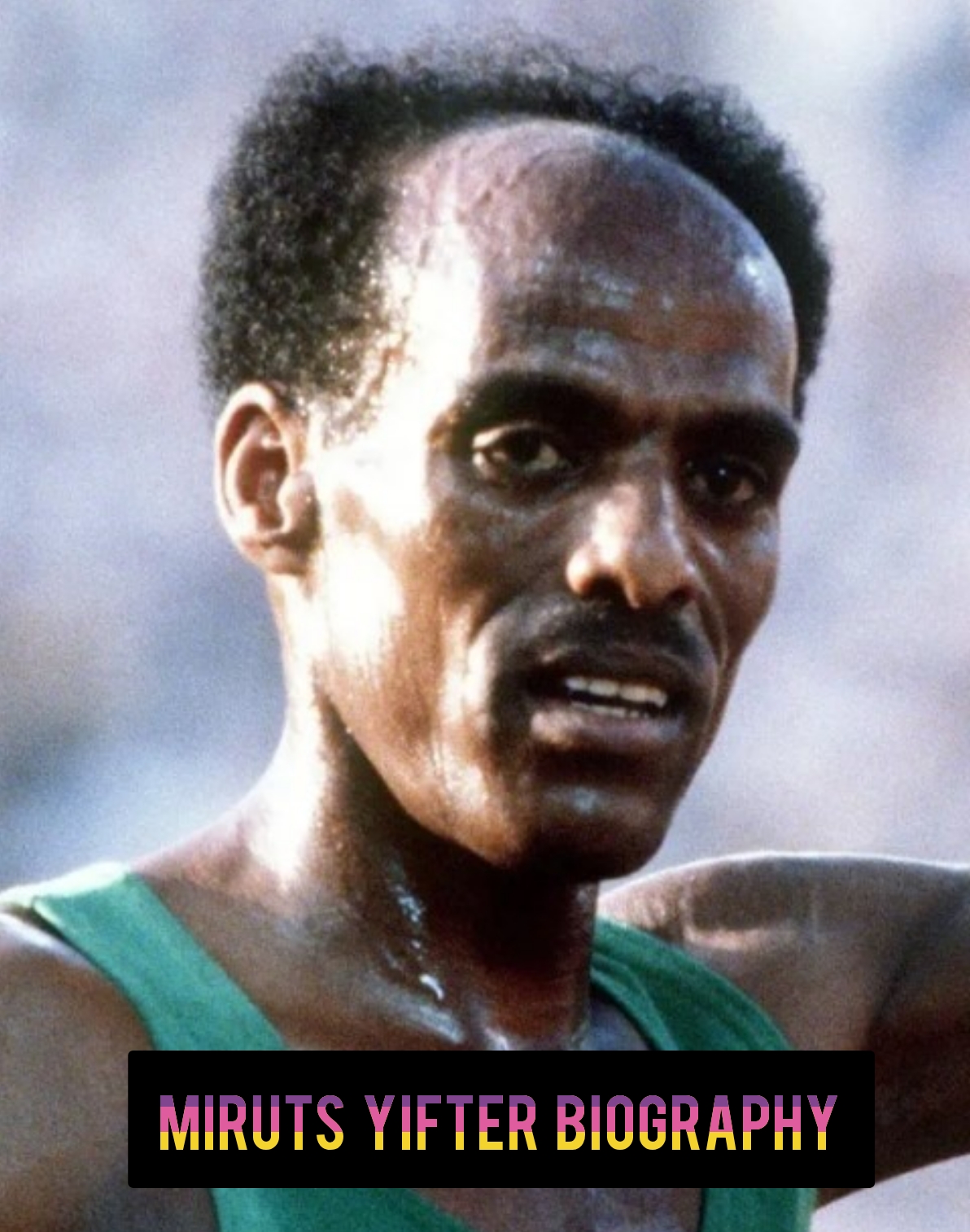
Miruts Yifter Biography
Miruts Yifter once stunned the world by winning Olympic gold medals in both the 5000 meters and 10000 meters at the age of what many believed was nearly forty, using a sudden and devastating burst of speed that left rivals helpless in the final stretch. That explosive change of pace earned him the lasting nickname Yifter the Shifter and turned a humble man from northern Ethiopia into a global sporting icon.
Miruts Yifter stands as one of the most remarkable long distance runners in Olympic history. Born in rural Ethiopia and shaped by hard physical labor, he rose through the ranks of the Ethiopian Air Force to become a double Olympic champion at the 1980 Moscow Games. His career featured triumph, mystery, political obstacles, and an enduring influence on the generations of Ethiopian athletes who followed. This biography traces his journey from the highlands of Tigray to the Olympic podium and beyond, capturing the determination and quiet strength that defined him.
Miruts Yifter Early Life
Miruts Yifter was born on 15 May 1944 in the Tigray region of northern Ethiopia, near the town of Adigrat or in the area of Zalambessa. Exact records from that time and place remain scarce, and Yifter himself later spoke with deliberate vagueness about his age. He once told reporters that men might steal his chickens or his sheep, but no man could steal his age. Official documents and most athletics records list the 1944 date, though some earlier accounts suggested he might have been born as early as 1938. What is certain is that he grew up in a rural highland community where daily life demanded physical endurance.
As a boy he walked long distances to school across the rolling hills of Tigray. Those walks and the simple games of childhood formed the first foundation of his stamina. Formal education was limited. Family circumstances required him to contribute to the household early. He worked in local factories and later as a carriage driver, jobs that involved long hours of physical effort under the strong African sun. The work built a lean and resilient frame. At full height he stood only about 162 centimeters and weighed around 53 kilograms, yet his body possessed unusual power for sustained running.
His path into organized athletics began almost by chance. While living in Asmara he watched members of the Ethiopian Air Force training. Impressed by their speed, he asked the team leader if he could join a practice session. Allowed to run, he finished surprisingly high and immediately attracted attention. Officers recognized his natural talent and helped him enlist in the Air Force. He transferred to the base at Debre Zeit near Addis Ababa, where structured training and better nutrition became available. In the military environment his ability flourished. He advanced in rank over the years and eventually served as a captain and physical instructor. The Air Force provided both a career and the platform that launched him onto the national and then international stage.
Those early years of manual labor and military discipline shaped a quiet, determined character. Yifter rarely sought the spotlight. He preferred to let his running speak. The combination of highland upbringing, hard physical work, and the disciplined life of the Air Force created the foundation for one of the most dramatic careers in distance running.
Miruts Yifter Personal Life
Away from the track Miruts Yifter lived a private and family centered life. He married and became the father of seven children. Most of his sons and daughters later settled outside Ethiopia. Family members described him as a devoted husband and father who valued closeness despite the demands of his athletic career and later his coaching work. In later years he was also a grandfather to nine grandchildren. Those who knew him spoke of a man who remained humble even after Olympic glory. He took quiet pride in a gold wedding ring he often wore and maintained strong bonds with his wife and children.
Yifter’s personal interests stayed close to the simple rhythms of daily life. Running itself remained central even after retirement. He continued to coach young athletes and found satisfaction in guiding others. When political difficulties in Ethiopia grew severe in the late 1990s, he sought a new home in Canada. He settled first in the Ottawa area and later lived in Toronto. There he coached university runners and Ethiopian community clubs, sharing the knowledge gained over decades of elite competition. He adapted to a colder climate and a different culture while remaining deeply connected to his Ethiopian roots.
Lesser known aspects of his character included a dry sense of humor and a strong sense of national pride that never turned into political ambition. He preferred the role of athlete and later mentor over any public office. Friends and family noted that he faced personal setbacks with the same quiet resolve he showed on the track. Respiratory problems troubled him in his final years, yet he continued to offer encouragement to younger runners whenever possible. His personal life reflected the same qualities that defined his racing: patience, resilience, and a steady focus on what truly mattered.
Miruts Yifter Rise to Prominence
Miruts Yifter’s rise began in the late 1960s when Ethiopian coaches noticed his performances in military competitions. He was considered for the national team preparing for the 1968 Mexico City Olympics, though he did not compete there. His first major international exposure came in 1971 at a dual meet between the United States and Africa held in Durham, North Carolina. In the 5000 meters he led for much of the race but miscounted the laps and began his finishing kick one circuit too soon. American runner Steve Prefontaine took advantage and won. The next day Yifter bounced back strongly, defeating Frank Shorter over 10000 meters. The meet announced his arrival on the world stage and revealed both his talent and the occasional lack of experience with international race procedures.
The following year brought his Olympic debut at the 1972 Munich Games. In the 10000 meters he ran with composure and claimed the bronze medal behind Finland’s Lasse Viren and another competitor. The performance marked Ethiopia’s first Olympic bronze in the event and confirmed Yifter as a serious contender. He had also qualified for the 5000 meters final, yet he never reached the starting line. Accounts differ on the reason. Some blame a coaching error that left him waiting too long. Others mention stadium security delays or simple confusion in the corridors of the Olympic stadium. Whatever the cause, the missed race became a painful early setback.
Despite the disappointment, Yifter continued to improve. At the 1973 All Africa Games in Lagos he won gold in the 10000 meters and silver in the 5000 meters. Through the mid 1970s he collected victories on the international circuit. He set a world best for the half marathon of 1 hour 2 minutes 57 seconds in Coamo, Puerto Rico, in February 1977. That same year and again in 1979 he completed rare doubles at the IAAF World Cup, winning both the 5000 and 10000 meters. In 1979 at the inaugural African Championships in Dakar he again took gold in both distances. These consistent performances established him as Africa’s premier distance runner and built anticipation for the next Olympic opportunity.
Miruts Yifter Major Achievements
The pinnacle of Miruts Yifter’s career arrived at the 1980 Moscow Olympics. Ethiopia had boycotted the 1976 Montreal Games along with many other African nations, so the Moscow stage represented a long delayed chance at gold. In the 10000 meters final Yifter stayed patient through the early stages. With roughly 300 meters remaining he unleashed his famous shift of speed, surging past the field and winning by a clear margin of about ten meters. The time was 27 minutes 42.69 seconds. Five days later he lined up for the 5000 meters. In the final lap he found himself boxed in by competitors. His Ethiopian teammate Mohamed Kedir, running on the inside, stepped aside to open a path. Yifter shifted once more, covering the last 200 meters in approximately 27.2 seconds and claiming gold in 13 minutes 20.91 seconds. He became only the fourth man in Olympic history to complete the 5000 and 10000 meters double at a single Games, and the first Ethiopian to win two gold medals at one Olympics.
Beyond the Olympic titles, Yifter’s record includes multiple continental and world level successes. He contributed to Ethiopia’s team gold medals at the 1982 and 1983 World Cross Country Championships. His personal bests stood at 13 minutes 13.82 seconds for 5000 meters, set in 1977, and 27 minutes 40.96 seconds for 10000 meters, recorded at the 1972 Olympics. The half marathon world best of 1977 further demonstrated his range. These achievements came at a time when Ethiopian distance running was still building its modern reputation after the marathon successes of Abebe Bikila and Mamo Wolde. Yifter’s double gold in Moscow inspired a new wave of athletes. Haile Gebrselassie later said that hearing radio reports of Yifter’s victories as a young boy made him want to become a runner. The same inspiration reached Kenenisa Bekele and many others who carried Ethiopian dominance forward into the next decades.
Yifter’s racing style itself became part of his achievement. Rather than leading from the front, he conserved energy and relied on an abrupt, powerful acceleration in the closing stages. Opponents learned to fear the moment when the short, balding figure in the Ethiopian vest suddenly changed gears. That signature move, repeated with clinical precision in Moscow, secured his place among the greats of the sport.
Miruts Yifter Challenges and Setbacks
Success never came without obstacles for Miruts Yifter. The missed 5000 meters final in Munich 1972 haunted him. Upon returning home he faced criticism and, according to some accounts, a period of imprisonment ordered by authorities disappointed by the lack of gold medals. He was released after a short time, yet the episode left a mark. Four years later the African boycott of the Montreal Olympics removed another chance at Olympic glory when he was near his competitive peak. He watched from afar as other runners claimed the medals he had trained for.
Political turbulence in Ethiopia continued to affect his life after the Moscow triumphs. In the years that followed he lost a national coaching position. He later stated that security forces had assaulted him because of his stance against certain ethnic policies. These difficulties, combined with ongoing instability, led him to leave Ethiopia in the late 1990s and seek refuge in Canada. Adjusting to a new country, a different language, and a colder climate presented fresh challenges, yet he met them with the same steady determination that marked his racing.
Even the mystery of his exact age became a recurring source of speculation and sometimes mild frustration for journalists. Yifter refused to resolve the question, treating it as a private matter. Respiratory illness troubled his later years. He spent months in hospital in Toronto with a collapsed lung before his death on 22 December 2016 at the age of 72. Each setback, whether on the track, in politics, or in health, tested him. He responded by continuing to run, to coach, and to support his family, turning adversity into quiet endurance.
Miruts Yifter Legacy
Miruts Yifter died in Toronto on 22 December 2016 after months of respiratory complications. His body was returned to Ethiopia and buried at the Holy Trinity Cathedral cemetery in Addis Ababa, a place of honor for national figures. Tributes poured in from across the athletics world. Haile Gebrselassie called him the reason for his own career and struggled with emotion when speaking of the man he had admired since childhood. The Ethiopian Athletics Federation and international bodies remembered him as a pioneer who proved that Ethiopian runners could conquer both the 5000 and 10000 meters on the Olympic stage.
His influence continues through the athletes he inspired and the coaches he trained. The double gold of 1980 remained unmatched by an Ethiopian man until Kenenisa Bekele achieved the same feat in 2008. Yifter’s nickname and racing style became part of the folklore of distance running. Young runners still study the way he waited patiently before exploding into the lead. In Canada he left a quieter legacy through university and community coaching, helping a new generation of athletes from various backgrounds. In Ethiopia he is remembered as a national hero whose achievements brought pride during difficult political times.
Today his story is told in athletics histories, Olympic documentaries, and the personal recollections of those who watched him race. The image of the short, powerful figure shifting gears in the final meters of the Moscow 10000 meters remains one of the defining moments of the 1980 Games. His life demonstrates that greatness can emerge from humble beginnings and that setbacks need not define a career.
The story of Miruts Yifter reminds us that true champions are measured not only by medals but by the resilience they show when the path is blocked. From the hills of Tigray to the Olympic stadium in Moscow and finally to a quiet life of coaching in Canada, he ran with purpose and finished with honor. His example continues to encourage anyone who faces long odds and still chooses to keep moving forward.
FAQs
What was Miruts Yifter’s nickname and why?
Miruts Yifter earned the nickname Yifter the Shifter because of his sudden and powerful change of pace in the final stages of races. He would stay with the pack for most of the distance and then accelerate dramatically in the last 300 meters or so, often leaving competitors unable to respond.
When and where was Miruts Yifter born?
Most official records list his birth date as 15 May 1944 in the Tigray region of northern Ethiopia, near Adigrat or Zalambessa. Some earlier sources suggested 1938, and Yifter himself preferred not to confirm an exact age.
What Olympic medals did Miruts Yifter win?
He won a bronze medal in the 10000 meters at the 1972 Munich Olympics and gold medals in both the 5000 meters and 10000 meters at the 1980 Moscow Olympics.
Why did Miruts Yifter miss the 5000 meters at the 1972 Olympics?
He qualified for the final but never appeared at the starting line. Explanations vary and include a coaching error, delays caused by stadium security, or confusion inside the Olympic stadium. The exact reason has never been fully clarified.
How many children did Miruts Yifter have?
He was the father of seven children. Most of them lived outside Ethiopia in his later years.
When and where did Miruts Yifter die?
He died on 22 December 2016 in Toronto, Canada, at the age of 72 after suffering from respiratory problems that included a collapsed lung.
Did Miruts Yifter inspire other famous runners?
Yes. Haile Gebrselassie has publicly stated that hearing about Yifter’s victories as a child inspired him to become a runner. Many later Ethiopian champions have cited Yifter as an important influence.
Where is Miruts Yifter buried?
His remains were returned to Ethiopia and interred at the Holy Trinity Cathedral cemetery in Addis Ababa.