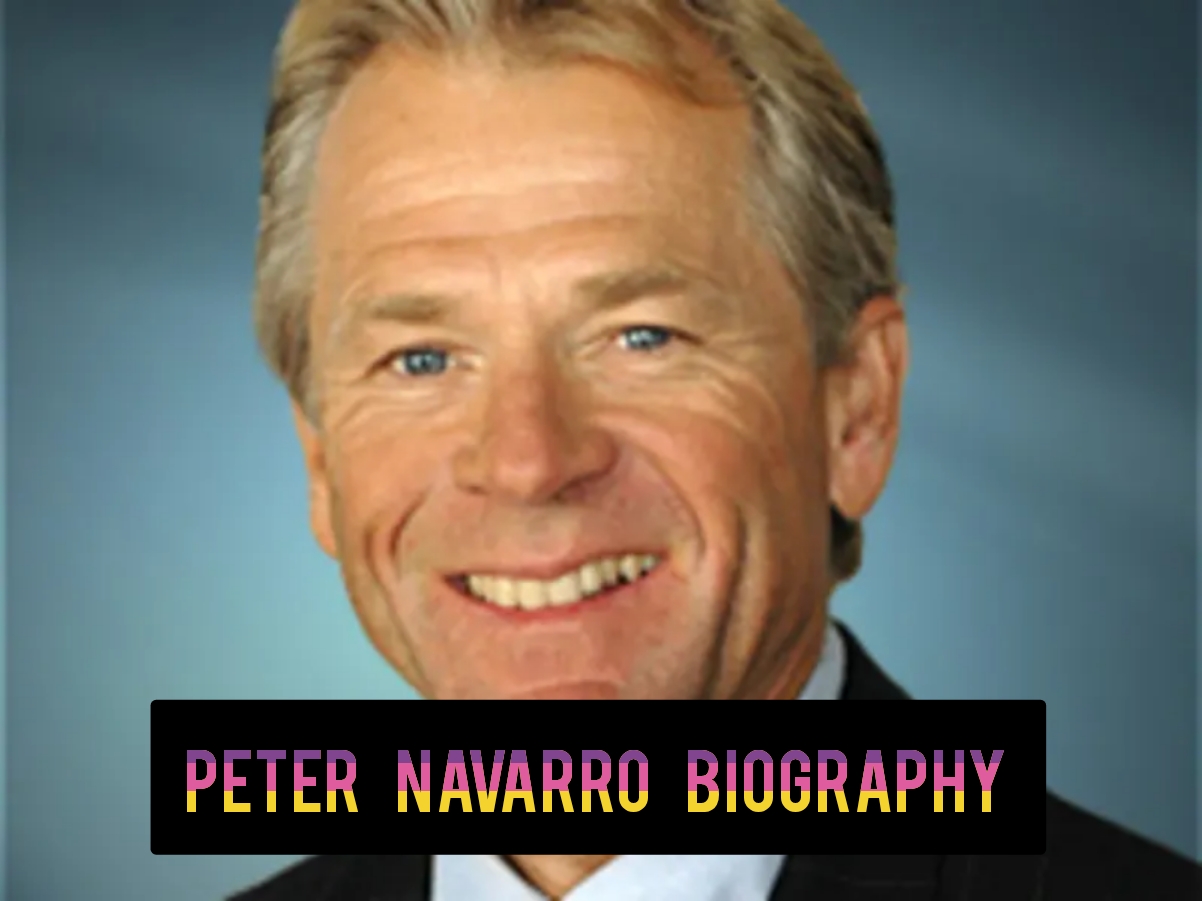
Peter Navarro Biography
Peter Navarro stands as one of the most influential and polarizing figures in modern American economic policy. As a Harvard trained economist, longtime university professor, prolific author, and senior adviser to President Donald Trump across two administrations, Navarro has shaped debates on trade, manufacturing, and relations with China in ways that continue to ripple through global markets and domestic politics. His journey from a working class childhood and idealistic Peace Corps volunteer to a central architect of protectionist policies offers a compelling study in evolving convictions, personal resilience, and the intersection of academia and power.
Peter Navarro An Interesting Fact
Few details about Peter Navarro capture the unconventional streak in his character quite like the revelation that he invented an expert named Ron Vara to quote in several of his books. Ron Vara, an anagram of Navarro’s own surname, appeared more than a dozen times across multiple volumes dispensing sharp commentary on topics ranging from investment strategy to the dangers of Chinese goods. Navarro later acknowledged the figure as a literary device and inside joke rather than a real person. This creative flourish, uncovered years after the books reached readers, underscores a willingness to blend narrative flair with economic argument that set him apart from more conventional academics and foreshadowed the bold, often confrontational style he would bring to the highest levels of government.
Peter Navarro Early Life
Peter Kent Navarro was born on July 15, 1949, in Cambridge, Massachusetts. His father, Alfred “Al” Navarro, worked as a professional saxophonist and clarinetist who led a house band performing at resort hotels. The family followed seasonal gigs, spending summers in New Hampshire and winters in Florida. His mother, Evelyn Littlejohn, later worked as a secretary and then a manager at a Saks Fifth Avenue store. When Navarro was about nine or ten years old, his parents divorced. He and his older brother were raised primarily by their mother in modest circumstances.
The family lived for a time in a garage apartment in Palm Beach, Florida, not far from the Kennedy family compound and the estate that would later become Mar a Lago. Navarro has recalled riding his bicycle along the sandy beaches during those years. Later the family moved to Bethesda, Maryland, where they shared a one bedroom apartment. As a teenager Navarro became a classic latchkey child. He worked multiple jobs, including pumping gas, and learned to prepare many of his own meals. He has described those years as formative, teaching him self reliance and the ability to survive on his own. At Bethesda Chevy Chase High School he played guard on the basketball team and also developed skills as a football placekicker.
Academically strong, Navarro earned a full academic scholarship to Tufts University in Medford, Massachusetts. He graduated in 1972 with a Bachelor of Arts degree. Immediately afterward he joined the United States Peace Corps and spent three years serving in Thailand as a teacher. During holiday breaks he traveled extensively through the region, visiting Laos, South Korea, Japan, India, Burma, and Malaysia. The experience left a lasting impression. In later interviews he has spoken of feeling like a small speck in a sea of humanity, an encounter with poverty and different cultures that instilled humility and sharpened his interest in global economic forces.
Upon returning to the United States, Navarro pursued advanced studies at Harvard University. He earned a Master of Public Administration from the John F. Kennedy School of Government in 1979. He continued at Harvard for a doctorate in economics, completing his Ph.D. in 1986 under the supervision of economist Richard E. Caves. His dissertation examined the theoretical and empirical motives behind corporate charitable giving. During his doctoral years he also worked as a research associate at Harvard’s Energy and Environmental Policy Center from 1981 to 1985, focusing on energy regulation and environmental policy.
Peter Navarro Personal Life
Peter Navarro’s personal life has unfolded largely outside the intense public scrutiny that later surrounded his political roles. In 2001 he married Leslie Lebon, a California architect who had previously been married and had a son named Alexander from that earlier relationship. The couple made their home in Laguna Beach, California, purchasing and renovating a sizable house with ocean views. Lebon oversaw much of the remodeling. They lived there while Navarro taught at the University of California, Irvine. The marriage lasted nearly two decades before ending in divorce, finalized on December 31, 2020, after a separation that began in 2018. The settlement involved an equal division of certain assets, including interests in Navarro’s books and pension benefits, with both parties waiving spousal support.
In the years following the divorce, Navarro began a relationship with Bonnie Brenner, whom he met in the corridor of their Washington, D.C., apartment building. Brenner, who had worked for decades as an assistant to senior banking executives, became a steadfast presence during Navarro’s legal challenges. The couple became engaged around 2023 or 2024 and appeared together at the 2024 Republican National Convention shortly after his release from prison. They married at Mar a Lago in March 2026. During his incarceration, Brenner provided emotional support through letters and visits, and the couple later co authored a book reflecting on that period, framing it as both a personal love story and a broader commentary on the justice system.
Navarro has long maintained an active lifestyle centered on outdoor exercise and physical fitness. He has been an avid cyclist, bodysurfer, paddle boarder, and cold water plunger. He competed in triathlons and valued swimming, once noting that he missed the Olympic size pool at the University of California, Irvine campus more than any other aspect of academic life. Earlier interests included windsurfing during time spent on Cape Cod. These pursuits reflect a disciplined approach to health that has accompanied him through demanding professional chapters. He has also shown a practical side, once renovating a Victorian building in Cambridge as a young man, an experience he later described as an early lesson in economics.
Lesser known aspects of his character include a love of language that favors muscular or militaristic phrasing and a history of hands on engagement with projects, whether remodeling homes or drafting policy. He has kept a relatively private profile regarding family beyond the public records of his marriages, preferring to focus public attention on policy rather than personal details.
Peter Navarro Rise to Prominence
Navarro’s path to national influence began in the realms of policy analysis and academia rather than electoral politics. After his Peace Corps service and early graduate work, he held positions as a policy analyst with the Urban Services Group, the Massachusetts Energy Office, and the United States Department of Energy. These roles centered on energy and environmental issues. He then moved into teaching, first at the University of California, San Diego, and the University of San Diego, before joining the faculty at the University of California, Irvine, in 1989 as a professor of economics and public policy at the Paul Merage School of Business. He remained there for more than two decades, eventually becoming professor emeritus, and earned multiple teaching awards for his MBA courses.
During these years Navarro published extensively. Early books such as The Policy Game in 1984 examined how special interests shaped American policy and included arguments defending free trade principles. He wrote investment guides like If It’s Raining in Brazil, Buy Starbucks and The Well Timed Strategy, offering practical advice on market cycles. His research covered energy policy, deregulation, and corporate behavior.
Political ambition surfaced in San Diego, where Navarro became active in local environmental and growth management causes. He opposed large scale development that he believed threatened the city’s character. Running as a Democrat or independent, he sought office multiple times. In 1992 he advanced in the primary for mayor of San Diego but lost the general election. In 1996 he ran for the U.S. House of Representatives in California’s 49th district, speaking at the Democratic National Convention in support of the Clinton Gore ticket, yet lost that race as well. Additional campaigns for city council seats also ended in defeat. These experiences, while unsuccessful at the ballot box, honed his public communication skills and revealed a persistent drive for influence.
A significant shift occurred in the early 2000s. Observing that many of his MBA students struggled to find or keep good jobs, Navarro concluded that competition from China played a central role. China’s entry into the World Trade Organization in 2001 accelerated this change in perspective. He began writing critically about Chinese trade practices, currency policies, intellectual property issues, and labor conditions. Books such as The Coming China Wars in 2006, Death by China in 2011, co authored with Greg Autry, and Crouching Tiger in 2015 established him as a prominent China hawk. The documentary adaptation of Death by China, narrated by Martin Sheen, further amplified his message. Donald Trump publicly praised the film, creating an early connection.
The breakthrough arrived during the 2016 presidential campaign. Jared Kushner, impressed by Death by China, brought Navarro onto the Trump team as a trade adviser. Navarro helped shape campaign rhetoric on globalization and manufacturing decline. After the election he joined the administration, first as director of the newly created White House National Trade Council and later as director of the Office of Trade and Manufacturing Policy. This role placed him at the center of trade policy formulation and marked his transition from academic commentator to high level decision maker.
Peter Navarro Major Achievements
Navarro’s most visible achievements center on his contributions to American trade policy and his body of written work. In the first Trump administration he served as a principal advocate for tariffs on Chinese goods and for measures aimed at revitalizing domestic manufacturing. He pushed for stronger enforcement against intellectual property theft, currency manipulation, and other practices he viewed as unfair. During the COVID 19 pandemic he took on additional responsibilities as Defense Production Act policy coordinator, working to accelerate production of medical supplies and equipment. His influence helped elevate manufacturing and supply chain resilience as national priorities.
As an author, Navarro has produced more than a dozen books spanning investment strategy, economic policy, and geopolitical analysis. Titles such as Seeds of Destruction, co authored with Glenn Hubbard, and his China focused trilogy reached wide audiences and influenced public discourse. He has also written memoirs reflecting on his White House years, including In Trump Time and Taking Back Trump’s America. His academic output includes peer reviewed articles on energy, charity, deregulation, and related topics. At the University of California, Irvine, he received multiple teaching awards recognizing excellence in MBA instruction.
In the second Trump administration, beginning in 2025, Navarro returned as senior counselor for trade and manufacturing. He has played a central role in advancing broad tariff policies, including measures targeting Canada, Mexico, China, and other partners, as well as efforts to close loopholes on low value imports. He has publicly defended these approaches as tools for negotiating better deals, encouraging domestic investment, and addressing strategic dependencies. Supporters credit him with keeping manufacturing and fair trade at the forefront of the national agenda even amid market volatility and internal debates.
Beyond specific policies, Navarro’s impact lies in shifting the Overton window on protectionism. Once a defender of free trade principles, he became a leading voice arguing that unfettered globalization had hollowed out American industry and communities. His persistence helped mainstream concerns about China that many mainstream economists had downplayed for years. Teaching awards and a long academic career further underscore his ability to communicate complex ideas to students and the broader public.
Peter Navarro Challenges and Setbacks
Navarro’s career has included repeated obstacles that tested his resolve. Early political campaigns in San Diego ended in a series of losses despite strong primary showings and high profile endorsements. These defeats, occurring while he balanced a full time faculty position, could have ended his ambitions for public office. Instead he channeled the experiences into writing and policy advocacy, using books and media appearances to build influence outside elected roles.
A more public controversy emerged around the fictional Ron Vara citations in his books. When the invention became widely known, critics questioned his scholarly rigor. Navarro addressed the matter by describing it as a stylistic choice rather than deception intended to mislead on substantive points. The episode nevertheless provided ammunition for opponents who sought to undermine his credibility as an economist.
The most significant legal challenge arose after the 2020 election. Navarro advanced theories of election irregularities and outlined strategies, including the so called Green Bay Sweep, aimed at delaying certification of results. When the House select committee investigating the January 6, 2021, Capitol events issued subpoenas for documents and testimony, he refused to comply, citing executive privilege and other protections. He was indicted on two counts of contempt of Congress, convicted in 2023, and sentenced in 2024 to four months in federal prison along with a fine. At age 74 he reported to a prison camp in Miami in March 2024. He completed the sentence and was released in July 2024, traveling almost immediately to speak at the Republican National Convention.
Throughout the legal process Navarro maintained that he was defending constitutional principles and refusing to betray the president he served. The experience, which he and Bonnie Brenner later chronicled in a joint book, tested personal relationships and public standing. Yet upon release he reentered political life without apparent diminishment of influence within Trump circles. Market reactions and criticism from economists and business leaders during the implementation of aggressive tariffs in 2025 presented further professional headwinds. Navarro has responded by emphasizing long term strategic gains over short term volatility and by highlighting subsequent trade negotiations as validation of the approach.
These setbacks, from electoral losses to public scrutiny to incarceration, reveal a pattern of adaptation. Rather than retreat, Navarro has consistently returned to advocacy, writing, and advisory roles, using adversity to reinforce his narrative of principle over convenience.
Peter Navarro Legacy and Current Status
As of 2026 Peter Navarro continues to serve as senior counselor for trade and manufacturing in the second Trump administration. He remains a visible public voice, appearing on media programs, writing opinion pieces, and advancing arguments for tariffs, supply chain repatriation, and a competitive posture toward China. Recent activities include defending tariff policies in the face of market fluctuations, supporting legislative efforts related to customs valuation, and framing U.S. China economic relations as a form of cold war competition that requires sustained strategic response.
His legacy is still taking shape and remains contested. Admirers view him as a truth teller who diagnosed the costs of offshoring and Chinese economic practices earlier and more forcefully than many peers. They credit him with helping restore manufacturing discourse to the center of American politics and with providing intellectual scaffolding for policies that prioritize domestic production and worker interests. Critics, including many mainstream economists, regard his views as outside the professional consensus, arguing that broad tariffs raise costs for consumers and risk retaliatory measures that harm growth. The use of a fictional expert and his role in post 2020 election challenges have further polarized assessments of his judgment.
Regardless of viewpoint, Navarro’s influence is undeniable. He helped move trade policy from a technocratic consensus favoring liberalization toward a more contested, nationalist orientation. His books and documentary work reached audiences beyond academic circles. His return to high office after prison illustrates both personal durability and the enduring appeal of his message within a significant segment of the political spectrum. Ongoing debates over tariffs, rare earth supply chains, and industrial policy ensure that his ideas will continue to be tested in real time.
Conclusion
Peter Navarro’s life illustrates how personal experience, intellectual evolution, and political opportunity can converge to reshape national policy. From a latchkey childhood and Peace Corps service in Thailand to the corridors of the White House, he has pursued a consistent interest in the forces that determine economic outcomes for ordinary Americans. Whether history ultimately judges his tariff centered vision as visionary or costly, his story demonstrates the power of persistence in the face of repeated setbacks and the capacity of an individual to alter the terms of a major policy debate.
FAQs
Who is Peter Navarro?
Peter Navarro is an American economist, author, and political adviser who has served as a senior trade and manufacturing counselor to President Donald Trump in both of his administrations. He previously taught economics and public policy at the University of California, Irvine, for more than twenty years and has written extensively on China, trade, and investment strategy.
When and where was Peter Navarro born?
Peter Navarro was born on July 15, 1949, in Cambridge, Massachusetts.
What is Peter Navarro’s educational background?
He earned a Bachelor of Arts from Tufts University in 1972, a Master of Public Administration from Harvard University’s Kennedy School in 1979, and a Ph.D. in economics from Harvard in 1986.
What roles has Peter Navarro held in the Trump administrations?
In the first term he directed the White House National Trade Council and later the Office of Trade and Manufacturing Policy. In the second term, beginning in 2025, he has served as senior counselor for trade and manufacturing.
Why was Peter Navarro sentenced to prison?
He was convicted of contempt of Congress for refusing to comply with subpoenas from the House committee investigating the January 6, 2021, Capitol events. He served a four month sentence in 2024.
Is Peter Navarro currently married?
Yes. After a previous marriage to Leslie Lebon that ended in 2020, he married Bonnie Brenner in March 2026.
What are some of Peter Navarro’s best known books?
Notable titles include The Coming China Wars, Death by China, Crouching Tiger, and memoirs such as In Trump Time and Taking Back Trump’s America.
How did Peter Navarro’s views on trade evolve?
Early in his career he defended free trade principles. Later observations about the impact of Chinese competition on American jobs and industry led him to advocate strong protectionist measures and tariffs.