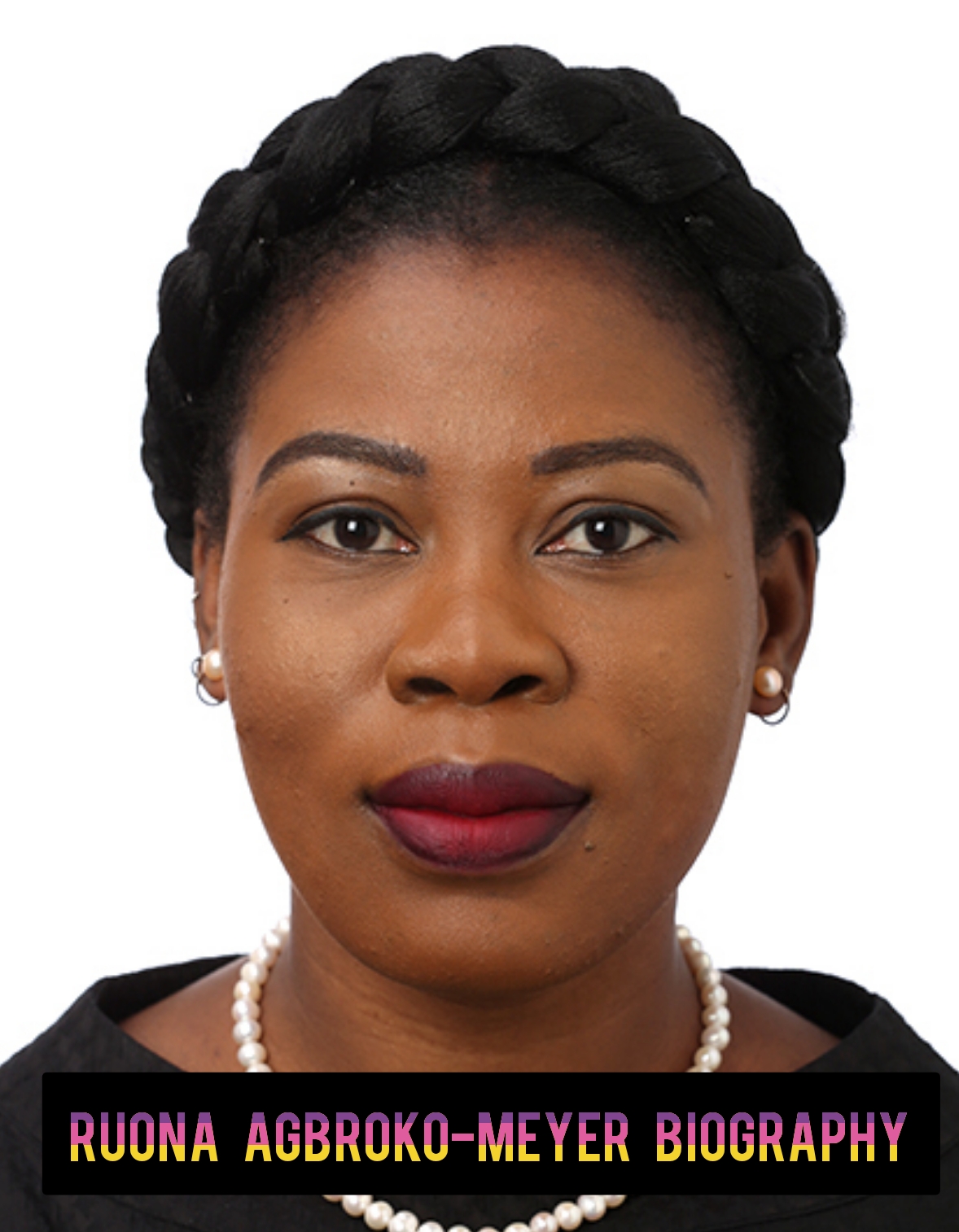
Ruona Agbroko-Meyer Biography
Ruona Agbroko-Meyer stands as one of Nigeria’s most determined investigative journalists, a storyteller whose work has crossed continents and forced real change in policy and public awareness. From her roots in a family steeped in the dangers and duties of the press to her breakthrough reporting that reached global screens, she has built a career defined by courage, precision, and a refusal to accept easy answers. Her reporting has appeared in major outlets across Africa and Europe, earned her historic nominations, and inspired a new generation of reporters who see African stories told with African voices at the center.
What makes her path especially striking is that she once nearly walked away from journalism entirely, only to return stronger after personal loss and deliberate reinvention. That decision to keep going would later produce one of the most impactful documentaries of its decade.
Ruona Agbroko-Meyer Early Life
Ruona Agbroko-Meyer was born in 1982 in Benin City, the capital of Edo State in southern Nigeria. She was one of five children raised by Rachel and Godwin Agbroko. Her father worked as a respected journalist and later served as chairman of the editorial board at This Day newspaper. He covered politics, business, and development with a clarity that often put him at odds with those in power. Under the military regime of General Sani Abacha he was arrested more than once for his outspoken reporting. In 1997 he received the PEN Barbara Goldsmith Freedom to Write Award, an international recognition of the risks he took to keep information flowing in a country where free expression was frequently under threat.
The Agbroko household was filled with newspapers, late night discussions, and the constant awareness that words carried weight. Young Ruona absorbed that atmosphere. At the age of thirteen she told her father she wanted to choose arts subjects in secondary school so she could follow him into journalism. He refused. He had seen colleagues imprisoned and impoverished. He wanted his daughter safe and financially secure, so he steered her toward the sciences. She studied biology and chemistry and eventually entered the Microbiology department at the University of Lagos.
University life proved difficult. Ruona later described spending years in a course she never truly liked. She would sit in laboratories shaking test tubes while her mind stayed fixed on storytelling. At one point she stopped attending classes altogether and focused on writing. Her first published byline appeared in This Day on 12 June 2003, a weekly column that began after her father discovered a notebook of her writings and a colleague, Simon Kolawole, encouraged its publication. She continued freelancing even while still registered as a student. After her father’s death she returned under family pressure, completed the degree, and graduated with a third class result. The academic record was modest, yet the practical experience she had already gathered proved far more valuable.
Tragedy struck the family on 22 December 2006. Unknown gunmen shot and killed Godwin Agbroko as he returned home from work. The murder has never been solved. For Ruona the loss was both personal and professional. Her father had tried to protect her from the very dangers that claimed his life. In the years that followed she would turn that grief into a deeper commitment to the craft he had practiced.
She left Nigeria for further study. At the University of the Witwatersrand in Johannesburg she completed a postgraduate degree in Journalism and Media Studies, finishing with distinction. She also contributed to the department’s blog. Later she earned a Master of Arts in Broadcast Journalism from the University of Westminster in London. These qualifications gave her technical range across print, radio, and television. They also confirmed what her early columns had already shown: she possessed the curiosity and discipline required for serious reporting.
Ruona Agbroko-Meyer Personal Life
Ruona Agbroko-Meyer married in 2011 and took her husband’s surname, becoming known professionally for a time as Ruona Agbroko-Meyer and later as Ruona J. Meyer. The couple has kept the details of their private life carefully guarded, a common choice among investigative journalists who face occasional threats. Public records indicate she holds both Nigerian and German citizenship and has lived in Trier, Germany, since 2015. She continues to identify strongly with her Nigerian roots while building a professional life that spans Europe.
She has spoken sparingly about family, preferring to keep children and domestic matters out of the public eye. What is known is that she maintains close ties with relatives who have supported her through demanding periods of travel, research, and health challenges. In late 2019 she received a diagnosis of Herceptin positive DCIS breast cancer. Symptoms had been present for months. She pressed doctors for proper tests after initial delays and began chemotherapy in early 2020, the same period she was due to begin PhD work in Leicester. Her supervisors at De Montfort University kept her scholarship in place. She rearranged treatment schedules around award travel and continued writing and researching. The episode reinforced her belief that individuals must advocate for themselves within medical systems, a lesson she has shared publicly with quiet resolve.
Outside of work she values clear communication and practical self reliance. She has written about refusing to blame external forces for personal setbacks, insisting instead that people make deliberate choices about their futures. That outlook shapes both her private resilience and her professional ethic. She remains an active mentor to younger reporters, often emphasizing the importance of craft, verification, and ethical boundaries over shortcuts or excuses.
Ruona Agbroko-Meyer Rise to Prominence
Ruona’s professional journey began in Lagos newsrooms. After her early columns in This Day she worked with editors and reporters who shaped a generation of Nigerian journalism, among them Simon Kolawole, Paul Ibe, Ijeoma Nwogwugwu, Kadaria Ahmed, and Dele Olojede at the innovative but short lived 234Next newspaper. She covered business, finance, and development with a methodical style that combined scientific training and narrative skill.
A Reuters scholarship took her to South Africa. Between 2010 and 2013 she worked as a markets and finance reporter at the agency’s Africa headquarters. In 2010 she became the sole winner of the Reuters Niall Fitzgerald Prize for Young African Journalists, recognition that opened further doors. She later completed an editorial internship at the Financial Times in London through the Pearson Diversity programme. These roles taught her the discipline of wire reporting, the demands of international audiences, and the value of precise sourcing.
In 2017 she joined the pioneering team that launched the BBC News Pidgin service for West Africa. As a senior broadcast journalist she produced and presented stories that included exclusive access to Nigerian prisons and coverage of migrants fleeing violence in Libya. The experience sharpened her skills in television storytelling and audience engagement across language communities.
The decisive breakthrough arrived in 2018. Commissioned by BBC Africa Eye, she pitched, produced, and presented a one hour undercover documentary titled Sweet Sweet Codeine. The film examined the widespread abuse of codeine based cough syrup in Nigeria, the networks that supplied it, and the human cost among young people. Working with the Africa Eye investigations unit, she navigated significant personal risk to gather evidence. The documentary aired to wide attention. Within days the Nigerian government announced a ban on the manufacture and import of codeine syrup. Civil society groups continued private screenings across the country. The film later won the One World Media Award for Television Documentary and the BBC News Award for Investigation of the Year. In August 2019 it received a nomination for the International Emmy Award in the News and Current Affairs category, the first such nomination for both a Nigerian journalist and the BBC World Service.
That single project elevated her from respected reporter to internationally recognized investigative voice. It also demonstrated that rigorous, solutions oriented journalism from African perspectives could command global platforms and produce measurable policy results.
Ruona Agbroko-Meyer Major Achievements
Beyond the Emmy nomination, Ruona’s body of work includes several landmark investigations. In 2013 the Wole Soyinka Centre for Investigative Journalism named her Investigative Journalist of the Year for reporting that exposed how Nigeria spent millions of public funds on generators for its embassies and missions abroad while basic services at home remained underfunded. The story combined data analysis with on the ground verification and highlighted systemic waste.
Her reporting has appeared in the Financial Times, Reuters, Daily Trust, This Day, Premium Times, Deutsche Welle, El País, and RiffReporter. She has coordinated cross border investigations that examined undeclared assets of legislators in Liberia, questionable contracts in the Nigerian Interior Ministry, and misuse of COVID relief funds in South Africa. As Africa Initiative Manager at the Solutions Journalism Network she designed and delivered climate and gender focused training programmes that reached roughly two thousand journalists and media professionals across newsrooms in Nigeria, Kenya, Uganda, and Rwanda over a three year period.
In November 2024 the University of Bayreuth’s Africa Multiple Cluster of Excellence awarded her a prize in the BIGSAS Journalist Award for outstanding reporting on Africa in German language media. The recognition honored an article on a Senegalese startup producing regional organic baby food and distributing it through social media platforms, a piece that connected African innovation with European audiences. She has served on juries for the Climate Journalism Award of the European Journalism Centre and the IJ4EU Freelancer Support Scheme. Academic contributions include research published in special issues of African Journalism Studies and Journalism, focused on power dynamics inside transcontinental investigative networks.
These achievements rest on a consistent approach: empirical evidence, careful verification, and a preference for stories that illuminate both problems and workable responses. She has trained reporters for organizations including DW Akademie, King’s College London, Media in Cooperation and Transition, and the European Network of Equality Bodies. Her consulting work emphasizes equitable collaboration between African and international newsrooms so that local knowledge is not subordinated to external agendas.
Ruona Agbroko-Meyer Challenges and Setbacks
The path has never been smooth. Early pressure to abandon journalism for science delayed her formal training and left her with a third class degree that she later described as the price of divided attention. Her father’s assassination created both emotional trauma and a public reminder of the profession’s mortal risks. Investigative work itself carries ongoing threats of legal pressure, surveillance, and personal danger, especially when reporting on powerful commercial or political interests.
Health became another formidable obstacle. The 2019 cancer diagnosis arrived just as she prepared to deepen her academic research. Chemotherapy coincided with PhD commitments and award related travel. She has spoken of the need to become her own strongest advocate when medical systems moved slowly. Support from supervisors, family, and colleagues helped her continue working through treatment.
Professional setbacks have included the usual freelancing uncertainties, the challenge of balancing consultancy income with independent reporting, and the occasional editorial disagreement that every careful journalist encounters. She has publicly rejected the tendency among some peers to blame external forces or cultural excuses for stalled careers. Instead she stresses personal responsibility, continuous skill building, and the willingness to start again when necessary. That mindset turned early academic disappointment and family tragedy into fuel for later excellence.
Ruona Agbroko-Meyer Legacy and Current Status
Today Ruona Agbroko-Meyer continues to work as an independent journalist, researcher, and media trainer based in Germany. She remains a PhD candidate at De Montfort University, examining how power operates inside cross border investigative collaborations. In spring 2025 she served as a visiting journalism fellow at Toronto Metropolitan University, exploring how international students and migrants use social media influencers as sources of policy information. Her recent bylines and consulting projects keep her connected to both African and European media ecosystems.
Her influence appears most clearly in the journalists she has trained and the policy changes her reporting has helped trigger. The codeine ban stands as a concrete example of journalism that moved from exposure to action. Younger reporters cite her Emmy nomination as proof that African produced investigations can compete at the highest international level. Her insistence on solutions oriented approaches has encouraged newsrooms to look beyond problem diagnosis toward evidence based responses.
She maintains an active presence as a public speaker at journalism festivals and training events, discussing the ethics of impact focused reporting, the practicalities of cross border collaboration, and the need for greater safety and fair compensation for African journalists. Through board and advisory roles with media development organizations she helps shape funding and training priorities that favor sustainable local capacity.
Conclusion
Ruona Agbroko-Meyer’s story shows that vocation can survive both parental caution and personal catastrophe. She began under pressure to choose a safer path, lost her father to the dangers of the very profession he practiced, and still chose to deepen her commitment. The result has been reporting that informed millions, altered government policy, and expanded the possibilities for African investigative journalism on the world stage. Her career reminds us that careful, courageous storytelling remains one of the most effective tools for accountability and understanding across borders.
FAQs
Who is Ruona Agbroko-Meyer?
Ruona Agbroko-Meyer is a Nigerian German investigative journalist, media trainer, and researcher known for groundbreaking reporting on public health, governance, and development issues. She is the first Nigerian journalist nominated for an International Emmy Award.
What is Ruona Agbroko-Meyer best known for?
She is best known for the 2018 BBC Africa Eye documentary Sweet Sweet Codeine, which exposed widespread codeine syrup addiction in Nigeria and led to a nationwide ban on the product. The film earned her an Emmy nomination and multiple international awards.
Where was Ruona Agbroko-Meyer born and educated?
She was born in Benin City, Nigeria, in 1982. She earned a Bachelor of Science in Microbiology from the University of Lagos, a postgraduate degree in Journalism from the University of the Witwatersrand in South Africa, a Master of Arts in Broadcast Journalism from the University of Westminster in London, and is pursuing a PhD at De Montfort University in the United Kingdom.
Is Ruona Agbroko-Meyer married?
Yes, she married in 2011 and has used the surname Meyer since then. She keeps details of her private family life largely out of the public domain.
What awards has Ruona Agbroko-Meyer received?
Her major recognitions include the Reuters Niall Fitzgerald Prize for Young African Journalists in 2010, Nigerian Investigative Journalist of the Year in 2013, the One World Media Television Documentary Award and BBC News Investigation of the Year Award in 2019, an International Emmy nomination in 2019, and a BIGSAS Journalist Award from the University of Bayreuth in 2024 for outstanding reporting on Africa in German language media.
Where does Ruona Agbroko-Meyer live and work now?
She lives in Germany and works as an independent journalist, consultant, and trainer. She continues academic research, contributes to European and African media outlets, and provides training and diversity consulting for international journalism organizations.