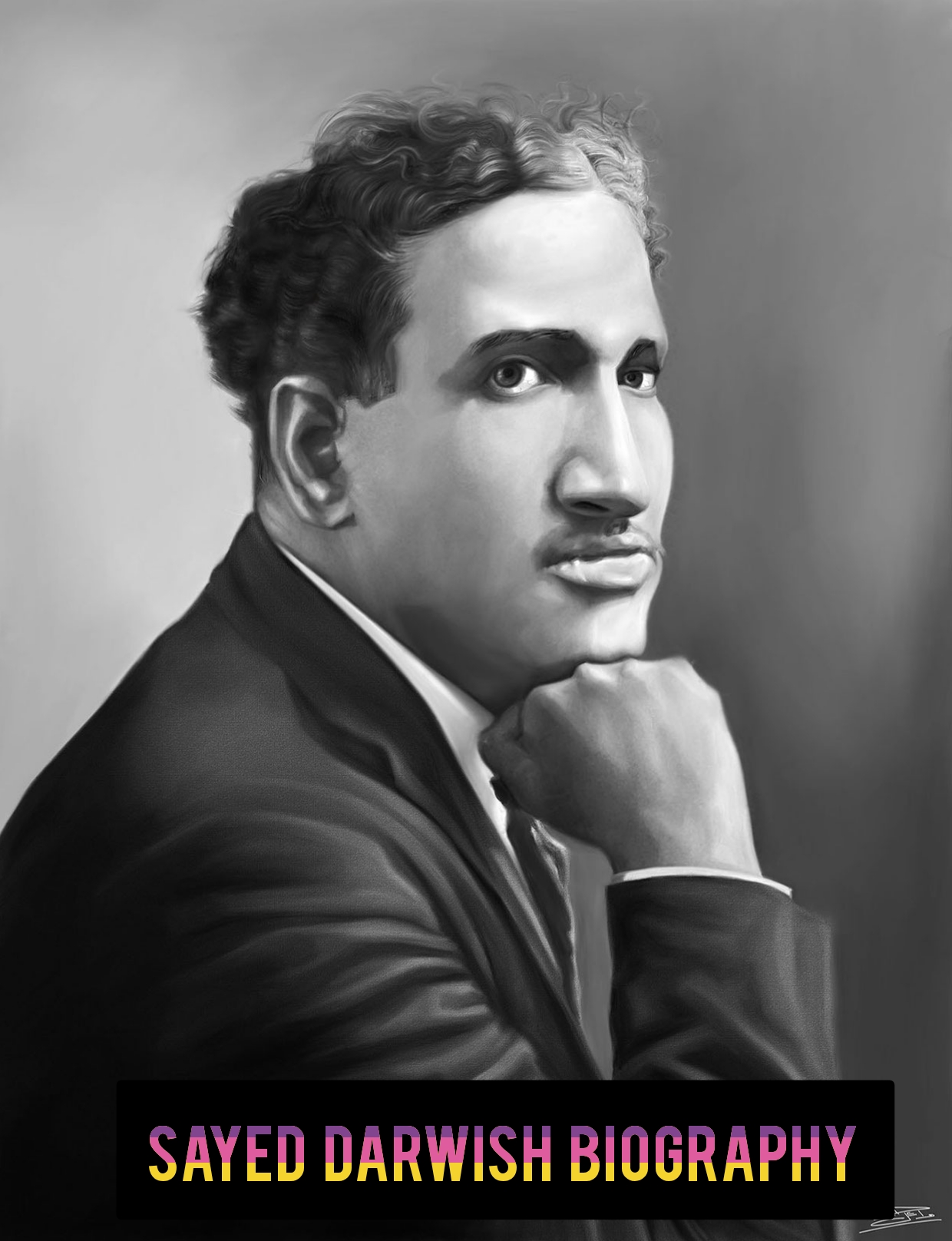
Sayed Darwish Biography
Sayed Darwish stands as one of the most transformative figures in the history of Egyptian and Arab music. In a life that lasted only thirty one years he reshaped the sound of an entire nation, giving ordinary people songs that spoke their language, carried their hopes, and voiced their struggle for independence. His melodies moved from the streets of Alexandria and the stages of Cairo into the heart of Egyptian identity, and one of them became the national anthem that still echoes across the country today.
This biography traces the journey of the man known as the People’s Artist. It explores the poverty that shaped him, the personal relationships that inspired him, the creative breakthroughs that made him famous, the obstacles he faced, and the lasting influence that continues long after his death. The story that follows is both a portrait of a gifted musician and a window into a turbulent period of Egyptian history when art and national awakening walked side by side.
Sayed Darwish Intro
Few artists manage to capture the soul of a nation in the short span of a single decade of mature work. Sayed Darwish did exactly that. Born into poverty and gone before his thirty second birthday, he left behind a body of music so powerful that it still defines Egyptian popular culture more than a century later. His songs mixed the rhythms of everyday life with the longing for freedom, turning the common speech of workers, students, and revolutionaries into unforgettable melodies.
What makes his story especially compelling is the speed and depth of his impact. In an era when classical Arab music remained formal and distant from ordinary listeners, Darwish brought it down to the street, the café, and the theater stage. He wrote for the people and the people answered by singing his tunes in protests, celebrations, and quiet moments of reflection. That rare ability to speak for an entire society is the starting point for understanding why his name still carries such weight.
Sayed Darwish Early Life
Sayed Darwish was born on 17 March 1892 in the working class neighborhood of Kom El Dekka in Alexandria, Egypt. His family lived in modest conditions. His father worked as a carpenter and sometimes as a woodworker making simple household items, while the household struggled to make ends meet. Darwish was one of seven children, and the limited resources of the family meant that formal schooling beyond basic religious instruction was out of reach for most of them.
From an early age he showed a natural gift for music. Family accounts describe him as a child who would imitate the nursery songs his mother sang and later join friends in playful performances after school. Because the family could not afford regular education, he was sent to a local kuttab, a traditional religious school attached to a mosque. There he mastered the art of Quranic recitation under the guidance of skilled teachers. His clear voice and musical ear earned him the respectful title of Sheikh while he was still young.
After completing his early religious studies he continued for about two years at an institute linked to Al Azhar, the renowned center of Islamic learning. He also spent time at the religious school of the Abul Abbas Mosque in Alexandria, where his talent for chanting became widely noticed. Yet the pull of music proved stronger than the path toward a formal religious career. Financial pressure intensified when his father died while Darwish was still a boy, leaving the family without its main provider. The young man took on the responsibility of supporting his mother and siblings.
He worked as a bricklayer and construction laborer, singing to pass the long hours and lift the spirits of fellow workers. Those spontaneous performances drew attention. At the same time he continued to sing in religious gatherings and local cafés. A teacher who had connections to the musical world of Sheikh Salama Hegazi recognized his gift and encouraged him. Darwish also studied at a music school and later at an Italian musical institute where he learned notation, instruments, and elements of Western harmony. These experiences gave him tools that would later help him modernize Egyptian music while remaining rooted in its traditions.
His early years in Alexandria shaped both his character and his art. The cosmopolitan port city exposed him to many cultures and sounds, yet the daily reality of poverty kept him close to the lives of ordinary Egyptians. That combination of openness and deep local attachment became the foundation of everything he created.
Sayed Darwish Personal Life
Darwish’s personal life was marked by early responsibility, several marriages, and a series of intense emotional attachments that often found their way into his songs. He married for the first time at a young age, around sixteen. That union produced a son, Mohamed El Bahr Darwish, who later became the father of the musician Iman El Bahr Darwish. The marriage did not last long and ended in divorce.
He later married again, and accounts mention a short union with a cousin that lasted only a few months. Another significant relationship was with Hayat Sabry, with whom he had two sons, Yahia and Hassan. Hassan would grow up to play an important role in preserving his father’s legacy. Family members have described Darwish as a devoted but often absent parent because the demands of his artistic life kept him moving between cities and stages.
Love and inspiration were closely linked in his world. One well known story concerns a woman named Ferdous whom he met while performing in Alexandria. When she asked him to prove his feelings with a new song, he immediately created verses that ended with the line choosing the Garden of Ferdous over paradise itself. Another important figure in his emotional life was the Alexandrian dancer Galila, who is said to have inspired several compositions. These relationships were sometimes complicated by family disapproval and the unstable nature of a performer’s existence.
Beyond romance, Darwish found pleasure in the simple rhythms of daily life that later appeared in his music. He listened carefully to street vendors, workers, and the sounds of the city. Friends and colleagues remembered him as modest, often signing letters as a servant of Arabic music. He enjoyed the company of poets and theater artists, especially collaborators such as Badi Khayri and Bayram al Tunsi, whose words matched the spirit of his melodies. Despite periods of financial success, he rarely accumulated wealth and continued to live with a certain simplicity that kept him connected to the people he wrote for.
Lesser known aspects of his character include a serious interest in musical innovation and a quiet determination to improve his craft. He studied Western opera and notation not to abandon his roots but to enrich them. He also wrote songs that warned against the dangers of alcohol and excess, reflecting a personal awareness of the risks that surrounded nightlife and performance in his era. These private struggles and affections humanized a man who otherwise seemed larger than life in the public eye.
Sayed Darwish Rise to Prominence
The path from construction sites and café stages to national fame began with a chance encounter. While Darwish was singing with fellow laborers, members of the Syrian theatrical troupe led by the Attalah brothers heard him and were struck by the quality of his voice. They invited him to join them on tour. Around 1909 he traveled with the group to the Levant, spending significant time in Aleppo.
That period proved decisive. In Aleppo, a city renowned for its classical Arab music traditions, he studied under masters including Sheikh Othman al Mawsili. He absorbed the refined techniques of muwashshahat and other classical forms while beginning to compose his own pieces. His first known melody, “Wana Mali,” was created during this time. He returned to Egypt with new skills and a growing sense of artistic direction.
Back in Alexandria he performed in cafés and at weddings, gradually building a local following. The outbreak of the First World War and the political tensions that followed created a charged atmosphere. Darwish’s songs began to reflect the mood of the country. In 1917 he moved to Cairo, where the larger theatrical scene offered greater opportunities. There he met the pioneering figure Sheikh Salama Hegazi, who introduced him more fully to the world of musical theater.
Collaboration with leading troupes followed. He wrote music for George Abyad, then formed a productive partnership with the comedian Naguib el Rihani and the poet Badi Khayri. Their operettas mixed humor, social commentary, and catchy tunes that appealed to wide audiences. Works such as “Al Ashara al Tayyiba” captured both entertainment value and nationalist feeling. He also composed for Ali al Kassar and the celebrated performer Munira al Mahdiyya.
The Egyptian Revolution of 1919 marked the true breakthrough. Darwish poured his energy into patriotic songs that gave voice to the demand for independence from British occupation. Pieces such as “Oum Ya Masri,” “Ana al Masri,” and others spread rapidly through demonstrations and gatherings. His ability to set the aspirations of the people to memorable music made him a central cultural figure of the uprising. By the early 1920s he was widely recognized as the leading composer of his generation and the artist who had brought Egyptian music into the modern age.
Sayed Darwish Major Achievements
In a creative career that lasted little more than a decade of intense activity, Darwish produced an extraordinary volume of work. Estimates place the number of songs at around two hundred sixty, along with roughly twenty to thirty operettas and theatrical scores. He composed in classical forms such as the dawr and the muwashshah while also creating lighter taqatiq and theater songs that entered popular memory.
His most enduring contribution is the melody for “Biladi Biladi Biladi,” whose words were adapted from a speech by the nationalist leader Mustafa Kamil. The song was prepared in connection with the return of Saad Zaghloul from exile and later became Egypt’s official national anthem. Other patriotic works such as “Oum Ya Masri” and “Ana al Masri” helped shape the emotional landscape of the independence struggle.
On the theatrical side he scored memorable successes with “Shahrazad,” “El Barooka,” and “Al Ashara al Tayyiba.” These productions combined Western influenced orchestration with Egyptian folk elements and social themes. He was among the first in the region to experiment with polyphony in Eastern music, most notably in sections of the Shahrazad operetta. He also introduced greater structure into the traditional dawr, reducing the amount of pure improvisation and giving the composer a stronger authorial voice.
Darwish modernized Egyptian song by making it more accessible and expressive. He replaced the slow, heavily ornamented style of earlier classical music with clearer melodies that ordinary listeners could sing. He drew inspiration from street cries, work songs, and everyday speech, then elevated them with sophisticated craft. Collaborations with poets such as Badi Khayri and Bayram al Tunsi produced lyrics that addressed social ills, poverty, and national dignity without losing popular appeal.
His influence extended beyond composition. He formed his own troupe, trained musicians, and helped raise the standard of musical theater in Egypt. Later generations of composers, including Mohamed Abdel Wahab, openly acknowledged the debt they owed him. Songs such as “Salma Ya Salama,” “El Helwa Di,” “Zuruni Kull Sana Marra,” and “Ana Haweit” continue to be performed and re recorded across the Arab world, proving the lasting quality of his invention.
Sayed Darwish Challenges Setbacks
Poverty remained a constant companion for much of Darwish’s life. Even after success arrived, the irregular income of theatrical work and the demands of supporting an extended family meant that financial security was never guaranteed. Early on he had to choose between religious studies and music, a decision that brought tension with relatives who preferred a more conventional path.
Family opposition also affected his personal relationships. Disapproval of certain attachments led him at one point to step away from performing and work in the furniture trade with relatives. The pull of music and love eventually drew him back, but the episode illustrated the social pressures that surrounded an artist of his background.
The professional world presented its own difficulties. In the beginning his own singing was sometimes criticized for lacking the polished stage presence of established stars. He therefore focused more on composition, allowing others to interpret his works. Theatrical ventures were risky. When he formed his own company and staged “Shahrazad” and “El Barooka,” the productions did not achieve the commercial success he hoped for, forcing him to return to writing for other troupes.
Political engagement carried dangers. Songs that criticized occupation and social injustice attracted attention from authorities. There are accounts of arrests and pressure during the revolutionary years. The final months of his life were shadowed by controversy. He died in Alexandria in September 1923 at the age of thirty one. Official and popular explanations have varied between a heart attack, the effects of excess, and claims by family members that he was deliberately poisoned because of his nationalist influence. Whatever the precise medical cause, the sudden loss cut short a career still at its height and left many projects unfinished.
Throughout these difficulties Darwish continued to create. He turned personal and collective hardship into art that strengthened rather than defeated the spirit of his audience. That resilience remains one of the most admirable aspects of his story.
Sayed Darwish Legacy Current Status
More than a century after his death, Sayed Darwish is remembered as the father of modern Egyptian popular music and a central figure in the Arab musical renaissance. His name appears on streets, theaters, and cultural institutions. The Alexandria Opera House and various performance spaces have carried his name. Statues stand in public places, and a commemorative stamp was issued in his honor. In 2025 the Egyptian Ministry of Culture designated 15 September as Egyptian Music Day in recognition of the anniversary of his passing and his foundational role.
His family has played an active part in preserving the legacy. The Sayed Darwish Association, founded in 1966, works to collect recordings, scores, and documents. Grandchildren and later descendants have performed his music and spoken publicly about the need to protect and properly present his archive. Recent initiatives include efforts to restore high quality editions of early recordings and to develop a museum site on the land associated with his childhood home in Kom El Dekka.
Musicians across generations continue to draw from his catalog. Classical ensembles perform his muwashshahat, popular artists re interpret his theater songs, and the national anthem remains a living link between his era and the present. Scholars study his innovations in form, harmony, and the relationship between music and social change. International interest has grown through recordings, radio programs, and academic work that place him within the broader history of twentieth century world music.
Although he did not live to see the full fruits of Egyptian independence or the later flowering of the music industry he helped create, his influence is visible in the very language of Egyptian song. The idea that serious art can speak in the voice of ordinary people and still achieve lasting beauty is part of the inheritance he left behind.
Conclusion
The life of Sayed Darwish reminds us that greatness is measured not by the number of years lived but by the depth of the mark left on others. In a brief span he gave his country a new musical voice that was both modern and deeply rooted, both entertaining and profoundly meaningful. His songs still invite listeners to feel the pulse of a nation finding its identity. That invitation continues to resonate, offering inspiration to anyone who believes that art can help a people see themselves more clearly and move forward with greater confidence.
FAQs
Who was Sayed Darwish?
Sayed Darwish was an Egyptian singer and composer born in 1892 who is widely regarded as the father of modern Egyptian popular music. He created hundreds of songs and dozens of theatrical works that mixed traditional Arab forms with new expressive styles and strong national themes.
What is Sayed Darwish best known for?
He is best known for composing the melody of Egypt’s national anthem “Biladi Biladi Biladi” and for a large body of patriotic and popular songs written during and after the 1919 Revolution. His theatrical scores and innovative approach to classical forms also secured his lasting reputation.
When and where was Sayed Darwish born?
He was born on 17 March 1892 in the Kom El Dekka district of Alexandria, Egypt.
How did Sayed Darwish die?
He died in Alexandria in September 1923 at the age of thirty one. Accounts of the exact cause differ, ranging from a heart attack to other explanations. His family has long maintained that political motives were involved.
What was the impact of Sayed Darwish on Egyptian music?
He modernized Egyptian song by making it more accessible, expressive, and connected to everyday life and national feelings. He influenced generations of later composers and helped establish musical theater as a major art form in Egypt.
Did Sayed Darwish write the lyrics to his songs?
He composed the music. Many of the most famous lyrics were written by collaborators such as the poet Badi Khayri, whose words matched the spirit of Darwish’s melodies.
Why is Sayed Darwish called the People’s Artist?
The title reflects the way his music spoke directly to ordinary Egyptians, addressing their daily struggles, joys, and desire for independence in language and melodies they could immediately understand and sing.