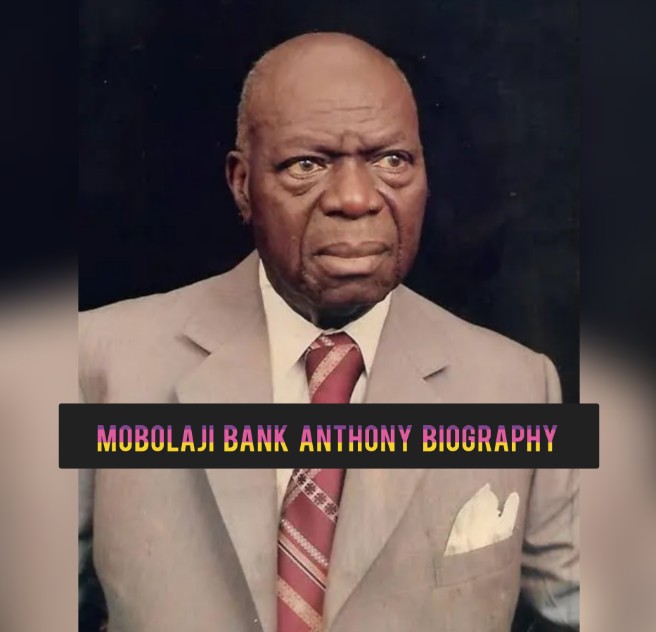
Mobolaji Bank Anthony Biography
Bank-Anthony whose full name is Mobolaji Bank Anthony stands among the foremost indigenous entrepreneurs who helped define modern Nigerian commerce in the twentieth century. From a junior clerical post in the colonial Posts and Telegraphs Department he built a diversified business empire spanning trade, construction, insurance, manufacturing and finance. His quiet philanthropy left permanent marks on Lagos healthcare, while his boardroom leadership helped open space for Nigerian participation in enterprises once dominated by foreign firms. This biography traces the full arc of his life with attention to verified historical detail and a clear, accessible style suited to general readers.
An interesting fact that continues to capture attention is that the same man who once travelled as a seller of patent medicines later became chairman or director of more than twenty companies, served at the head of the Lagos Stock Exchange, and donated an entire maternity complex named Ayinke House in lasting honour of his mother. The distance between those early days and the institutions he helped shape remains one of the most striking elements of his story.
Bank-Anthony Early Life
Bank-Anthony was born on 11 June 1907 in the Kinshasa region of the Belgian Congo. His parents belonged to established commercial families linked to Lagos Island. His father, Alfred Bank Anthony, operated an undertaker business known as A. Bank Anthony and Sons Limited and was associated with the Brazilian quarters of Lagos. His mother was connected to the Aleshinloye Williams family of Olowogbowo. Both parents were active in trade, so the household placed high value on commercial discipline, reliability and education.
Although born outside Nigeria, the family maintained strong ties to Lagos. Young Bank-Anthony grew up within a social circle that understood the importance of networks, careful record keeping and long term reputation. These early influences shaped a practical outlook that later guided his business decisions. The colonial environment of the time offered limited formal opportunities for Africans in large scale enterprise, yet the Lagos commercial class had already developed its own traditions of trade and mutual support.
He received his primary education at St Peter’s School in Faji, Lagos. Secondary education followed at several respected mission institutions: Methodist Boys’ High School in Lagos, Ijebu Ode Grammar School under the guidance of the well known Reverend I. O. Ransome Kuti, CMS Grammar School in Lagos, and Baptist Academy in Lagos. These schools emphasised literacy, arithmetic, moral instruction and orderly habits. Moving between Lagos and Ijebu settings exposed him to different strands of Yoruba society and to the broader colonial educational system that prepared many of Nigeria’s first generation of professionals and businessmen.
In 1923 or 1924 he entered the Department of Posts and Telegraphs as a junior clerk in the correspondence or accounts section. He remained in government service until approximately 1931 or 1932. The work taught him administrative routines, the importance of accurate records and the structure of large organisations. At the same time it revealed the limited prospects available to Africans in the colonial civil service. He chose to leave paid employment and begin independent commercial activity, a decision that required confidence and a willingness to accept risk at a period when secure government posts were highly prized.
Bank-Anthony Personal Life
In 1935 Bank-Anthony married Olamide Adeshigin, later known as Lady Bank Anthony or Lande Adeshingbin. The marriage provided a stable personal foundation that lasted until his death. Contemporary accounts describe a partnership marked by mutual respect and discretion. While the couple did not have children together, he was the father of four daughters: Omoseri Bank Anthony, Ajibike Bank Anthony, Dame Oremi Evans and Bolaji Bank Anthony. He managed family responsibilities with the same quiet care that characterised his public dealings.
Despite growing wealth he maintained a modest personal style. Associates remembered him as disciplined, focused and unwilling to display success for its own sake. His recorded hobbies were straightforward: working, reading and dancing. These simple pursuits reflected a temperament more interested in steady progress than in spectacle. He belonged to a number of established social and business clubs in Lagos, among them the Lagos Race Club, the Metropolitan Club, the Yoruba Tennis Club, the Nigerian American Chamber of Commerce, the Lagos Rotary Club and several others. Membership in these organisations both reflected genuine social interest and provided the networks essential for serious commerce in mid century Lagos.
Traditional recognition followed his commercial standing. In 1968 he received the title of Chief Ba’loro of Lagos. In 1988 he was installed as the Otunba Lofin of Ijebuland. These honours acknowledged his place within indigenous structures as well as his contributions to wider public life. Throughout his career he kept a respectful distance from partisan politics, preferring to direct energy toward business building and philanthropy. His personal conduct remained consistent: hard working, understated and oriented toward results that would endure.
Bank-Anthony Rise to Prominence
After leaving the Posts and Telegraphs Department, Bank-Anthony entered private trade. He established M. de Bank Brothers as a general merchant firm. Early efforts focused on palm oil processing. He travelled to Germany and England to study methods and obtain equipment. When that venture proved difficult he turned to patent medicines and later to the importation of watches, clocks and fountain pens. At one stage he ranked among the largest sellers of fountain pens in Nigeria, trailing only the major European trading houses.
The Second World War provided a decisive turning point. Prices rose sharply across the country. Traders who had built up substantial stocks of goods before the inflationary pressures benefited. Bank-Anthony was among those who had prepared carefully. His business expanded. He also took contracts connected to his father’s undertaker firm, including the supply of tombstones, which generated additional capital for larger undertakings.
In the 1950s he began operating at a higher level by introducing European firms to Nigeria and assuming leadership roles within them. In 1950 he facilitated the entry of the Italian construction company Borini Prono and became chairman of its Nigerian subsidiary. The firm participated in significant infrastructure projects including the Ijora Causeway and sections of major roads such as the Benin Asaba and Sapele Onitsha routes. This marked one of the earliest cases of a Nigerian serving as chairman of a European construction company active in the country.
He also became agent for Law Union and Rock Insurance and later held chairmanships or directorships across a widening range of firms. These included Aero Contractors of Nigeria Limited, Holman Brothers Nigeria Limited, Foremost Dairies, Weide and Company, Motor Parts Industry Limited and others linked to electrical parts, plywood, pharmaceuticals and oil. He acquired minority shares in Aero Contractors before larger indigenous interests developed. At one period he held distribution rights for certain vehicles manufactured by the Rootes Group. His capacity to identify opportunities, form partnerships and manage across sectors established him as a central figure in the growth of indigenous enterprise in Lagos.
Bank-Anthony Major Achievements
By the later decades of his career Bank-Anthony held chairmanships or directorships in a broad array of companies covering insurance, construction, aviation support, dairy, manufacturing and finance. He served as chairman of the Lagos Stock Exchange during a formative period for Nigeria’s capital market. The position placed him at the centre of efforts to organise formal securities trading and to encourage wider participation in corporate ownership.
He was associated with the Lagos Chamber of Commerce, the Nigeria National Stadium Board, the Federal Rehabilitation Appeal Board established after the civil war to assist affected citizens, and various tourism and transport bodies. He became a fellow of the Nigerian Institute of Management. His contributions were later recognised through the establishment of an award bearing his name within that institute. His work demonstrated that Nigerian entrepreneurs could operate successfully as partners and leaders alongside foreign capital rather than remaining confined to subordinate roles.
Philanthropy formed an essential part of his public contribution. He donated a ward to the National Orthopaedic Hospital at Igbobi in Lagos. In 1990 he built and donated Ayinke House, a substantial maternity and child care facility, to the Lagos State Government in memory of his mother. The complex became an important centre for maternal health services linked to what is now the Lagos State University Teaching Hospital in Ikeja. These gifts reflected a deliberate decision to support institutions that would serve ordinary people long after his own lifetime.
National and international honours recognised his standing. He received the Officer of the Order of the British Empire in 1957, the Knight Commander of the Order of the British Empire in 1963, the Commander of the Order of the Niger in 1979, and various Italian decorations including the Stella della Solidarietà Italiana and later the Grande Ufficiale. He was awarded the Queen Elizabeth II Coronation Medal in 1953. Universities conferred honorary degrees: Doctor of Laws from the University of Ibadan in 1968 and Doctor of Letters from Ahmadu Bello University in 1988. He also held fellowships and patronage roles with medical, scientific and cultural bodies. These recognitions confirmed both commercial achievement and public service.
Bank-Anthony Challenges and Setbacks
The path was never free of difficulty. Early experiments in palm oil processing and patent medicines did not succeed as hoped. Capital was limited, markets were controlled by large European firms, and colonial regulations often favoured established trading houses. Switching repeatedly between product lines required resilience and a willingness to learn from failure.
Leaving a secure civil service position for uncertain private trade involved personal risk. The wartime and post war periods brought inflation, supply shortages and political uncertainty as Nigeria moved toward independence. Building trust with foreign partners while asserting Nigerian leadership demanded careful diplomacy. The Nigerian Civil War and its aftermath created further economic disruption. Serving on the Federal Rehabilitation Appeal Board required him to address the human and material costs of conflict while continuing to manage his own enterprises.
He met these challenges through disciplined attention to detail, patient accumulation of capital and the cultivation of reliable networks. Rather than seeking rapid speculative gains, he focused on sectors with tangible infrastructure and consumer demand. Partnerships with Italian and other European firms allowed access to technical expertise while he retained significant local control. Quiet persistence rather than dramatic confrontation characterised his approach. Over time the early setbacks became the foundation for broader influence and lasting institutional contribution.
Bank-Anthony Legacy and Current Status
Bank-Anthony died on 26 May 1991 in Lagos, sixteen days before his eighty fourth birthday. He left a reputation for enterprise combined with restraint and public minded generosity. A statue of him stands in Lagos State, and Ayinke House continues to serve as a reminder of his commitment to maternal health. Roads and institutional references keep his name present in the physical and civic landscape of Lagos.
His career illustrated the possibilities open to disciplined indigenous entrepreneurs in the transition from colonial rule to independence. He helped normalise the idea that Nigerians could chair major companies, participate fully in the capital market and partner with foreign capital on terms of mutual respect. The award associated with the Nigerian Institute of Management continues to honour excellence in management under his name. His example remains relevant to discussions of private enterprise, corporate governance and the social responsibilities of wealth.
Although he is no longer alive, the institutions he supported and the commercial patterns he helped establish continue to influence Lagos and Nigerian business life. Successive generations of entrepreneurs and public officials have drawn lessons from the combination of commercial success and quiet philanthropy that marked his career. The maternity complex he donated still functions, the corporate structures he helped lead evolved into later Nigerian owned enterprises, and the memory of steady, responsible leadership endures.
Conclusion
The life of Bank-Anthony offers a clear lesson in the power of steady purpose. From a junior clerical desk and early trading experiments he built a network of companies, contributed to national infrastructure, strengthened financial institutions and gave lasting gifts to healthcare. He showed that commercial achievement and public service need not stand in opposition. In an era when many sought rapid political or speculative success, he chose the longer road of building institutions and serving the community through concrete action. His story continues to encourage those who believe that disciplined work, careful partnerships and a sense of responsibility can leave a mark that endures beyond any single lifetime.
FAQs
Who was Bank-Anthony?
Bank-Anthony was a Nigerian industrialist, philanthropist and business leader born in 1907 who rose from clerical work and small scale trading to become chairman or director of numerous companies and a prominent figure at the Lagos Stock Exchange. He is remembered for both commercial success and major donations to healthcare facilities in Lagos.
When and where was Bank-Anthony born?
He was born on 11 June 1907 in the Kinshasa region of the Belgian Congo into a Lagos connected commercial family. He spent his formative years and education in Lagos and related Yoruba communities.
What were the main business activities of Bank-Anthony?
He began with general merchandising under M. de Bank Brothers, dealing in palm oil, patent medicines, watches, clocks and fountain pens. He later became chairman of Borini Prono and Company Nigeria and held leadership roles in insurance, aviation support, dairy, manufacturing and other sectors. He also served as chairman of the Lagos Stock Exchange.
What philanthropic contributions did Bank-Anthony make?
He donated a ward to the National Orthopaedic Hospital at Igbobi and built and donated Ayinke House, a maternity and child care complex, to the Lagos State Government in memory of his mother. These facilities provided lasting public health benefits.
What honours did Bank-Anthony receive?
He received the OBE in 1957, the KBE in 1963, the CON in 1979, Italian decorations, traditional titles including Chief Ba’loro of Lagos and Otunba Lofin of Ijebuland, and honorary doctorates from the University of Ibadan and Ahmadu Bello University.
When did Bank-Anthony die?
He died on 26 May 1991 in Lagos at the age of eighty three, shortly before his eighty fourth birthday.
What is the lasting legacy of Bank-Anthony?
His legacy includes the growth of indigenous participation in Nigerian commerce, the strengthening of institutions such as the stock exchange, concrete contributions to infrastructure and healthcare, and an example of quiet, disciplined enterprise combined with public generosity that continues to be remembered in Lagos and beyond.