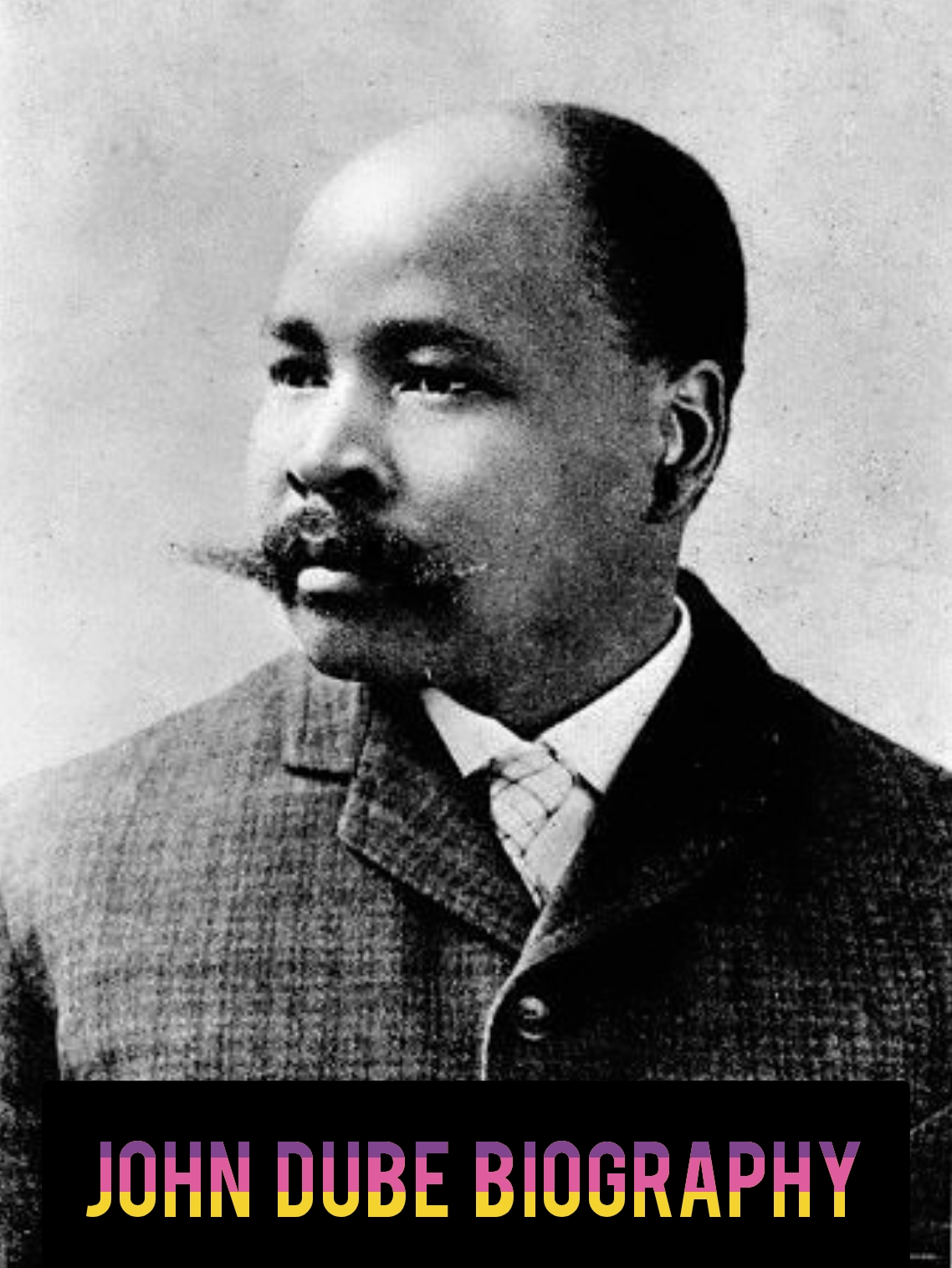
John Dube Biography
John Langalibalele Dube was a South African educator, publisher, writer, minister and political leader who became the first president of the organisation that later grew into the African National Congress. He founded one of the earliest African owned industrial schools and a pioneering Zulu language newspaper, and he worked throughout his life to advance education, self reliance and political rights for African people. His efforts helped shape the early organised struggle against racial discrimination in South Africa. This biography presents his story in clear and simple English.
An interesting fact that continues to inspire is that the same man who opened a school for African students at Ohlange later became the first president of the South African Native National Congress, and decades after his death Nelson Mandela chose that same school as the place where he cast his first vote in the democratic elections of 1994.
John Dube Early Life
John Langalibalele Dube was born on 22 February 1871 at the Inanda Mission Station in Natal. The mission belonged to the American Zulu Mission, a branch of the American Board of Commissioners for Foreign Missions. His father, the Reverend James Dube, was one of the first African men ordained as a pastor by the mission. His mother was Elizabeth Dube. The family belonged to the Qadi clan, which had links to the wider Zulu royal house, yet the father’s conversion to Christianity meant that John did not inherit traditional chiefly authority.
He received his early schooling at the Inanda mission and later at Adams College in Amanzimtoti. Missionaries recognised his ability and arranged for him to travel to the United States for further study. In 1887 or 1888 he left South Africa and enrolled at Oberlin College in Ohio, one of the few American institutions then open to students of all races. He supported himself through various jobs while studying. He later continued theological training at the Union Missionary Training Institute in Brooklyn, New York. He was ordained as a Congregational minister around the turn of the century. During his years in America he came under the influence of the ideas of Booker T. Washington, especially the emphasis on industrial education and practical self help.
John Dube Personal Life
John Dube married Nokutela Mdima in the mid eighteen nineties. The couple worked closely together in educational and community projects. Nokutela shared his commitment to the school at Ohlange and to the wider upliftment of African people. She died in 1917. In 1920 he married Angelina Khumalo of Pretoria. With his second wife he had several children, including sons and daughters who continued the family connection to Ohlange and to public life.
He was known by the praise name Mafukuzela, a title that reflected respect within Zulu speaking communities. He combined the roles of minister, teacher, editor and political organiser while maintaining a strong attachment to his home area of Inanda. He valued both Christian teaching and Zulu cultural heritage, and he sought to bring the two together in the education he offered young people. His personal discipline and sense of duty shaped the institutions he created and the public positions he held.
John Dube Rise to Prominence
After returning from the United States, John Dube began teaching and preaching in Natal. He became increasingly convinced that African communities needed their own educational institutions that combined academic learning with practical skills. Inspired by the model of Tuskegee Institute, he founded the Zulu Christian Industrial School at Ohlange near Inanda in 1901. The school later became known as the Ohlange Institute. It was the first major educational institution in South Africa established and run by Africans for African students. Dube served as its superintendent and principal. The school offered both literary and industrial training and aimed to produce self reliant young men and women.
In 1903 he founded the newspaper Ilanga lase Natal. Published in Zulu and English, it became an important voice for African opinion in Natal and beyond. As editor he used the paper to discuss education, land, labour and political rights. The combination of the school and the newspaper established his reputation as a leading figure in African public life.
When African leaders gathered in Bloemfontein in January 1912 to form a national political organisation, they elected John Dube as the first president general of the South African Native National Congress. The organisation later changed its name to the African National Congress. His election recognised both his educational work and his growing political influence. In 1914 he led a congress delegation to London to protest against the Natives Land Act of 1913, which severely restricted African land ownership. Although the mission did not succeed in reversing the law, it marked an early organised attempt to take African grievances to the imperial government.
John Dube Major Achievements
The founding of the Ohlange Institute stands as one of John Dube’s most lasting achievements. At a time when educational opportunities for Africans were severely limited, he created a school that emphasised both character and practical competence. Generations of students passed through its classrooms. The institution became a symbol of African initiative in education and remained a place of historical importance long after his death.
The newspaper Ilanga lase Natal gave African readers a regular platform for news and opinion in their own language. It helped to develop a wider public discussion of the issues facing African communities under segregationist policies. Dube’s work as editor and publisher contributed to the growth of an independent African press.
As the first president of the South African Native National Congress he helped to launch the first permanent national organisation dedicated to the defence of African rights. The congress brought together leaders from different regions and laid the organisational foundation for the long struggle that followed. His leadership of the 1914 delegation to Britain demonstrated a commitment to peaceful petition and constitutional protest at a time when other options were limited.
Dube was also a significant literary figure. He wrote essays, historical works and the novel Insila ka Shaka, published in 1930. The book, later translated into English as Jeqe the Bodyservant of King Shaka, was one of the earliest novels written in Zulu by a Zulu author. It combined historical narrative with reflection on Zulu tradition and leadership. Other writings addressed the internal challenges facing African communities and the need for unity and self improvement. In later years he received an honorary doctorate from the University of South Africa, recognition of his contribution to education and public life. He also served on the Natives Representative Council, continuing to speak for African interests within the limited constitutional structures of the time.
John Dube Challenges and Setbacks
John Dube worked under the severe restrictions of colonial and later segregationist rule. African land rights were progressively reduced, political representation was minimal, and educational and economic opportunities were tightly controlled. Raising funds for Ohlange required constant effort, including journeys to raise support in South Africa and abroad. Keeping the school open and maintaining standards demanded persistence in the face of limited resources.
Political leadership brought its own difficulties. The South African Native National Congress had to balance the views of different regions and social groups. The failure of the 1914 mission to change the Land Act was a clear setback. Differences of opinion within the organisation led to his replacement as president in 1917. He continued to support the broader cause while returning more of his energy to education, writing and local leadership in Natal.
Personal loss also marked his life. The death of his first wife Nokutela in 1917 removed a close partner in the work at Ohlange. Health problems and the pressures of public life added further strain. Despite these challenges he maintained a steady commitment to the institutions he had founded and to the principle that education and organised political effort were essential for African progress.
John Dube Legacy and Current Status
John Langalibalele Dube died on 11 February 1946 in the Umhlanga area of Natal. He was seventy four or seventy five years old. His death removed a founding figure of modern African political organisation in South Africa, yet the institutions and ideas he left behind continued to grow.
The Ohlange Institute remained a centre of education and later became a site of national memory. In 1994 Nelson Mandela chose Ohlange as the place where he cast his first vote in South Africa’s first democratic elections, deliberately linking the new democracy to Dube’s earlier work. The school and its associated buildings have been recognised as places of historical importance. Ilanga lase Natal continued as a voice in the Zulu language press. The African National Congress, which grew out of the organisation he first led, became the dominant force in the liberation struggle and in the democratic government that followed.
Dube is remembered as an educator who believed in practical skills and moral character, as a publisher who gave African opinion a platform, as a writer who helped establish modern Zulu literature, and as a political leader who helped create the first national African political organisation. Streets, schools and commemorative events continue to carry his name. Historians regard him as a central figure in the early history of African nationalism in South Africa and as an example of leadership grounded in education and community institution building.
Conclusion
The life of John Langalibalele Dube shows that lasting change begins with the creation of institutions that educate, inform and organise. From a mission childhood in Natal he travelled to America, returned to found a school and a newspaper, and accepted the responsibility of leading the first national African political body. He faced the hard limits of segregationist law and the ordinary difficulties of building under constraint, yet he left structures that outlived him and that later generations could use. His example continues to encourage the belief that education, clear communication and organised effort can open the way to greater freedom and dignity.
FAQs
Who was John Dube?
John Langalibalele Dube was a South African educator, publisher, writer, minister and political leader who founded the Ohlange Institute and Ilanga lase Natal and served as the first president of the South African Native National Congress, later the African National Congress.
When and where was John Dube born?
He was born on 22 February 1871 at the Inanda Mission Station in Natal, South Africa.
What school did John Dube found?
He founded the Ohlange Institute in 1901 near Inanda. It was the first major industrial and academic school established and run by Africans for African students in South Africa.
What newspaper did John Dube start?
He founded the newspaper Ilanga lase Natal in 1903. It was published in Zulu and English and became an important voice for African opinion.
When did John Dube lead the ANC?
He was elected the first president general of the South African Native National Congress in 1912 and served until 1917. The organisation was later renamed the African National Congress.
When did John Dube die?
He died on 11 February 1946 in the Umhlanga area of Natal.
What is the lasting legacy of John Dube?
His lasting legacy includes the Ohlange Institute, the newspaper Ilanga lase Natal, his role in founding the African National Congress, his contribution to Zulu literature, and the example of leadership through education and organised political work.