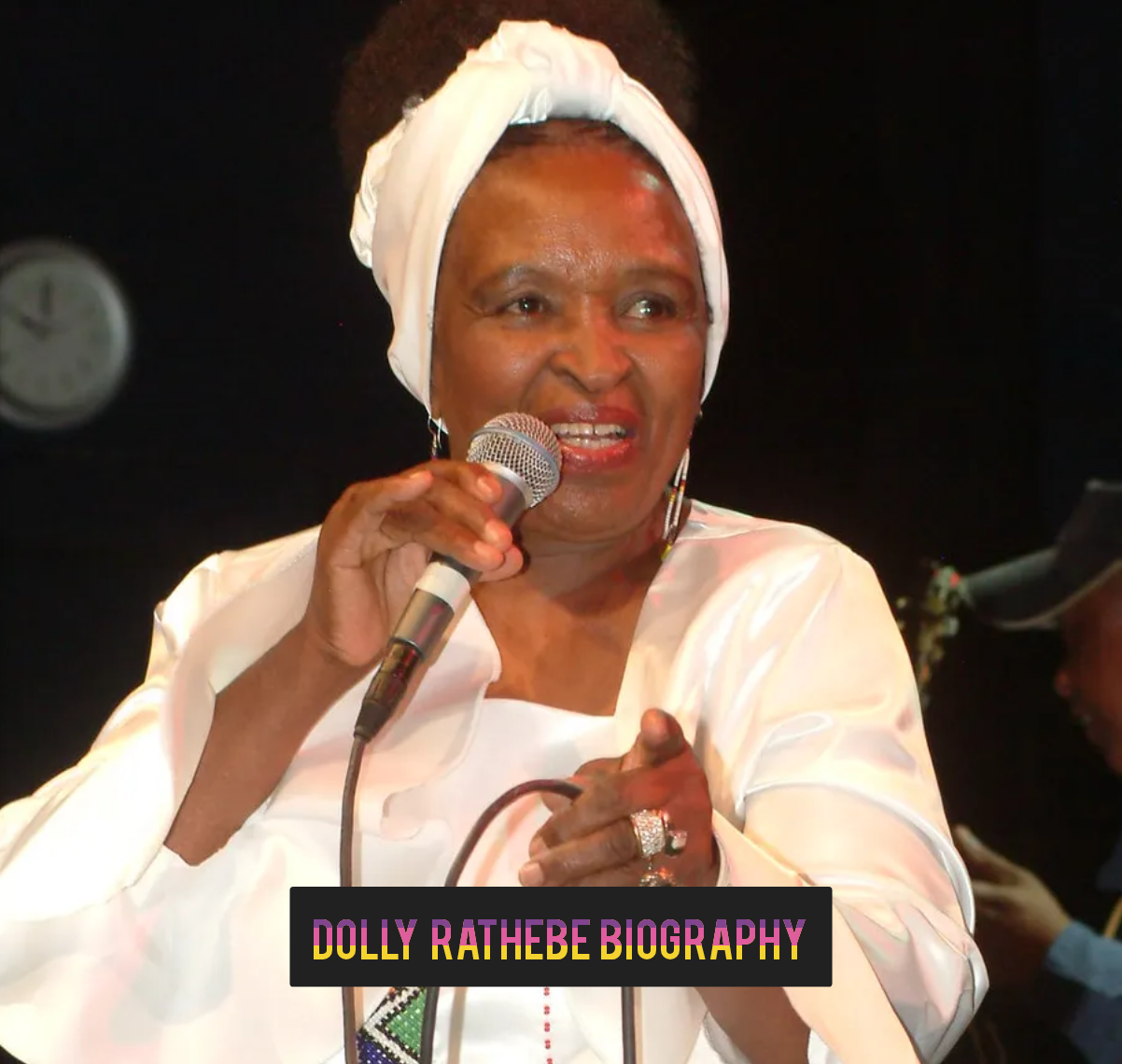
Dolly Rathebe Biography
Dolly Rathebe was South Africa’s first black female film star and a defining voice of the Sophiatown jazz era. Her natural talent, magnetic stage presence, and glamorous image made her a household name in the late 1940s and 1950s at a time when apartheid laws sought to limit black creativity and mobility. Through film, song, and sheer resilience she helped shape the sound and style of urban African entertainment that still echoes today.
This biography traces the full arc of her life from a childhood of hardship in Randfontein and Sophiatown to national stardom, years of quiet struggle under tightening apartheid restrictions, and a late return to the stage and public recognition. It presents a clear, respectful account of the woman whose name once became township slang for anything excellent.
Dolly Rathebe Intro
In the late 1940s a young woman singing at a Sunday picnic in Johannesburg was overheard by talent scouts looking for a star who could match the glamour of American performers such as Lena Horne. That chance moment turned Josephine Malatsi into Dolly Rathebe, Africa’s first internationally recognised black female film actress and one of the brightest lights of the Sophiatown cultural renaissance. Overnight her name entered everyday speech. If something was “Dolly” it was fine. If it was “double Dolly” it was outstanding.
Her story is more than a tale of sudden fame. It is the story of a woman who carried the hopes of a generation of black South Africans on screen and on stage while navigating the daily humiliations and dangers of apartheid. She sang jazz with leading township bands, appeared on the covers of popular magazines, mentored younger artists who later became world famous, and later used her earnings to support community projects. Even when political pressure forced her into relative obscurity she refused to abandon her people or her craft. Her life remains an inspiring example of talent, courage, and quiet determination.
Dolly Rathebe Early Life
Dolly Rathebe was born on 2 April 1928 in Randfontein, a mining town west of Johannesburg. Her birth name was Josephine Kedibone Malatsi, though some records list variations such as Josephine Kedibone. Her mother, Elizabeth Mmatanki Malatsi, came from a farming family and had already lost several children in infancy. When the healthy baby girl arrived her mother gave her the Sesotho name Kedibone, meaning “I have seen it all,” an expression of relief and wonder after so much loss. Her father was a migrant labourer who worked on the gold mines and was often absent. The marriage eventually broke down.
Young Josephine spent her earliest years partly with her maternal grandparents. After her mother remarried the family moved to Sophiatown, the lively mixed-race suburb of Johannesburg where black people could still own freehold property. Sophiatown in the 1930s and 1940s was a place of music, conversation, and cultural energy. Whites, Indians, and blacks mixed more freely there than the law officially allowed. Josephine attended St Cyprian’s missionary school and absorbed the sounds of American jazz records, local marabi music, and the talent contests held regularly at the Odin Cinema.
Family life was difficult. She later spoke of a broken home and an abusive stepfather. At the age of fifteen she became the main breadwinner after her mother fell ill or died (accounts differ slightly on the exact timing of her mother’s death, which most sources place around 1949). She left school before completing standard five and took domestic work in Johannesburg while continuing to sing at wakes, parties, and neighbourhood gatherings. Music was already her refuge and her gift. She borrowed the more glamorous name Dolly Rathebe from a school friend or a well-off young woman she admired and began to build a small local reputation.
Dolly Rathebe Personal Life
Dolly Rathebe’s personal life was shaped by the same intensity and turbulence that marked the Sophiatown years. She was married twice and had three children: daughters Zola and Ntsiki Thelma, and a son named Smilo. One significant relationship in the early 1950s was with William Buti Nketle, a well-known Sophiatown gang leader. She became part of that world for a time, living with the risks that came with it. Later she formed other partnerships and focused on raising her children as best she could under difficult circumstances.
She was known for her style, humour, and generosity. Friends and fellow performers remembered her laughter and her willingness to help younger artists. Miriam Makeba, Thandi Klaasen, Dorothy Masuka, and others looked up to her as both a star and a mentor. In later years she settled in Mabopane near Pretoria and became active in community organisations, including the executive committee of the Ikageng Women’s League. She funded the building of a multi-purpose community hall at Sofasonke village near Klipgat, north of Pretoria. The hall was named Meriting kwaDolly, meaning Dolly’s Retreat, a lasting gift to local people.
Despite the glamour of her early career she remained grounded. She ran a shebeen in Cape Town for many years to support her family when performing opportunities dried up. She never sought exile, choosing instead to stay in South Africa through the harshest years of apartheid. Those who knew her in later life described a woman of quiet dignity who still carried the spark that had once lit up stages across southern Africa.
Dolly Rathebe Rise to Prominence
The turning point came in 1948 or 1949 when Dolly was singing casually at a picnic. Talent scouts connected to the British filmmakers Donald Swanson and Eric Rutherford heard her and recognised star quality. She was cast as Judy, the nightclub singer, in the film African Jim, later retitled Jim Comes to Jo’burg. Released in 1949, it was one of the first South African feature films made primarily for black audiences and the first to show urban African life in a positive light. Although she had no formal acting training, her natural screen presence and singing voice made her an instant sensation.
Overnight she became Africa’s first black female film star. Crowds greeted her in the streets. Her name entered township slang as a term of approval. She followed the film with another role in The Magic Garden in 1951. Magazine covers followed, especially for Drum. A famous photograph taken by Jürgen Schadeberg on a Johannesburg mine dump, with Dolly posing in a makeshift bikini, led to both of them being arrested under the Immorality Act because the police assumed an interracial relationship. The incident only increased her fame.
Throughout the 1950s she toured southern Africa with leading bands including the Manhattan Brothers, the Harlem Swingsters, and the African Inkspots. In 1954 she became the star attraction of Alf Herbert’s African Jazz and Variety Show, a long-running revue that kept her in the public eye for years. She also appeared in the South African production of the musical King Kong. By the mid-1950s she was the undisputed queen of African jazz and variety entertainment, a symbol of sophistication and style at a time when official policy tried to deny black people any claim to modern urban culture.
Dolly Rathebe Major Achievements
Dolly Rathebe’s achievements span film, music, fashion, and cultural influence. Her performance in Jim Comes to Jo’burg opened the door for black actors and musicians on South African screens. She became the first black woman to appear on the covers of popular magazines aimed at black readers and the first brand ambassador for products such as Max cigarettes. Her image helped define a confident, glamorous black femininity that rejected the stereotypes of the time.
As a singer she worked with the finest township jazz groups of the era. In 1964 she joined the Elite Swingsters and achieved a measure of international recognition. Decades later the group reunited and released albums including Woza in 1991, A Call for Peace, and Siya Gida/We Dance. She performed at Nelson Mandela’s presidential inauguration in 1994 and at the ceremony marking South Africa’s return to the Commonwealth. In 1995 she appeared in the film remake of Cry, the Beloved Country as Mrs Kumalo. She also acted in Mapantsula and other productions.
In 2001 she received a Lifetime Achievement Award at the South African Music Awards. In 2003, at the age of seventy-five, she still performed in the Johannesburg show Sof’Town, A Celebration. Her song Mbombela was covered by Miriam Makeba and Harry Belafonte on their Grammy-winning album. Most importantly, she helped create the cultural language of Sophiatown jazz and showed that black South African artists could command the stage and screen with talent and presence equal to any in the world.
Dolly Rathebe Challenges and Setbacks
Apartheid created constant obstacles. The destruction of Sophiatown under the Group Areas Act in the late 1950s scattered the community that had nurtured her career. An eight o’clock curfew and increasing restrictions on black movement and gathering made regular performances almost impossible. Many of her contemporaries went into exile after the Sharpeville massacre and the state of emergency that followed. Dolly chose to stay. Work dried up. She moved between Port Elizabeth, Durban, and Cape Town, eventually running a shebeen to survive and support her children.
The music industry itself changed. When the cast of King Kong stayed abroad, the old jazz scene weakened and newer styles such as mbaqanga took over. Personal relationships were complicated by the pressures of fame, gangster culture in Sophiatown, and the daily realities of poverty and racial laws. Arrest under the Immorality Act was only one of many humiliations she endured. Health problems and the ordinary struggles of raising a family without steady income added to the burden.
She overcame these difficulties through practical resilience and an unbroken connection to her community. Running a shebeen kept her close to ordinary people. Mentoring younger singers kept her creative spirit alive. When democracy arrived she was ready to step back onto the stage, not as a faded star but as a living link to a vital cultural past.
Dolly Rathebe Legacy and Current Status
Dolly Rathebe died on 16 September 2004 in Pretoria after suffering a stroke. She was seventy-six. Shortly afterward the South African government awarded her the Order of Ikhamanga in Silver for her excellent contribution to music and the performing arts and her commitment to the ideals of justice, freedom, and democracy. A tombstone was later erected at her grave in an official ceremony.
Her legacy lives on in the music of South African jazz, in the history of black cinema, and in the memory of Sophiatown as a place of creativity and defiance. Younger artists and scholars continue to rediscover her recordings and films. A biography published in recent years has brought new attention to her life. The community hall she funded still serves people near Pretoria. Postage stamps and cultural programmes have honoured her as one of the popular music legends of South Africa.
She is remembered as the original black superstar who made it possible for later generations of women to claim the stage without apology. Her story shows that talent and dignity can survive even the harshest political systems.
Conclusion
Dolly Rathebe’s life reminds us that cultural pioneers often work under the greatest pressure. She rose from poverty and family hardship to become a symbol of black elegance and artistic excellence at a time when the law tried to deny both. She stayed in South Africa when others left, kept singing when the stages closed, and returned when freedom finally arrived. Her voice, her image, and her quiet strength continue to inspire anyone who believes that art can affirm human dignity even in the hardest of times.
FAQs
Who was Dolly Rathebe?
Dolly Rathebe was a pioneering South African singer and actress, known as the country’s first black female film star and a leading figure in the Sophiatown jazz scene of the 1940s and 1950s.
When and where was Dolly Rathebe born?
She was born on 2 April 1928 in Randfontein, west of Johannesburg, South Africa. She grew up mainly in Sophiatown.
What was Dolly Rathebe’s real name?
Her birth name was Josephine Kedibone Malatsi. She adopted the stage name Dolly Rathebe early in her career.
What film made Dolly Rathebe famous?
She rose to fame in 1949 with the film Jim Comes to Jo’burg (also known as African Jim), in which she played a nightclub singer. It was one of the first South African films to present urban African life positively.
Which bands did Dolly Rathebe perform with?
She sang with the Manhattan Brothers, the Harlem Swingsters, the African Inkspots, and later the Elite Swingsters, among others.
Did Dolly Rathebe face problems under apartheid?
Yes. She was arrested under the Immorality Act during a photo shoot, lost performance opportunities when Sophiatown was destroyed, and struggled under curfews and restrictions that limited black artists. She stayed in South Africa rather than going into exile.
What awards did Dolly Rathebe receive?
She received a Lifetime Achievement Award at the South African Music Awards in 2001 and was posthumously awarded the Order of Ikhamanga in Silver in 2004.
When did Dolly Rathebe die?
She died on 16 September 2004 in Pretoria after a stroke at the age of seventy-six.
What community work did Dolly Rathebe do?
In later years she was active in the Ikageng Women’s League and funded the construction of a multi-purpose community hall called Meriting kwaDolly near Pretoria.
Why is Dolly Rathebe still important today?
She opened doors for black women in film and music, helped define South African jazz style, and remains a symbol of resilience and cultural pride from the Sophiatown era.