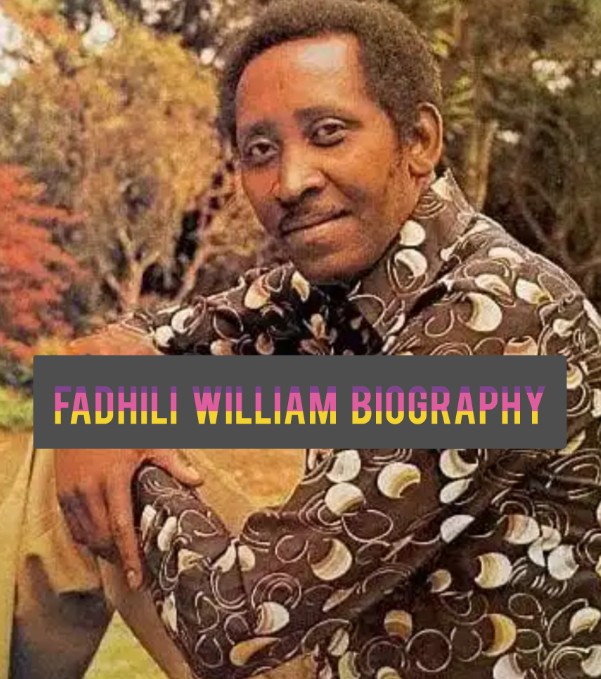
Fadhili William Biography
Fadhili William gave the world one of East Africa’s most enduring love songs. His recording of Malaika introduced a gentle Swahili ballad that traveled far beyond Kenya’s borders and became a global standard, covered by artists from Miriam Makeba to Harry Belafonte. Yet the man behind the song lived a life of quiet dedication to music, marked by early talent, professional struggle, and a lasting place in the story of Kenyan popular song.
This biography follows the path of Fadhili William Mdawida from his childhood in Taita Taveta through decades of performance, composition, and recording. It explores the family roots that shaped him, the personal stories behind his songs, the rise of a distinctive guitar driven style, the challenges of recognition and reward, and the way his music continues to speak to new generations.
Fadhili William Intro
One remarkable fact about Fadhili William is that a single song he recorded in the early 1960s grew into one of Africa’s best known compositions while he spent much of his life seeking proper credit and royalties for it. Malaika, meaning angel in Swahili, tells a simple story of love limited by poverty and bride price. The melody and words have been sung on stages and in homes across continents, yet the original artist often watched others profit more visibly from the work.
That tension between artistic achievement and material reward runs through his career. Fadhili William was more than the voice of one famous ballad. He was a skilled guitarist, bandleader, composer of roughly two hundred songs, and a central figure in the golden age of Kenyan popular music now remembered as Zilizopendwa. His story shows how talent, persistence, and a deep feeling for everyday emotion can create work that outlives its creator.
Fadhili William Early Life
Fadhili William Mdawida was born on 11 November 1938 in Taita Taveta District near Mombasa, Kenya. His parents were Halima Wughanga and Ramadhan Mwamburi. His father was a traditional musician who died when Fadhili was only seven years old. The early loss left a strong impression, yet music remained part of family life. Three of his siblings, Ali Harrison Mwataku, Esther John, and Mumba Charo, also became musicians, showing how deeply the art ran in the household.
He began singing in primary school in Taita. His teacher quickly noticed his ability and sometimes allowed him to conduct the choir. Around the age of fifteen his mother bought him his first guitar, a Gallotone that cost a significant sum for the family at the time. He taught himself by watching other players, sitting quietly and studying their finger movements because skilled guitarists were often reluctant to share their knowledge.
He continued his education at the Government African School in Pumwani, Nairobi. Later he enrolled at Shimo la Tewa Secondary School and reached Form Three before leaving to focus fully on music. The decision reflected a clear sense of direction. Formal schooling gave way to practical learning on stages, in studios, and among fellow musicians who were shaping the sound of independent Kenya.
Fadhili William Personal Life
Fadhili William’s personal life was closely tied to the stories in his songs. While living in Pumwani he fell in love with a young woman he called an angel. According to his own account her name was Fanny or Fennie, and he nicknamed her Malaika. He wished to marry her but could not raise the required bride price. She was given in marriage to an older man who could meet the family’s demands. The experience inspired the song that would define his reputation. He said he wrote it so that she might hear it on the radio and know he still thought of her, even if her husband would not understand the private message.
He married and had a family. One wife, Rosemary, was connected to the story behind another popular song, Taxi Driver. That piece describes a journey to Nakuru to keep a promise to a woman, interrupted by a puncture near Naivasha and the search for a taxi. He later lived for a period in the United States, where he took a second wife from Kenya. Together they had a daughter named Malaika. In total he was father to eight children and grandfather to nine. One of his daughters, Peggy, died only two days before him.
He was a Muslim and was buried according to Islamic rites at Kariokor Muslim Cemetery in Nairobi. Friends and family remembered a man who remained dedicated to music even when financial rewards were limited. He continued performing late in life, including weekly appearances at a Nairobi hotel after his return from America. His personal experiences of love, travel, and daily difficulty supplied the emotional material for many of his compositions.
Fadhili William Rise to Prominence
Fadhili William’s professional path began in the mid 1950s. He joined the Chem Chem Kids band, performing at weddings and parties and even touring Uganda. His first recordings appeared around 1955 with East African Records. In February 1959 he became leader and guitarist of the Jambo Boys, a group supported by the same company. The band started as a quartet and later expanded. They performed regularly on radio for the Kenya Broadcasting Service and built a strong local following.
The group evolved into the Equator Sound Band, working under the guidance of Charles Worrod at Equator Sound Studios. Alongside colleagues such as Daudi Kabaka, Fundi Konde, Gabriel Omolo, and others, Fadhili helped create the polished guitar based sound that defined Kenyan popular music of the independence era. His skills as a guitarist were especially valued at a time when accomplished players were still relatively few.
The recording of Malaika around 1960 to 1963 marked the decisive breakthrough. Whether he composed the song himself, as he consistently claimed, or adapted an earlier piece attributed by some to Adam Salim, his version became the definitive early recording. Worrod promoted and distributed the ballad, and it quickly spread across East Africa. The gentle melody, clear Swahili lyrics, and heartfelt delivery struck a deep chord with listeners. Other songs such as Taxi Driver further established his reputation as a storyteller who turned ordinary experiences into memorable music.
Fadhili William Major Achievements
Fadhili William’s central achievement is the popularisation of Malaika. His recording introduced the song to a wide audience and set the standard that later artists followed. International performers including Miriam Makeba, Harry Belafonte, Boney M, and many others recorded their own versions, carrying the melody and the Swahili words around the world. The song became a symbol of East African music for global listeners and remains one of the region’s most recognised cultural exports.
Beyond that single success he composed and recorded a large body of work estimated at around two hundred songs. Hits such as Taxi Driver, pieces recorded with the Jambo Boys and Equator Sound Band, and collaborations with fellow Kenyan artists helped shape the classic sound now celebrated as Zilizopendwa. As a guitarist and bandleader he contributed to the technical and stylistic development of Kenyan popular music during a formative period.
He also worked as an arranger and supported other musicians. His long career, stretching from the mid 1950s until the end of his life, made him one of the founding figures of modern Kenyan recording. After living in the United States for roughly fifteen years he returned to Kenya in the late 1990s and continued to perform, showing that his connection to local audiences had never been broken. His music provided a soundtrack for daily life, romance, and the hopes of a young nation.
Fadhili William Challenges Setbacks
The greatest professional challenge of Fadhili William’s life was the struggle over credit and royalties for Malaika. Although his recording launched the song’s international career, other artists and publishers often presented it as traditional material or claimed greater shares of the income. He spent years seeking proper recognition and fair payment. The experience left a lasting sense of frustration even as the song’s fame grew.
Financial insecurity was a recurring difficulty. Like many African musicians of his generation he worked under contracts and industry conditions that rarely provided long term security. A studio fire during his time in the United States destroyed recordings he had been preparing, adding another setback. Personal life brought its own pressures, including the demands of travel, multiple family responsibilities, and the early death of a daughter shortly before his own passing.
Health problems appeared in his final years. He was hospitalised with a lung infection and later developed pneumonia. Despite these obstacles he continued to perform when possible and remained committed to his craft. The gap between the global reach of his most famous song and the limited material rewards he received stands as a clear illustration of the challenges faced by many pioneering African recording artists.
Fadhili William Legacy Current Status
Fadhili William died on 11 February 2001 at Kenyatta