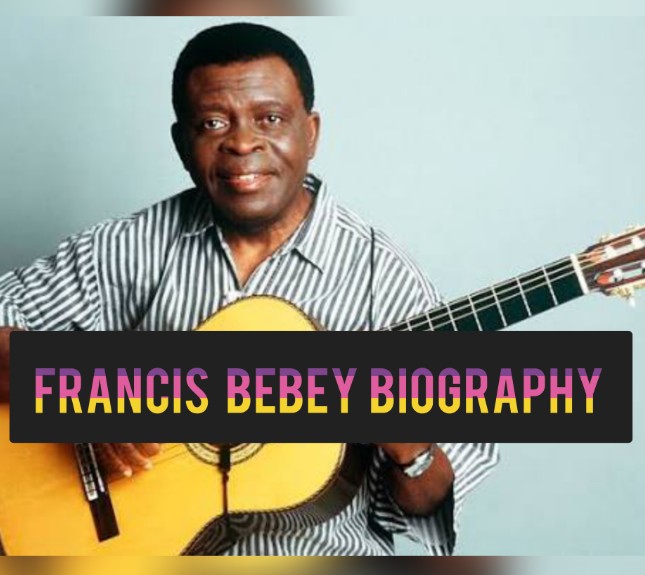
Francis Bebey Biography
Francis Bebey was a Cameroonian artist of rare range who worked as a musician, composer, novelist, poet, musicologist and broadcaster. He combined classical guitar technique with traditional African instruments and later electronic sounds, while also writing novels that captured the humour and tensions of African life. Many regard him as one of the early architects of what later became known as world music.
This biography presents the full arc of his life from a childhood marked by poverty and music in Douala through his years of study and work in Europe and Africa, his decision to leave a secure international post for full time artistic creation, and the lasting influence of his songs, books and ideas. It is written in clear language so that readers of every background can follow the story of a man who refused to limit himself to one field or one culture.
Francis Bebey Intro
Few African artists of the twentieth century moved so freely between literature, scholarship and popular music as Francis Bebey. In 1968 his first novel won the most important literary prize for Black African writing in French. A few years later he left a senior post at UNESCO so that he could devote himself entirely to composing and performing. He became the first African musician widely known for placing electric keyboards and drum machines beside the sanza and the Pygmy flute. His songs mixed humour, social observation and deep feeling, and his guitar playing carried both the discipline of classical study and the spirit of Cameroonian makossa.
What draws the listener and the reader to Bebey is the sense of freedom that runs through all his work. He never accepted the idea that an African artist must stay inside traditional forms or that a novelist must remain silent as a musician. He treated every instrument, every language and every experience as material for creation. That open attitude still speaks to musicians and writers who refuse neat categories.
Francis Bebey Early Life
Francis Bebey was born on 15 July 1929 in the Akwa quarter of Douala, then part of French Cameroun. He was the last of a large family that numbered between ten and thirteen children. His mother died giving birth to him. His father was a Protestant pastor who had taken a vow of poverty and gave away much of what little the household possessed. The children often went hungry. Bebey later recalled being thin with a swollen belly from lack of food. Because official birth registration was irregular under colonial rule, the exact year of his birth was sometimes uncertain, yet 15 July 1929 is the date that appears in most records.
The family lived in poverty, yet music filled the house. The father allowed only European sacred music in the home and the church. Young Francis heard the cantatas of Bach and the oratorios of Handel on the harmonium. At the same time he secretly listened to a neighbour who played the mouth bow and the sanza, the African thumb piano, through the night. That double inheritance of Western classical music and local traditional sound remained with him for life. He also taught himself the banjo and, by the age of nine, settled on the guitar.
An older brother, Marcel Bebey Eyidi, played a decisive role in his upbringing. Marcel watched over the younger boy, encouraged his studies and later helped him obtain a scholarship. Francis attended colonial schools in Douala and Yaoundé. He showed strong ability in mathematics and languages. In the early 1950s he left Cameroon for France. He completed secondary studies and then earned a degree in English at the Sorbonne in Paris. He also trained in radio broadcasting at the Studio école de la Radiodiffusion Outre Mer. Later he continued broadcasting studies at New York University. Those years exposed him to jazz, to the realities of racial segregation in the United States, and to the wider currents of African and Caribbean culture in Europe.
Francis Bebey Personal Life
Francis Bebey married Jacqueline Edinguele, often called Made, on 14 August 1956. She supported him through the long years when he balanced a full time job with artistic ambitions, and she gave him the confidence to resign from UNESCO in 1974. The couple raised several children. Among them are the writer and journalist Kidi Bebey, the musicians Patrick Bebey and Toups Bebey, and others including Francis junior. Patrick later became the guardian of his father’s extensive tape archive and has continued to release previously unheard recordings. Kidi has written about her father with affection and clarity, describing a man who was both serious and ready to laugh, a loving parent who taught her to see the world through culture.
Bebey’s home life mixed Cameroonian and French influences. Douala was spoken in the household alongside French. He remained close to his children and often performed with his sons. Friends and family remember him as a storyteller who could turn ordinary events into humorous or thoughtful tales. He sculpted, wrote poetry late at night and kept a home studio at a time when such facilities were rare. He enjoyed the company of other artists and maintained a long friendship with Manu Dibango, whom he had met in the early 1950s and with whom he shared early experiments in jazz.
Lesser known aspects of his character include a deep respect for the strength of women, visible both in his private life and in the strong female characters of his novels. He also carried a quiet sense of independence. Once he decided that music and writing must come first, he accepted the financial risk without complaint. His children have spoken of the freedom he claimed for himself and the example that freedom set for them.
Francis Bebey Rise to Prominence
After his studies Bebey worked as a radio journalist. In 1957 he accepted an invitation from Kwame Nkrumah and joined the francophone staff of Radio Ghana in Accra. The experience of newly independent Ghana marked him. He returned to France and worked for Radiodiffusion Outre Mer and other stations. In 1961 he entered UNESCO in Paris. Over the next thirteen years he rose to become head of the music programme in the Department of Culture. The post allowed him to travel across Africa, to record and document traditional music, and to argue for the value of African musical heritage on the world stage.
While holding that responsible job he continued to practise the guitar and to write. In 1964 the American Cultural Centre in Paris invited him to give a recital. It was one of the first times an African composer presented original classical style works on solo guitar to a European audience. The event announced a new presence. In 1967 he published his first novel, Le Fils d’Agatha Moudio. The book, a comic and sharply observed story of a young Cameroonian man and his complicated marriages, won the Grand Prix Littéraire de l’Afrique Noire in 1968. The prize brought literary recognition across the French speaking world.
Music remained equally important. He released early recordings of solo guitar pieces and began to experiment with the sanza, the Pygmy flute and percussion. In 1972 his album Idiba appeared. Two years later, at the age of forty five and with a young family to support, he resigned from UNESCO. The decision was difficult, yet his wife’s confidence and his own conviction carried him. From that moment he devoted himself fully to composition, performance and writing. He founded his own label, Ozileka, recorded in a home studio, and began a steady output of albums that mixed guitar, traditional instruments, synthesizers and drum machines. Humorous songs such as Agatha and La Condition Masculine reached wide audiences in Africa and France, while more experimental pieces attracted listeners interested in new combinations of sound.
Francis Bebey Major Achievements
Francis Bebey’s literary achievement rests first on Le Fils d’Agatha Moudio, still regarded as a classic of modern African fiction in French. Later novels include La Poupée Ashanti, Le Roi Albert d’Effidi, Le Ministre et le Griot and L’Enfant Pluie, which received the Prix Saint Exupéry in 1994. He also wrote poetry, short stories, children’s tales and a major study of African music, Musique de l’Afrique, published in 1969 and later issued in English as African Music A People’s Art. The book argued that African music is a living art that can absorb new tools without losing its soul.
In music he released more than twenty albums between the late 1960s and the end of the century. He was among the first African artists to integrate programmable drum machines and electronic keyboards with the sanza, the mouth bow and classical guitar. Songs such as La Condition Masculine earned him the Prix Jeune Chanson from SACEM in 1977. Pieces like The Coffee Cola Song and Forest Nativity showed his gift for melody and atmosphere. Classical musicians took notice. The guitarist John Williams composed a tribute piece called Hello Francis. The Kronos Quartet commissioned and performed his work Kasilane, written for string quartet and Pygmy flute.
As a musicologist and UNESCO official he helped document and defend traditional African music at a time when many outsiders still viewed it as primitive. He insisted that the music of the continent belonged in the same conversation as any other great musical tradition. Through concerts in more than sixty countries, from Carnegie Hall to halls in Japan, Brazil and across Africa, he presented an African artist who could move between humour and seriousness, between village instruments and modern technology. That example widened the possibilities for later generations of African musicians.
Francis Bebey Challenges Setbacks
Poverty shaped his earliest years. The death of his mother at his birth, the large number of siblings and his father’s vow of poverty meant constant hunger and insecurity. Colonial schooling demanded that he master French and European culture while the traditional music of his surroundings was often dismissed. The experience of racism during his studies in the United States left a lasting impression and sharpened his understanding of identity.
Balancing a demanding international career with artistic work required discipline and long hours. When he finally left UNESCO the financial risk was real. A family of five children depended on the success of albums and concerts that were never purely commercial. Some audiences wanted only the humorous songs and found his more experimental or classical pieces difficult. He accepted the misunderstanding and continued to invent.
Health problems appeared in later life. After a serious heart operation he suffered difficulties with his throat, yet he kept performing and recording. On 28 May 2001, while resting at home in Paris after a tour of Italy, he died of a heart attack at the age of seventy one. The sudden loss cut short a still active career. His children and colleagues faced the task of preserving a large body of unreleased tapes and of keeping his name alive in a changing musical landscape.
Through every obstacle Bebey returned to the same principles: curiosity, humour, respect for both tradition and innovation, and the belief that an artist must remain free.
Francis Bebey Legacy Current Status
Francis Bebey died in 2001, yet his work continues to find new listeners. Reissues and previously unreleased recordings, including the recent collection Trésor Magnétique drawn from his tape archive, have introduced his music to younger audiences interested in electronic and experimental African sounds. His sons Patrick and Toups perform and produce work that carries forward the family approach to instruments and rhythm. His daughter Kidi has written novels and essays that keep the memory of his character and ideas alive.
Scholars still consult his book on African music. Classical and contemporary ensembles continue to play his compositions. Popular artists have sampled or quoted his melodies. The Association Francis Bebey works to protect and promote his literary and musical heritage. In Cameroon and across the French speaking world he is remembered as a pioneer who proved that an African artist could be at once a novelist of the first rank, a serious musicologist and a popular performer.
His deepest legacy is the example of creative freedom. He showed that it is possible to honour the music of the ancestors while welcoming new technology, to write novels that make people laugh while revealing social truth, and to move between continents without losing a sense of home. That example remains open to every artist who refuses to be confined.
Conclusion
Francis Bebey lived as if the boundaries between literature, music and scholarship did not exist. From the hungry child who listened to Bach by day and the sanza by night, he became a voice that spoke with equal ease in the lecture hall, the concert stage and the pages of a novel. His life reminds us that the richest art often grows from the meeting of different worlds and from the courage to follow curiosity wherever it leads. In the sound of his guitar and the humour of his stories, that courage continues to invite others to create without fear.
FAQs
Who was Francis Bebey?
Francis Bebey was a Cameroonian musician, composer, novelist, poet, musicologist and radio broadcaster. He is known for blending classical guitar with traditional African instruments and electronic sounds, and for his award winning novel Agatha Moudio’s Son.
When and where was Francis Bebey born?
He was born on 15 July 1929 in Douala, Cameroon.
What is Francis Bebey’s most famous book?
His best known novel is Le Fils d’Agatha Moudio, published in 1967 and awarded the Grand Prix Littéraire de l’Afrique Noire in 1968. It appeared in English as Agatha Moudio’s Son.
What instruments did Francis Bebey play?
He played classical guitar, sanza, Pygmy flute, percussion and later electronic keyboards and drum machines.
Was Francis Bebey married and did he have children?
He married Jacqueline Edinguele in 1956. They had several children, including the writer Kidi Bebey and the musicians Patrick Bebey and Toups Bebey.
When did Francis Bebey die?
He died of a heart attack on 28 May 2001 in Paris at the age of seventy one.
Why is Francis Bebey called a pioneer of world music?
He was among the first African artists to combine traditional instruments with electric keyboards and programmable rhythms, and he argued that African music should evolve while remaining true to its roots. His work helped open the way for later global recognition of African popular and experimental music.
What was Francis Bebey’s connection to UNESCO?
He worked at UNESCO from 1961 to 1974 and became head of the music programme. In that role he researched and documented traditional African music before resigning to devote himself fully to artistic creation.