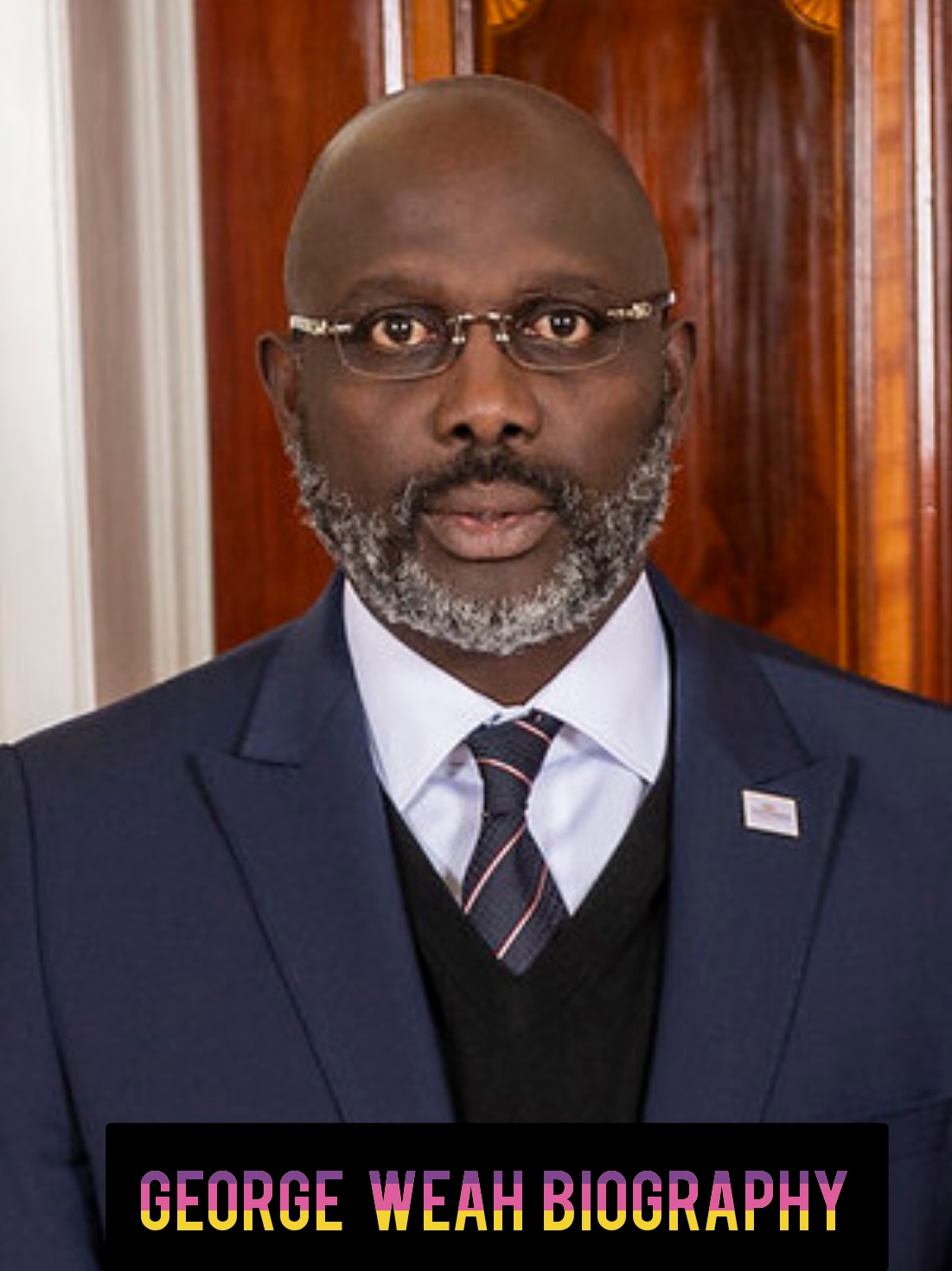
George Weah Biography
George Weah stands as one of the most extraordinary figures in modern African history. From the dusty streets of a Monrovia slum to the grand stages of European football and the highest office in Liberia, his life story captures the power of determination, talent, and an unyielding will to rise above circumstances. As a footballer he achieved what no other African player has matched. As a leader he guided his nation through a peaceful democratic transition. His journey continues to inspire people across the continent and beyond.
Few athletes have ever combined world class sporting excellence with the responsibilities of national leadership in the way George Weah has. His path from poverty to global recognition and then to the presidency of Liberia offers a rare example of how personal success can translate into public service. This biography explores every major chapter of that journey with care and clarity.
George Weah An Unforgettable Opening Moment
In 1995 the football world watched in amazement as a player from Liberia lifted both the Ballon d’Or and the FIFA World Player of the Year trophy in the same season. No African player had ever claimed either award before. George Weah became the first and remains the only one. That single year of individual brilliance sealed his place among the greatest strikers the game has known and announced to the world that talent from the poorest corners of Africa could conquer the highest levels of European football. The image of the Liberian striker holding those trophies still stands as a powerful symbol of possibility.
George Weah Early Life
George Manneh Oppong Weah was born on October 1, 1966, in Monrovia, the capital of Liberia. He entered the world in the Clara Town community, a crowded and underprivileged area known for its difficult living conditions. His father, William Tarpeh Weah, worked as a mechanic. His mother, Anna Quayeweh Weah, earned a living as a market seller. Both parents belonged to ethnic groups with deep roots in Liberia. His father came from the Kru people of Grand Kru County while his mother came from the Bassa people of Grand Bassa County. The young George was one of thirteen children in a large extended family.
His parents separated while he was still a baby. Responsibility for raising him fell largely to his paternal grandmother, Emma Forkay Klonjlaleh Brown, a devout Christian woman who provided stability and moral guidance in an environment marked by scarcity. Life in Clara Town demanded resilience. Food was often limited. Housing was basic. Opportunities for formal advancement were few. Yet the streets of the neighborhood became George’s first training ground. He and other children created footballs from rags and whatever materials they could find. They played for hours on uneven and dusty surfaces, developing the strength, speed, and instinctive skill that would later define his professional career.
Education came in stages. He attended Daniel E. Howard and C. W. Brumskine elementary schools, then moved to junior high at G. W. Gibson and Ellen Mills Scarborough. For secondary school he went to Muslim Congress and Wells Hairston High School. He left school before completing his final year. For a period he worked as a telephone operator to support himself. Football remained the constant focus of his energy and ambition. By his mid teens he was already playing for local teams and drawing attention for his powerful running and clinical finishing.
Years later, after achieving international fame, he returned to formal education. In 2007 he earned a high school diploma from Continental Academy in the United States. In 2011 he completed a bachelor’s degree in business administration at DeVry University in Miami. In 2013 he added a master’s degree in public administration from the Keller Graduate School of Management at the same institution. These achievements reflected a lifelong commitment to self improvement that matched his athletic discipline.
George Weah Personal Life
George Weah married Clar Marie Weah, a Jamaican born businesswoman and philanthropist, in 1993. The couple met in New York in late 1991 when Clar worked in customer service at a bank and George was establishing his European career. Their relationship grew steadily and has remained a central source of support through the many changes in his life. Clar later served as First Lady of Liberia during his presidency and focused her efforts on programs supporting children, women, and vulnerable communities.
Together they have three children: George Weah Junior, Martha often known as Tita, and Timothy. George Junior pursued football and music. Timothy has become a professional footballer, representing clubs in Europe and the United States national team. Weah also has a fourth child from another relationship. Family life has always held importance for him. He has spoken of the values of hard work and humility that he seeks to pass on, values rooted in his own upbringing under his grandmother’s care.
Faith has played a meaningful role across different stages of his life. Raised in a Christian household, he converted to Islam for about ten years during his early professional career before returning to Christianity after his grandmother’s death in 1994. He remains a practicing Christian and a member of a Methodist church in Monrovia. He holds French citizenship in addition to his Liberian nationality and speaks French fluently, a skill developed during his long years in European football.
Beyond family and faith, Weah has shown consistent interest in humanitarian work. He became a UNICEF Goodwill Ambassador in 1997 and used his platform to support immunization campaigns, HIV and AIDS education, and child welfare programs in Liberia and other African countries. Nelson Mandela once referred to him as an African Pride, a recognition of the positive influence he has sought to exercise beyond the football pitch.
George Weah Rise to Prominence
The path from local Liberian football to European stardom began in the early 1980s. At the age of fifteen Weah joined Young Survivors, a modest club in Clara Town. He scored freely and helped the side gain promotion. Moves to Bong Range United, Mighty Barrolle, and Invincible Eleven followed. With Invincible Eleven he won the Liberian Premier League in 1987 and finished as top scorer. His performances earned a move to Tonnerre Yaoundé in Cameroon in 1987. There he continued to impress, winning the Challenge Cup and attracting the attention of European scouts.
The decisive breakthrough came through the recommendation of Claude Le Roy, then coach of the Cameroon national team, who spoke of the young Liberian to Arsène Wenger, manager of AS Monaco. In 1988 Weah signed for Monaco. Under Wenger’s guidance he adapted quickly to the higher technical and tactical demands of French football. He helped the club win the Coupe de France in 1991 and established himself as one of the most exciting attackers in the league. In 1989 he was named African Footballer of the Year for the first time.
A transfer to Paris Saint Germain in 1992 elevated his profile further. At PSG he won the French league title in 1994, two Coupe de France trophies, and the Coupe de la Ligue. He also finished as the top scorer in the 1994 to 1995 UEFA Champions League with seven goals. His combination of explosive pace, physical power, and clinical finishing made him a constant threat. By the summer of 1995 major European clubs competed for his signature. He chose AC Milan, one of the most prestigious clubs in world football.
George Weah Major Achievements
The years at AC Milan from 1995 to 2000 marked the peak of his playing career. He won Serie A titles in the 1995 to 1996 and 1998 to 1999 seasons. His performances in 1995 earned him the Ballon d’Or, the FIFA World Player of the Year award, and a third African Footballer of the Year honor. These individual accolades remain unique in African football history. One of his most celebrated goals came in a Serie A match against Verona when he collected the ball near his own penalty area, dribbled the length of the pitch past multiple defenders, and finished calmly. The goal is still regarded as one of the finest individual efforts in Italian football.
Later short spells at Chelsea, where he won the FA Cup in 2000, Manchester City, Olympique de Marseille, and Al Jazira in the United Arab Emirates completed his club career. He retired from professional football in 2003 after an eighteen year journey that took him from Liberian domestic leagues to the very top of the European game. For the Liberian national team he served as captain and leading scorer, inspiring a generation of players even though the side never reached a major tournament finals during his peak years. His number fourteen jersey was later retired by the national association in recognition of his contributions.
Beyond individual and club honors, Weah used his success to support Liberian football and humanitarian causes. He funded the national team at times when resources were scarce and remained a visible advocate for peace and development in his homeland during periods of civil conflict.
George Weah Challenges and Setbacks
The road was never free of obstacles. Growing up in Clara Town meant constant exposure to poverty and limited opportunity. Civil war in Liberia during the 1990s brought additional hardship and uncertainty for his family and community even as he built his career abroad. On the pitch he faced the usual pressures of adaptation to new countries, languages, and playing styles. Early doubts about whether a player from a small African nation could succeed at the highest European level proved unfounded, yet the scrutiny remained intense.
Transitioning into politics brought a different set of challenges. When he first ran for the presidency in 2005 he finished second to Ellen Johnson Sirleaf. Critics questioned his limited formal education and political experience. He responded by completing his academic qualifications and building a political organization, the Congress for Democratic Change. Election as senator for Montserrado County in 2014 provided valuable legislative experience. Victory in the 2017 presidential election made him the first former African professional footballer to become a head of state and marked the first peaceful democratic transfer of power in Liberia in more than seventy years.
His six year presidency from 2018 to 2024 tested him further. High public expectations for rapid economic improvement met the realities of a fragile post conflict economy. Inflation rose. Salary delays affected civil servants. A major controversy involving newly printed banknotes and a related currency exercise in 2018 fueled public anger and accusations of mismanagement. Corruption perceptions remained high. Protests occurred. Some of the ambitious promises of his campaign proved difficult to deliver fully. In the 2023 election he lost a close runoff to Joseph Boakai and left office in January 2024. The peaceful concession earned widespread praise as a demonstration of democratic maturity.
Throughout these difficulties Weah consistently returned to the same principles that had guided his football career: hard work, resilience, and a refusal to accept permanent defeat. He used setbacks as motivation to improve rather than reasons to withdraw.
George Weah Legacy and Current Status
George Weah’s legacy rests on two foundations that few individuals ever combine. In football he remains the sole African winner of the Ballon d’Or and FIFA World Player of the Year awards. His career helped open doors for subsequent generations of African players and demonstrated that excellence could emerge from the most challenging environments. In politics he showed that a figure from outside the traditional political elite could win the confidence of voters and oversee a peaceful handover of power. His decision to concede after the 2023 election reinforced democratic norms in a region where such transitions have not always been smooth.
Since leaving office he has remained active in public life. He has reengaged with football governance, including a role with FIFA focused on players’ voices and efforts against racism. He continues to hold significant influence within the Congress for Democratic Change and has indicated interest in future political involvement. His children, particularly Timothy, carry the family name into professional football at a high level. Humanitarian work and public speaking remain part of his activities. The story of the boy from Clara Town who became a global sports icon and then president of his country continues to resonate with young people across Africa who see in him proof that circumstance need not define destiny.
Conclusion
George Weah’s life demonstrates that talent, discipline, and perseverance can overcome even the most difficult beginnings. From the streets of a Monrovia slum to the pinnacle of world football and the presidency of Liberia, he has written a story that belongs both to sport and to the broader human experience of striving for something greater. His achievements on the pitch remain unmatched by any other African player. His service in office, whatever its limitations, contributed to the strengthening of democratic practice in his nation. The example he has set continues to encourage those who face long odds and still choose to pursue excellence and public contribution.
FAQs
Who is George Weah?
George Weah is a Liberian former professional footballer and politician who served as the twenty fifth president of Liberia from 2018 to 2024. He is the only African player to have won the Ballon d’Or and the FIFA World Player of the Year award.
When and where was George Weah born?
He was born on October 1, 1966, in Monrovia, Liberia, and grew up in the Clara Town community.
What are George Weah’s greatest football achievements?
His greatest achievements include winning the Ballon d’Or and FIFA World Player of the Year in 1995, three African Footballer of the Year awards, and Serie A titles with AC Milan. He is regarded as one of the finest strikers of his generation.
Who is George Weah’s wife?
He is married to Clar Marie Weah, a Jamaican born businesswoman and philanthropist who served as First Lady of Liberia during his presidency.
How many children does George Weah have?
He has four children. Three of them, George Junior, Martha, and Timothy, are with his wife Clar. Timothy is a professional footballer.
Did George Weah play for any English clubs?
Yes. He played briefly for Chelsea, where he won the FA Cup, and for Manchester City.
What political party did George Weah lead?
He founded and led the Congress for Democratic Change, later forming part of a broader coalition that supported his successful 2017 presidential campaign.
When did George Weah serve as president of Liberia?
He served from January 22, 2018, until January 2024.
What challenges did George Weah face as president?
His administration dealt with economic difficulties, high inflation, public concerns over corruption, and the lasting effects of earlier civil conflict. These issues contributed to his narrow electoral defeat in 2023.
What is George Weah doing now?
After leaving the presidency he has remained involved in football related initiatives and Liberian politics. He continues to be a significant public figure both in Liberia and internationally.