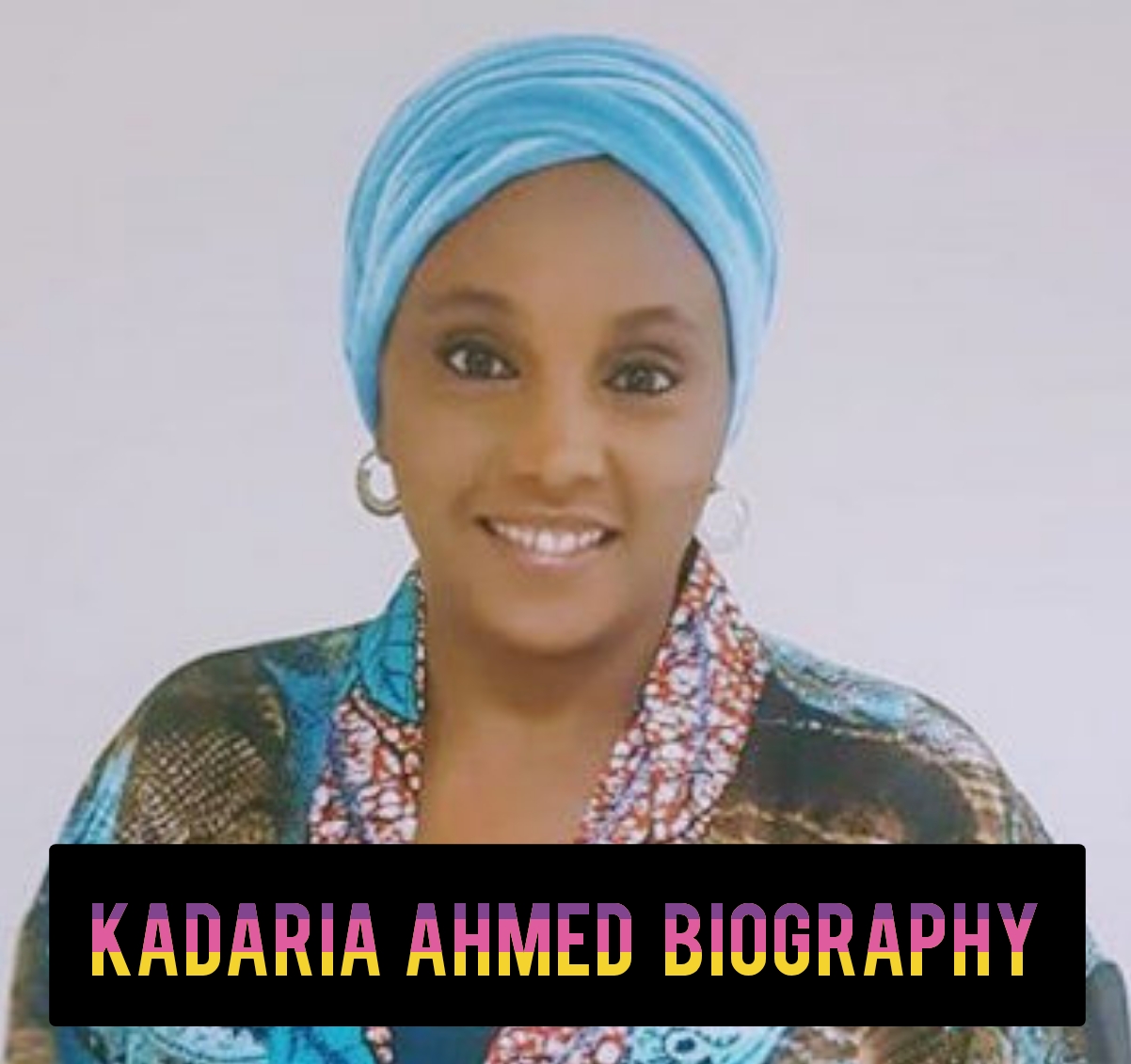
Kadaria Ahmed Biography
Kadaria Ahmed stands as one of Nigeria’s most respected voices in journalism and media entrepreneurship. Over more than three decades she has moved from the newsrooms of the BBC in London to the front lines of Nigerian broadcast and digital media, always guided by a clear commitment to public service journalism. Her work has shaped national conversations on governance, accountability, gender equity and nation building. Through television interviews that refused to flinch, radio platforms that prioritise facts over noise, and a documentary that placed women’s political struggles in sharp focus, she has consistently asked hard questions of those in power while remaining unapologetically pro Nigeria.
This biography traces the path of a woman who began life in the cultural heartland of northern Nigeria, travelled across continents for education and professional growth, and returned home to build institutions that continue to influence how Nigerians understand their country and themselves.
Kadaria Ahmed Early Life
Kadaria Ahmed was born on December 13, 1967, in Kano, Nigeria. She grew up in a family that placed high value on education, writing and public service. Her mother, Hafsat Abdulwaheed, is widely recognised as the first woman from northern Nigeria to publish a novel in the Hausa language. Hafsat’s pioneering literary work and her later advocacy for women’s rights created an environment in which young Kadaria learned early that words could challenge tradition and open new possibilities. Her father, Muhammed Ahmed Abdulwaheed, was a respected figure whose own background linked the family to deeper historical and commercial roots in the region, including ties to Zamfara. The household was one in which ideas were discussed, books were present, and the expectation that children especially girls would pursue learning was clear.
Kano in the late 1960s and 1970s was a busy commercial and cultural centre. Islamic scholarship, Hausa literary traditions and the rhythms of a growing Nigerian city shaped daily life. Kadaria attended local primary and secondary schools before proceeding to Bayero University Kano. There she studied communications and earned her bachelor’s degree. The university years coincided with a period of intellectual ferment in northern Nigeria, and the Department of Mass Communication provided both technical training and exposure to the responsibilities of the press in a developing democracy.
A decisive educational turning point came when she won a Chevening Scholarship. The award took her to Goldsmiths, University of London, where she completed a Master of Arts degree in Television. The programme combined practical production skills with critical thinking about the role of media in society. Living and studying in London also broadened her understanding of international broadcasting standards and the possibilities of radio and television as tools for informing large audiences across Africa. By the time she finished her studies she carried both solid Nigerian grounding and British professional training, a combination that would define much of her later career.
Family connections further enriched her early outlook. She is the elder sister of Zainab Ahmed, who later served as Nigeria’s Minister of Finance, and of Asia Ahmad el Rufai. These relationships placed her within networks of public service while reinforcing the importance of integrity and independent thought. From childhood she absorbed the lesson that privilege carried responsibility, and that storytelling whether in literature or journalism could serve the wider community.
Kadaria Ahmed Personal Life
Kadaria Ahmed has always drawn a careful line between her public work and her private world. She is married to Yemi Adesida, a professional whose background is Yoruba. Their marriage required mutual respect across cultural and regional lines; he embraced Islam before the union was formalised, reflecting the family’s commitment to shared faith and values. Together they have two children. The family has largely stayed out of the media spotlight, choosing a quiet domestic life that balances the intensity of her professional commitments.
She is a practising Muslim and has repeatedly affirmed that her faith remains personal and unchanged despite occasional online rumours to the contrary. Those false claims have sometimes escalated into threats, yet she has responded with calm insistence on the facts and continued focus on her work. Lesser known aspects of her character include a strong interest in mentoring younger journalists, especially women, and a practical commitment to education. She has supported scholarships in her father’s name and organised training workshops that equip new practitioners with ethical and technical skills.
Hobbies and personal interests remain largely private, consistent with her preference for substance over celebrity. Colleagues and friends describe her as disciplined, deeply prepared, and capable of both sharp analysis and genuine warmth once the cameras stop rolling. She has spoken of the support of close friends and professional allies who encouraged her to take risks she might otherwise have avoided. One such relationship proved pivotal when she first stepped in front of a television camera. These quieter dimensions of her life relationships built on trust, a protective approach to family, and a steady dedication to continuous learning form the foundation that allows her public voice to remain steady even under pressure.
Kadaria Ahmed Rise to Prominence
Kadaria Ahmed’s professional journey began in the early 1990s at the British Broadcasting Corporation in London. She started as a part time producer and rose to senior producer roles on the flagship programmes Focus on Africa and Network Africa. In those positions she shaped daily news agendas, conducted interviews with leaders across the continent, and reported from locations that included South Africa during its transition, Eritrea during conflict, and the United Nations. The BBC years taught her the craft of clear, fair and rigorous storytelling under tight deadlines and high editorial standards. After roughly fourteen years she returned to Nigeria with a wealth of international experience and a determination to apply it at home.
Back in Nigeria she first worked in corporate communications for energy and hospitality groups before being head hunted by Pulitzer Prize winning journalist Dele Olojede to help lead the newspaper Next. As managing editor and later editor she supervised a newsroom of more than one hundred staff and stringers. Next became known for investigative reporting that set a high bar for Nigerian print journalism. The paper’s eventual closure of its print edition in 2011 was a professional setback, yet it also freed her to explore new formats.
The breakthrough moment arrived in March 2011. A former BBC colleague invited her to co moderate Nigeria’s first major live televised presidential and vice presidential debates organised by NN24. She had spent her career largely behind the scenes and felt intense nervousness. On the night of the vice presidential debate her mouth went dry and she kept licking her lips, a detail she later recounted with honesty. Despite the fear she delivered a composed performance. That single event moved her from editorial rooms into the national spotlight and opened the door to on camera work she had previously avoided.
In 2014 she co created, produced and presented Straight Talk, an interview programme designed to probe Nigeria’s decision makers without the usual soft questions. The show reached audiences of several million and featured conversations with figures such as Ibrahim Babangida, Babatunde Fashola, Rotimi Amaechi and Oby Ezekwesili. Three years later she launched The Core on Channels Television. One of its most widely discussed episodes was her 2017 interview with Nnamdi Kanu, in which the IPOB leader declared “Biafra or death.” The exchange demonstrated her ability to create space for difficult views while keeping the focus on national consequences.
These programmes established her as one of the country’s foremost political interviewers. She combined preparation, calm persistence and an insistence on clarity that forced guests to engage with substance rather than rhetoric. The transition from radio producer and newspaper editor to television host illustrated both professional adaptability and personal courage.
Kadaria Ahmed Major Achievements
Across print, radio, television and digital platforms Kadaria Ahmed has left a measurable mark on Nigerian media. At the BBC she contributed to programmes that informed audiences across Africa and beyond. At Next she helped institutionalise investigative standards that influenced a generation of reporters. Her television work with Straight Talk and The Core set new expectations for political interviewing in a media environment often criticised for deference or sensationalism.
In 2017 she founded Daria Media Limited with the explicit purpose of advancing public service journalism. The company has produced content focused on accountability, inclusion and nation building. It has also received support from organisations such as the Ford Foundation, the MacArthur Foundation, OSIWA and PLAC for projects that strengthen civic awareness. In 2020 she became managing director of Radio Now 95.3 FM in Lagos. The station’s mission is to deliver factual, Nigeria focused programming that helps citizens hold power accountable and fosters social consciousness.
A recent and significant achievement is the documentary Double Minority. Produced with MacArthur Foundation support and directed by Kadaria Ahmed, the film follows nine women who contested elective office during the 2023 general elections. It examines the structural barriers cultural bias, limited funding, internal party obstacles and outright violence that women face when they seek political power. The documentary premiered in 2025 and has been screened and discussed in multiple forums, contributing to ongoing debates about gender representation in Nigerian governance. It stands as both a journalistic record and an advocacy tool.
She has moderated high profile national events, including the 2011 presidential debates and the 2019 town hall series featuring President Muhammadu Buhari and other candidates. She sits on boards and panels that shape media standards, including the Nigerian board of the International Press Institute, the Premium Times Centre for Investigative Journalism, the Wole Soyinka Centre for Investigative Journalism and the Promasidor Quill Awards. She is a member of the Nigerian Guild of Editors and the Nigerian Institute of Directors. Her written work has appeared in the Daily Trust, The Guardian, Premium Times and the Financial Times of London. She has also edited collections such as Nigeria the Good News and a volume on climate resilience in Lagos.
These achievements share a common thread: a belief that journalism should serve the public interest by clarifying issues, confronting power and amplifying voices that are too often sidelined.
Kadaria Ahmed Challenges and Setbacks
The path has not been smooth. The closure of Next’s print edition removed a platform she had helped build and left many talented colleagues without institutional support. Transitioning to television required overcoming personal reluctance and the intense scrutiny that comes with being the visible face of difficult conversations. Online smear campaigns have repeatedly targeted her credibility. One episode involved false claims about land allocation in Kaduna; she responded with detailed public clarification of the application process and the eventual loss of the plots. Another involved fabricated stories and AI generated videos that used her image to promote fraudulent schemes, prompting official disclaimers from her stations.
Threats have been more serious. In one widely reported case a social media user issued a death threat based on the false allegation that she had converted from Islam. Family members publicly confirmed that she has remained a Muslim throughout her life. Accusations of bias during election coverage, particularly the 2019 presidential town halls, have also surfaced. She has answered such claims by pointing to the differing levels of engagement shown by the candidates themselves and by reaffirming her commitment to fairness rather than favouritism.
Working as a woman in a male dominated media and political landscape has brought additional pressures. She has spoken of periods at the BBC when she was the only Black person in certain newsroom meetings, and of the need for mutual support among women professionals once she returned to Nigeria. Her response to these obstacles has been consistent: document the facts, refuse to be silenced, continue the work, and invest in the next generation through training and scholarships. The challenges have tested resilience yet have also sharpened her understanding of why independent media and inclusive public discourse matter.
Kadaria Ahmed Legacy and Current Status
Today Kadaria Ahmed continues as Executive Director of Daria Media and Managing Director of Radio Now 95.3 FM. Through these platforms she shapes daily content that prioritises accuracy, accountability and national cohesion. The documentary Double Minority has extended her influence into long form storytelling and gender advocacy, ensuring that the experiences of women seeking political office remain visible. She remains active on boards that set professional standards and mentors younger journalists who see in her career a model of integrity and persistence.
Her legacy is already evident in the raised expectations she has helped create for political interviewing, in the institutional platforms she has built, and in the quiet but steady encouragement she offers to those entering the profession. She has demonstrated that a journalist can confront power without theatricality, that media entrepreneurship can prioritise public value, and that a woman from northern Nigeria can occupy the centre of national conversation while remaining true to her roots and convictions. Recent activities including board service with international media organisations and continued production work show that her influence is still expanding rather than receding.
Conclusion
Kadaria Ahmed’s story is one of preparation meeting opportunity, of private resolve sustaining public courage, and of a consistent belief that honest information is essential to a functioning society. From the classrooms of Bayero University and the studios of the BBC to the airwaves of Radio Now and the screens showing Double Minority, she has treated journalism as a form of service. In a media environment often strained by commercial pressure, political interference and ethnic division, her example reminds us that clarity, fairness and persistence still matter. The questions she continues to ask and the platforms she continues to build are investments in a more accountable and inclusive Nigeria.
FAQs
Who is Kadaria Ahmed?
Kadaria Ahmed is a Nigerian British journalist, media entrepreneur, television host and the managing director of Radio Now 95.3 FM. She is also the founder of Daria Media, a company dedicated to public service journalism.
When and where was Kadaria Ahmed born?
She was born on December 13, 1967, in Kano, Nigeria.
What is Kadaria Ahmed’s educational background?
She earned a bachelor’s degree in communications from Bayero University Kano and a Master of Arts in Television from Goldsmiths, University of London. She is also a Chevening Scholar.
What are some of Kadaria Ahmed’s major career milestones?
Key milestones include senior producer roles at the BBC, editorship of the newspaper Next, moderation of Nigeria’s 2011 presidential debates, creation of the television programmes Straight Talk and The Core, founding of Daria Media, leadership of Radio Now 95.3 FM, and direction of the documentary Double Minority.
Is Kadaria Ahmed married?
Yes, she is married to Yemi Adesida and they have two children.
What is the focus of Daria Media and Radio Now?
Both organisations emphasise factual, Nigeria focused content that promotes accountability, inclusion and nation building.
Has Kadaria Ahmed faced controversies?
Yes. She has faced online smear campaigns, false allegations about land allocation and religion, accusations of bias in election coverage, and threats. In each case she has responded with factual clarification and continued her professional work.
What is the documentary Double Minority about?
Double Minority follows nine Nigerian women who contested elective office in the 2023 general elections. It examines the systemic barriers they encountered and aims to contribute to national discussion on gender representation in politics.