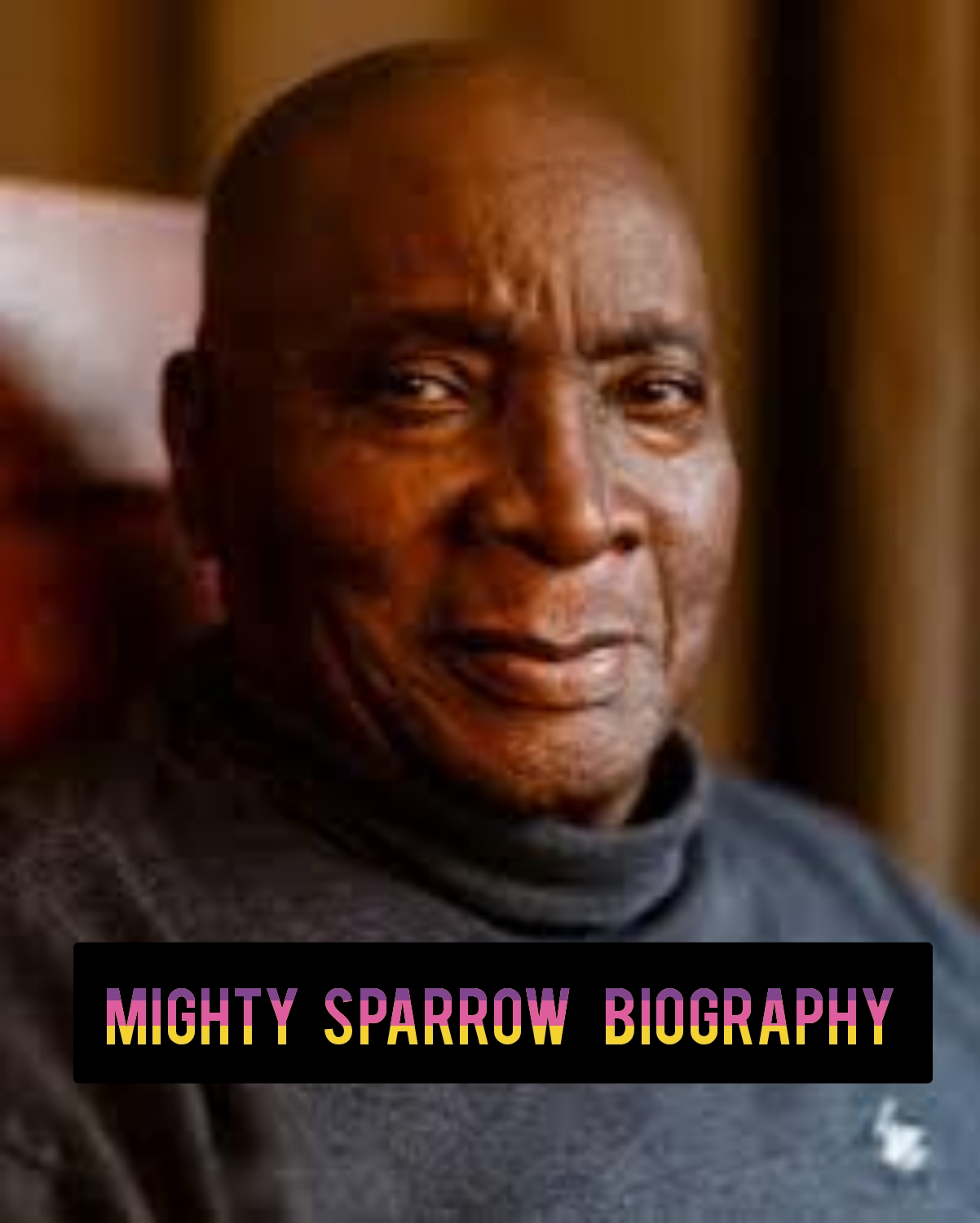
Mighty Sparrow Biography
Mighty Sparrow stood as the undisputed Calypso King of the World for more than six decades. Born Slinger Francisco, he transformed calypso from a local Trinidadian art form into a global musical force through sharp wit, unforgettable melodies, and fearless social commentary. His songs mixed humor, politics, and storytelling in ways that captured the spirit of the Caribbean while reaching audiences far beyond its shores. With more than five hundred original compositions and over seventy albums, he left a body of work that continues to define the genre.
Mighty Sparrow Early Life
Slinger Francisco was born on 9 July 1935 in the fishing village of Grand Roy on the island of Grenada. His parents were Rupert Francisco, a carpenter, and Clarissa Francisco. When he was still an infant, his mother took him to Trinidad to join his father, who had moved there seeking better work opportunities. The family settled in Laventille, a working class suburb of Port of Spain. Growing up in that environment shaped his later view of life and gave him a lifelong identification with ordinary people.
As a boy he sang in the choir at Newtown Boys Catholic School and later at St. Patrick’s Catholic Church. There he learned Gregorian chants and Latin hymns, experiences that refined his vocal control and sense of harmony. Calypso was discouraged in the formal school setting, yet the music of the streets and Carnival called to him. At the age of fourteen he joined a neighborhood steel band and performed during Carnival. His energetic style of moving while singing stood out among the more stationary performers of the day. Fellow musicians began calling him Little Sparrow because of the way he darted about the stage. Over time the name evolved into Mighty Sparrow, a title that matched both his small physical stature and his large musical presence.
He taught himself to play the guitar and began writing his own songs. After leaving school he worked for a time with the government’s Control Board, but evening performances soon proved more rewarding. A residency at the Lotus Club helped establish him as a local favorite. These early years in Port of Spain’s vibrant yet challenging neighborhoods gave him the material and the motivation that would fuel a lifetime of songwriting. He absorbed the sounds of American jazz and popular singers such as Nat King Cole and Frank Sinatra while remaining rooted in the calypso tradition of storytellers like Lord Melody and Lord Kitchener.
Mighty Sparrow Personal Life
Mighty Sparrow maintained a large and close family throughout his long life. He was married to Margaret Skinner, a Barbadian woman who remained by his side for many years. Together they raised a family that grew to include numerous children. Among them were daughters Karen Francisco, who publicly announced his passing, Gina Francisco, Michelle, Nicole, Alicia, Atiyah, and sons including Frederick, Anthony, Leroy, Leon, Mario, Sancho, and Jabari. He was also a grandfather and great grandfather. Family members often described him as a devoted father who made each of his children feel special and valued.
In later years he lived primarily in Jamaica, Queens, in New York, while keeping strong ties to Trinidad. He became a familiar figure at the annual West Indian Day Parade in Brooklyn. Despite the demands of international touring and a demanding creative life, he valued time with family. In 2022, at the age of eighty seven, he was baptized into the Seventh Day Adventist faith in Brooklyn. Faith became an important part of his final years. He was known among those close to him for a generous spirit and a welcoming manner that extended beyond the stage.
Lesser known aspects of his character included a deep interest in current events and a willingness to speak plainly about social issues. He enjoyed the company of fellow musicians and maintained friendships across generations of Caribbean artists. Even as fame grew, he retained a down to earth quality that endeared him to fans and colleagues alike. His private life remained largely focused on family and the quiet satisfaction of creating music that spoke to everyday experiences.
Mighty Sparrow Rise to Prominence
Mighty Sparrow made his first appearance as a carnival singer in 1954 with the song The Parrot and the Monkey. By 1955 he was recording for local labels. The true breakthrough arrived in 1956 when he entered Trinidad’s Carnival competitions with Jean and Dinah, also known as Yankees Gone. The song cleverly observed the situation of local women after American military bases closed on the island. He won both the Calypso King title and the Road March competition that year, an extraordinary double victory for a young performer. The song became an international success and was later covered by Harry Belafonte, helping introduce calypso to wider audiences.
His energetic stage presence and sophisticated songwriting quickly set him apart. In 1957 he recorded his first full album and continued to release material that mixed social observation with danceable rhythms. A dispute over prize money and industry practices led him to write Carnival Boycott, a pointed critique that temporarily kept him out of the competitions. When he returned, he resumed his dominance. Throughout the late 1950s and 1960s he won the Road March and Calypso Monarch titles multiple times, sometimes claiming both in the same year.
Major labels took notice. He signed with RCA and recorded a series of albums that brought polished production and jazz influenced arrangements to his work. Songs such as Mae Mae, Federation, and Dan Is the Man in the Van displayed his range, moving from lighthearted storytelling to sharp political commentary. Collaborations with musicians such as Byron Lee expanded his reach. By the end of the 1960s he was firmly established as the leading figure in calypso, capable of filling venues across the Caribbean, North America, and Europe.
Mighty Sparrow Major Achievements
Mighty Sparrow won Trinidad’s Carnival Road March competition eight times and the Calypso King or Monarch title eight times. He also claimed the Calypso King of Kings title on two occasions. These victories alone would secure a place in the history of the music, yet they represent only part of his contribution. He recorded more than seventy albums and wrote over five hundred songs, many of which became standards performed by artists across the Caribbean and beyond.
His catalog includes enduring hits such as Jean and Dinah, Congo Man, Mr. Walker, Obeah Wedding, Education, and Only a Fool Breaks His Own Heart. The latter, recorded with Byron Lee, became a significant success in Europe. He addressed themes of independence, education, social inequality, and everyday human relationships with equal skill. Albums from the 1960s, particularly those featuring arrangements by Ron Berridge, are often cited as high points of the genre, blending traditional calypso with jazz sophistication.
Honors accumulated over the decades. In 1987 the University of the West Indies awarded him an honorary Doctor of Letters. He received the Humming Bird Medal and later the Chaconia Medal from Trinidad and Tobago. In 2001 he was named to the Order of the Caribbean Community. The government of Trinidad and Tobago conferred the Order of the Republic of Trinidad and Tobago, the nation’s highest honor. In 2015 he was appointed an Officer of the Order of the British Empire. Lifetime achievement awards from various cultural organizations further recognized his global impact. Colin Powell once described him as the Mount Olympus of calypso, a reflection of the respect he commanded among listeners of many backgrounds.
His influence extended to the evolution of the music itself. As calypso gave rise to soca, Sparrow adapted while remaining true to the storytelling core of the tradition. He mentored younger artists and maintained an active presence on stages well into advanced age, demonstrating both longevity and continued creativity.
Mighty Sparrow Challenges and Setbacks
The path of a calypsonian in the mid twentieth century was never simple. Prize money in the early Carnival competitions was modest, and the industry often undervalued the artists who created the music. Sparrow’s decision to boycott the contests after his first major wins highlighted these tensions. The move carried financial risk, yet it also helped push for better conditions. Health challenges appeared later in life. In the 2010s complications including diabetes and other medical issues required adjustments to his schedule and performance intensity.
Living between Trinidad and New York meant balancing two homes and two communities. The demands of constant travel and recording took a physical toll over seven decades of professional activity. Public expectations remained high even as he aged. Fans hoped for a major stage return around his ninetieth birthday in 2025, but that appearance did not materialize. Through these difficulties he continued to compose and to appear when health allowed. His response was consistent: he returned to the work of writing and performing, drawing strength from the music itself and from the support of family.
The competitive nature of the calypso world also brought rivalries, most notably with Lord Kitchener. These contests pushed both artists to higher levels of creativity. Sparrow met each challenge by focusing on craft and by trusting the connection he had built with audiences. The combination of resilience and ongoing productivity allowed him to outlast many contemporaries and to remain relevant across changing musical eras.
Mighty Sparrow Legacy and Current Status
Mighty Sparrow passed away on 27 September 2026 at a hospital in Queens, New York, at the age of ninety one. His daughter Karen Francisco announced the news, describing him as an institution in the entertainment industry and a beloved mentor. Tributes poured in from across the Caribbean and from international artists who recognized his foundational role. His body was returned to Trinidad for final honors, and cultural events dedicated segments of Calypso History Month to his memory.
His legacy lives in the continued performance of his songs, in the standards he set for lyrical intelligence and stage presence, and in the generations of musicians who followed the path he cleared. Calypso remains a vital expression of Caribbean identity in large part because of the international platform he built. Younger artists still study his recordings for lessons in phrasing, storytelling, and social observation. Statues, awards, and academic recognition ensure that his name remains central to the history of the music.
In the years leading to his death he continued to be celebrated as the definitive voice of the form. Even after he reduced public appearances, new listeners discovered his catalog through reissues and digital platforms. The breadth of his work, spanning pure calypso, experiments with other styles, and late career reflections, offers a complete portrait of an artist who never stopped engaging with the world around him.
Conclusion
Mighty Sparrow proved that a voice rooted in a specific place and culture can speak to the entire world. From a fishing village in Grenada to the stages of Port of Spain, New York, and beyond, he carried the stories of ordinary people with extraordinary skill and humor. His career reminds us that lasting art combines sharp observation, technical mastery, and genuine connection with an audience. In elevating calypso, he elevated the Caribbean itself, leaving a body of work that continues to entertain, provoke, and inspire long after the final note has faded.
FAQs
Who was Mighty Sparrow?
Mighty Sparrow was the stage name of Slinger Francisco, a Trinidadian calypso singer, songwriter, and guitarist widely regarded as the Calypso King of the World. He dominated Carnival competitions and brought the music to international audiences.
When and where was Mighty Sparrow born?
He was born on 9 July 1935 in Grand Roy, a fishing village in Grenada. His family moved to Trinidad when he was an infant.
How many times did Mighty Sparrow win major Carnival titles?
He won the Carnival Road March competition eight times and the Calypso King or Monarch title eight times. He also won the Calypso King of Kings title twice.
What was Mighty Sparrow’s breakthrough song?
His breakthrough came in 1956 with Jean and Dinah, also known as Yankees Gone. The song won both the Road March and Calypso King titles and became an international hit.
Was Mighty Sparrow married?
Yes. He was married to Margaret Skinner and was the father of a large family that included many sons and daughters.
What honors did Mighty Sparrow receive?
He received an honorary Doctor of Letters from the University of the West Indies, the Order of the Republic of Trinidad and Tobago, the Order of the Caribbean Community, and was appointed an Officer of the Order of the British Empire, among other awards.
When did Mighty Sparrow die?
Mighty Sparrow died on 27 September 2026 in Queens, New York, at the age of ninety one.