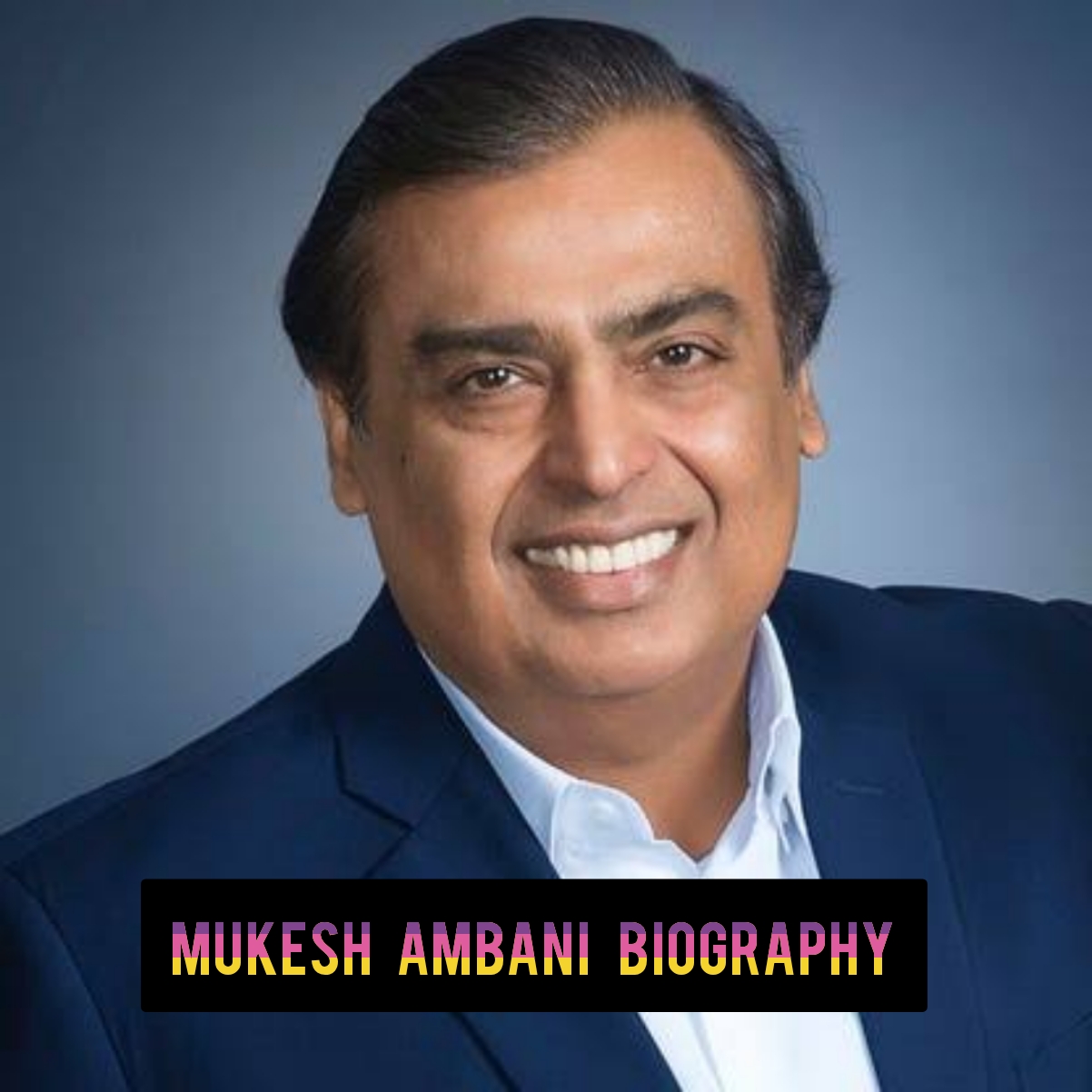
Mukesh Ambani Biography
Mukesh Ambani known as one of the most influential business leaders of modern India. As the chairman and managing director of Reliance Industries Limited, he has guided a company that began as a modest textile trader into a sprawling global conglomerate spanning energy, petrochemicals, telecommunications, retail, and digital services. His journey reflects the transformation of India’s economy itself, from the constrained years of the License Raj to the open, competitive markets of today. This biography traces the life of a man whose decisions have shaped industries, created millions of jobs, and brought high-speed connectivity to hundreds of millions of people.
What makes Mukesh Ambani’s story especially compelling is the quiet intensity with which he approaches risk. While many leaders talk of innovation, he has repeatedly committed tens of billions of dollars to projects that appeared impossible at the time, from building the world’s largest grassroots oil refinery in a remote coastal town to launching a nationwide 4G network that undercut every existing tariff structure. The results have rewritten the rules of Indian business.
Mukesh Ambani An Interesting Fact That Draws the Reader In
Few people realize that the man who now commands one of the largest private companies in the world once lived in a two-room tenement in Mumbai’s crowded Bhuleshwar neighborhood and traveled by public bus. Even after the family moved to better addresses, his father insisted that the children continue using ordinary transport so they would never lose touch with everyday India. That early discipline of simplicity and observation stayed with Mukesh Ambani. Decades later, when he decided to enter the telecommunications business, he studied how ordinary Indians used their phones and what they could afford. The result was Jio, a service that delivered unlimited data at prices so low that millions of first-time internet users came online within months. The same man who once shared a cramped flat with five other family members now lives in a 27-storey residence, yet he still speaks of scale and public trust as the twin foundations of lasting enterprise.
Mukesh Ambani Early Life
Mukesh Dhirubhai Ambani was born on 19 April 1957 in Aden, then a British crown colony at the southern tip of the Arabian Peninsula and now part of Yemen. His parents were Dhirubhai Ambani and Kokilaben Ambani, members of a Gujarati Hindu family with roots in the coastal village of Chorwad in Gujarat’s Junagadh district. Dhirubhai had left India as a teenager and worked as a petrol pump attendant and later as a clerk in a trading firm in Aden. The political climate in Aden grew unsettled, so in 1958 the family returned to Bombay, now Mumbai.
They settled in a modest two-bedroom flat in Jai Hind Estate, a typical chawl in the dense commercial quarter of Bhuleshwar. Six people shared those rooms. Dhirubhai started a small trading firm called Reliance Commercial Corporation from a one-room office near Masjid Bunder. He dealt first in spices and then in yarn and textiles. The business grew steadily through the 1960s. By the early 1970s the family had moved to a more comfortable apartment on Altamount Road, yet the children were never shielded from ordinary life. They continued to use public buses and were expected to understand the value of every rupee.
Mukesh attended Hill Grange High School on Peddar Road along with his younger brother Anil and a classmate named Anand Jain, who later became a close business associate. After secondary school he studied at St. Xavier’s College in Mumbai. He then enrolled at the University Department of Chemical Technology, now the Institute of Chemical Technology, and earned a bachelor’s degree in chemical engineering. He chose the subject himself. Many expected him to study textile engineering because of the family business, but he preferred the broader scientific foundation that chemical engineering offered.
In 1979 he traveled to the United States and began an MBA program at Stanford University. He roomed near future Microsoft chief executive Steve Ballmer. After roughly one year, his father called him home. Dhirubhai believed that real business education came from building factories and managing people, not from classrooms alone. Mukesh left Stanford in 1980 without completing the degree and returned to India to help construct a polyester filament yarn plant. That decision marked the end of formal education and the beginning of a career that would reshape Indian industry.
Mukesh Ambani Personal Life
In 1985 Mukesh married Nita Dalal, a school teacher and classical dancer whom his father had noticed at a performance. The marriage was arranged in the traditional sense, yet it grew into a genuine partnership. Nita Ambani later founded the Reliance Foundation, one of India’s largest corporate philanthropic organizations, and became the owner of the Mumbai Indians cricket team. The couple have three children. Twins Akash and Isha were born on 23 October 1991 through in-vitro fertilization after several years of waiting. Their younger brother Anant was born on 10 April 1995.
The family lives in Antilia, a 27-storey private residence on Altamount Road in Mumbai. The building contains multiple floors of living space, a garage for more than 160 cars, three helipads, a private cinema, a spa, and even a snow room to provide relief from the city’s humidity. It requires a large staff to maintain. Despite the grandeur, Mukesh maintains simple personal habits. He is a strict vegetarian and does not drink alcohol. He enjoys reading, especially technical books on gene editing, blockchain, and biographies such as Walter Isaacson’s account of Leonardo da Vinci. He watches Bollywood films, listens to old Hindi songs, swims, and takes long walks. He has said he often reads several books at the same time.
The children have gradually assumed leadership roles within Reliance. Akash chairs Reliance Jio Infocomm. Isha oversees aspects of retail and consumer businesses. Anant leads the new energy and materials vertical. In 2023 all three were appointed to the Reliance Industries board. Family gatherings remain important. The weddings of Isha and Anant were celebrated on a grand scale and drew international attention, yet the parents have spoken of the need to balance privilege with responsibility.
Mukesh Ambani Rise to Prominence
When Mukesh returned from Stanford in 1980, Reliance was still primarily a textile company trading under the Vimal brand. His first major assignment was the construction of a polyester filament yarn plant at Patalganga in Maharashtra. He was only in his early twenties. The project demanded coordination of technology, land, labor, and government clearances in an era of strict industrial licensing. He completed it successfully and began to earn his father’s confidence.
Through the 1980s and 1990s he drove backward integration. Reliance moved from making fabric to producing polyester fiber, then to the chemicals needed for that fiber, and finally to refining crude oil. In the late 1990s he led the construction of a massive petroleum refinery at Jamnagar on the Gujarat coast. At the time it was the largest grassroots refinery ever built. The complex later expanded to process more than 1.4 million barrels of oil per day at a single location, turning India from a net importer of refined fuels into an exporter. The project required thousands of workers, advanced engineering, and the creation of an entire township and port infrastructure.
Dhirubhai suffered strokes in the late 1980s and early 1990s. Mukesh took on increasing responsibility for day-to-day operations. When Dhirubhai died on 6 July 2002 without leaving a will, Mukesh was named chairman of Reliance Industries. A bitter public dispute with his brother Anil followed. Their mother Kokilaben mediated, and in 2005 the empire was divided. Mukesh retained the core energy, petrochemical, and refining businesses under Reliance Industries Limited. Anil received telecommunications, power, and financial services. The settlement was painful but allowed Mukesh to focus on scaling the assets he controlled.
Mukesh Ambani Major Achievements
Under Mukesh Ambani’s leadership, Reliance Industries became India’s largest private sector company by market capitalization and revenue. The Jamnagar complex remains a global benchmark for refining efficiency. In 2006 he launched Reliance Retail, which grew into the country’s largest organized retail network with hundreds of millions of customers across grocery, electronics, fashion, and e-commerce.
The most transformative move came in telecommunications. After studying the sector for years, he re-entered the market with Reliance Jio in 2016. Jio offered free voice calls and data at prices far below existing operators. Within months it acquired tens of millions of subscribers. By the mid-2020s it served more than 500 million users and had rolled out one of the world’s largest 5G networks. The launch forced every other operator to cut tariffs dramatically and accelerated India’s digital adoption. Jio Platforms later attracted investments from Facebook (now Meta), Google, and other global technology firms totaling more than 20 billion dollars.
Reliance also expanded into media through partnerships and acquisitions, including a major joint venture with Disney’s Indian operations that created JioStar. In new energy the company has invested in solar manufacturing, battery technology, and green hydrogen with the stated goal of becoming net-zero by 2035. Through the Reliance Foundation, the family has supported education, healthcare, rural development, sports, and disaster relief on a large scale. Nita Ambani has led many of these efforts, including the Dhirubhai Ambani International School and programs that have helped Indian athletes win medals at major international events.
Mukesh has received numerous honors, including the Ernst and Young Entrepreneur of the Year award, recognition from the Harvard Business Review as one of the world’s best-performing chief executives, the Othmer Gold Medal from the Chemical Heritage Foundation, and election as a foreign member of the United States National Academy of Engineering. He has served on advisory councils and boards that connect Indian industry with global policy discussions.
Mukesh Ambani Challenges and Setbacks
The path was never smooth. The family split after Dhirubhai’s death was publicly acrimonious and cost Mukesh the telecommunications and power businesses he had helped build. For nearly a decade he stayed out of telecom while his brother’s company struggled. When he returned with Jio, the capital required was enormous and the regulatory environment complex. Existing operators fought hard, and many analysts doubted that free data could ever become profitable.
The Krishna-Godavari D6 gas field, once promoted as a solution to India’s energy shortage, produced far less gas than expected for years and generated prolonged legal and regulatory disputes. Reliance faced questions over pricing and contracts. In the stock market, certain 2007 trades in Reliance Petroleum shares led to investigations by the Securities and Exchange Board of India. Penalties were imposed, later partly overturned by appellate and higher courts. Mukesh himself has not been convicted of any crime, yet the episodes required careful legal navigation and attracted public scrutiny.
Market competition remains intense. In recent years Reliance’s retail margins have come under pressure, and the company’s share price has fluctuated, affecting the family’s wealth ranking. Global energy transitions and geopolitical shifts in crude oil supply also present ongoing strategic challenges. Mukesh has often spoken of preparing for the worst-case scenario first and then building from there. That mindset helped the company raise record capital during the difficult months of 2020 and continue expanding even when others retreated.
Mukesh Ambani Legacy and Current Status
As of 2026 Mukesh Ambani continues to serve as chairman and managing director of Reliance Industries. His children now hold operational leadership of major verticals, and he has stated that the succession process is nearly complete. The company remains focused on digital services, consumer businesses, and the energy transition. Plans for a public listing of Jio Platforms have advanced, potentially unlocking significant value. Investments in artificial intelligence data centers, advanced materials, and renewable energy signal the next phase of growth.
His influence extends beyond balance sheets. Cheap mobile data changed how Indians access education, entertainment, banking, and government services. Organized retail modernized supply chains and created formal employment for hundreds of thousands. The philanthropic work of the Reliance Foundation reaches rural schools, hospitals, and sports academies across the country. Antilia may be a symbol of extreme wealth, yet the broader Ambani story is one of building institutions that outlast any single individual.
Mukesh Ambani remains among the richest individuals in Asia, with a fortune that rises and falls with the market value of Reliance shares. More importantly, he occupies a unique place in the narrative of India’s economic rise. From a shared tenement in Bhuleshwar to the boardrooms of global technology and energy companies, his career demonstrates what sustained ambition combined with operational discipline can achieve.
Conclusion
The life of Mukesh Ambani offers a clear lesson. Great enterprises are rarely built in comfort. They grow from the willingness to leave familiar paths, to absorb setbacks without losing direction, and to bet on the future of an entire nation. He once left a prestigious American university to build a factory in rural Maharashtra. Decades later he committed tens of billions to bring high-speed internet to every corner of India. Between those two decisions lies a continuous thread of calculated courage. For young entrepreneurs and ordinary citizens alike, his journey shows that scale is possible when vision is matched by relentless execution and a lasting respect for the people who ultimately use what is built.
FAQs
What is Mukesh Ambani’s date of birth and place of birth?
Mukesh Ambani was born on 19 April 1957 in Aden, which was then a British colony and is now part of Yemen. His family moved to Mumbai the following year.
Whom did Mukesh Ambani marry and how many children does he have?
He married Nita Dalal in 1985. They have three children: twins Akash and Isha, born in 1991, and younger son Anant, born in 1995.
Why did Mukesh Ambani leave Stanford University?
He left the MBA program in 1980 after about one year because his father asked him to return to India and help build a polyester yarn manufacturing plant for the growing family business.
What is the significance of the Jamnagar refinery?
The Jamnagar complex is the world’s largest single-location refining hub. It processes more than 1.4 million barrels of crude oil per day and helped transform India into a major exporter of refined petroleum products.
How did Reliance Jio change the Indian telecom market?
Launched in 2016, Jio offered free voice and extremely low-cost data. It acquired hundreds of millions of subscribers rapidly, forced competitors to lower prices, and accelerated nationwide internet adoption.
What role does the Reliance Foundation play?
Founded under the leadership of Nita Ambani, the foundation runs large programs in education, healthcare, rural development, sports, and disaster response. It is one of India’s most significant corporate philanthropic organizations.
Is Mukesh Ambani still the richest person in India?
His ranking fluctuates with the share price of Reliance Industries. In recent years he has alternated with other industrialists at the top of Indian wealth lists, remaining consistently among the wealthiest individuals in Asia.