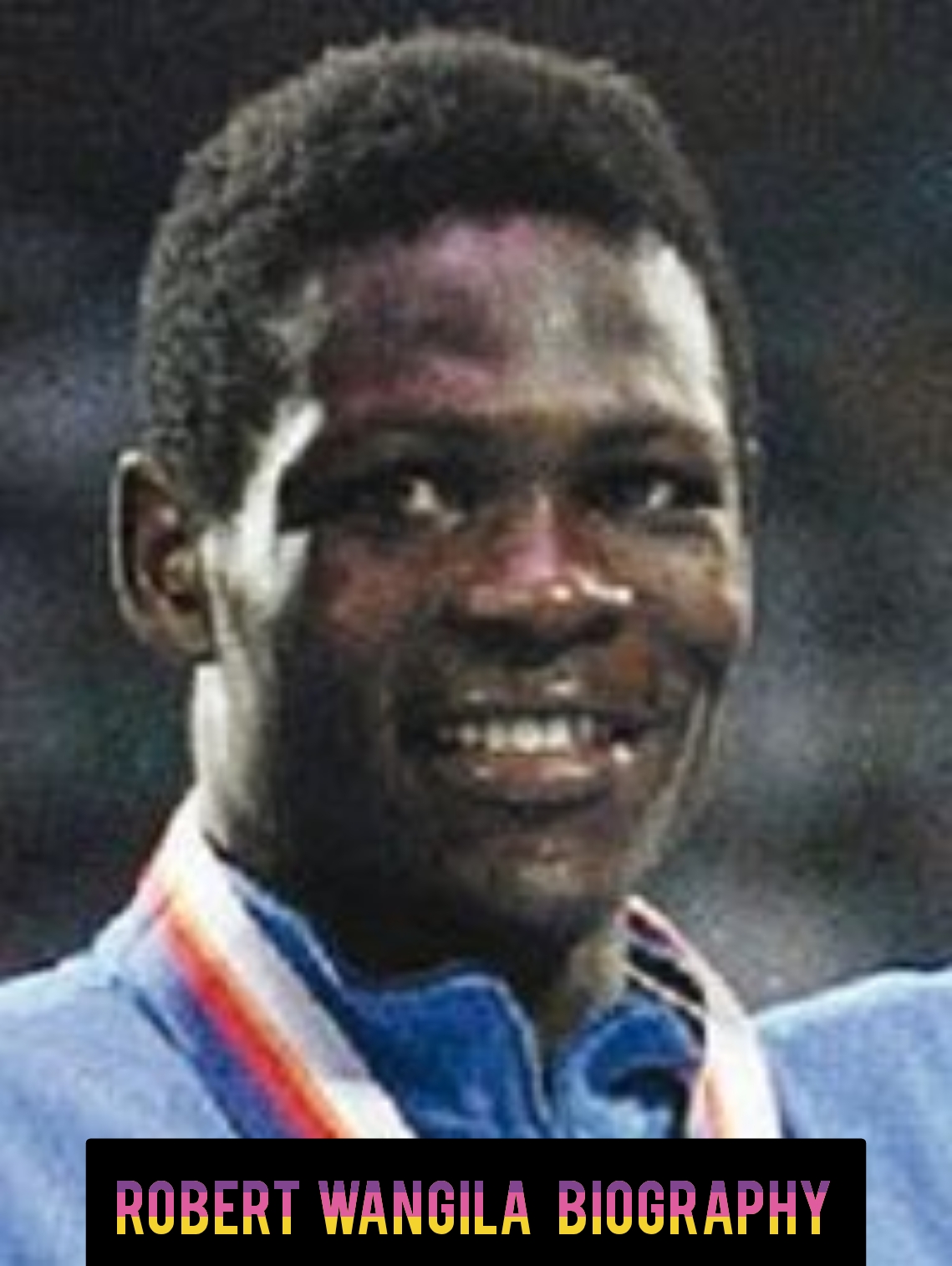
Robert Wangila Biography
Robert Napunyi Wangila holds a unique and lasting place in Kenyan and African sporting history. As the welterweight gold medalist at the 1988 Seoul Olympics he became the first Kenyan to win Olympic gold outside athletics and the only boxer from Sub Saharan Africa outside South Africa to claim an Olympic boxing title. His powerful style and determined rise from the streets of Nairobi to the highest stage of amateur boxing inspired a generation. Though his professional career and life were cut short far too soon his achievement continues to stand as a landmark for Kenyan sport.
Robert Wangila Interesting Fact That Draws the Reader In
Robert Wangila remains the only Kenyan athlete to win an Olympic gold medal in any sport other than track and field. In a nation celebrated around the world for its distance runners he alone carried the Kenyan flag to the top of the Olympic boxing podium. His victory in the welterweight final at the 1988 Seoul Games came by knockout and made him the first boxer from Sub Saharan Africa outside South Africa to achieve that honour. More than three decades later no other Kenyan has matched that feat in boxing or in any non athletics event. The gold medal he won still shines as a singular moment of national pride.
Robert Wangila Early Life
Robert Napunyi Wangila was born on September 3 1966 in Nairobi Kenya. He grew up in the Jericho neighbourhood an informal settlement on the eastern side of the capital. The area was known for its close knit community but also for the challenges of urban poverty and limited opportunities that many young people faced in post independence Kenya. Locals knew him affectionately as Roba.
His family background reflected Kenya’s rich ethnic mix. His mother Eunice Moraa Mabeche came from the Kisii community while his father was linked to the Samia sub tribe of the Luhya people from the western part of the country. Wangila later married into the Luo community further weaving together different Kenyan cultures. He also had a cousin Modest Oduori known as Napunyi a respected professional boxer. Wangila adopted the middle name Napunyi from his cousin and grew up aware of the family’s connection to the sport.
Education took second place to the realities of daily life. As a young man Wangila found work as a truck driver for the Kenya Breweries Boxing Club. While ferrying boxers and equipment he began watching training sessions from the sidelines. He quietly copied the movements and footwork he saw and soon the coaches noticed his interest and natural ability. He joined the club as a fighter and began the serious training that would change his life. The tough environment of Jericho and the discipline of the gym shaped a quiet determined young man who preferred to let his fists do the talking.
Robert Wangila Personal Life
Robert Wangila married Queen Noble also known as Grace Akinyi on May 16 1992. The couple lived in the United States during his professional career and had two children. While in America Wangila converted from Christianity to Islam. His new faith became important to him and he expressed clear wishes about how he wanted to be buried according to Muslim rites.
Those who knew him described a focused and somewhat reserved personality. He was not one for loud celebrations even after major victories. In the ring he maintained a calm expression that made it difficult for opponents to read his intentions. Outside the ring he stayed connected to the Kenyan community in the United States and remained proud of his roots. After his death a legal dispute arose between his widow and members of his Kenyan family over burial arrangements. A court eventually upheld his will and he received a Muslim burial. His wife later moved with the children and continued life in the United States. Wangila’s personal story reflects both the opportunities and the complications that came with leaving home for a professional career far from Kenya.
Robert Wangila Rise to Prominence
Wangila’s rise began inside the Kenya Breweries Boxing Club. Once he moved from driver to active boxer his progress was rapid. He developed a powerful right hand and a strong work rate that made him difficult to handle. By the mid 1980s he was already regarded as one of the best welterweights in Kenya. His amateur record reached approximately 175 wins against only five losses with the great majority of victories coming by knockout.
The first major international success arrived in 1987 when Nairobi hosted the All Africa Games. Competing on home soil Wangila won the gold medal and announced himself as a force on the continental stage. The victory brought national attention and confirmed his place on the Kenyan Olympic team for the 1988 Seoul Games.
At the Olympics Wangila competed in the welterweight division. He received a first round bye then stopped Đorđe Petronijević of Yugoslavia and Khaidan Gantulga of Mongolia. He defeated Khristo Furnigov of Bulgaria by a clear decision and advanced when Jan Dydak of Poland withdrew. In the final he faced France’s Laurent Boudouani. Wangila produced a strong performance and secured the gold medal by knockout in the second round. The moment was historic. Kenya had its first Olympic champion outside athletics and Africa had a new boxing hero.
Robert Wangila Major Achievements
The 1988 Olympic gold medal stands as Robert Wangila’s greatest achievement. It remains the only Olympic gold medal won by a Kenyan in a sport other than athletics and the only Olympic boxing gold won by a boxer from Sub Saharan Africa outside South Africa. That single victory placed him in a unique category in the history of Kenyan and African sport.
His amateur career was exceptional. With a record of roughly 175 wins and five losses and more than 160 stoppages he dominated the domestic welterweight scene for several years. The All Africa Games gold in 1987 added a continental title to his growing list of honours. These successes made him a national figure and a source of pride at a time when Kenyan boxing was searching for new heroes after earlier Olympic medalists such as Philip Waruinge.
As a professional Wangila compiled a record of 22 wins and five losses between 1989 and 1994. Fifteen or sixteen of those victories came by knockout. He fought regularly in Las Vegas and other American venues showing the power that had carried him to Olympic gold. Although he never captured a major world title he challenged for the vacant World Boxing Board super welterweight belt in 1993. His professional career demonstrated courage and the willingness to test himself against experienced opponents far from home.
Wangila’s impact extended beyond the medals. He proved that Kenyan talent could succeed in Olympic boxing and opened the door of possibility for future generations of fighters from the region. His story continues to be told whenever discussions turn to Kenya’s greatest sporting moments outside the track.
Robert Wangila Challenges and Setbacks
Turning professional brought new difficulties. The transition from the structured amateur system to the business of professional boxing proved demanding. Wangila based himself in Las Vegas and fought frequently yet consistent high level opportunities were limited. Financial pressures mounted at times and reports later emerged of difficult periods when money was scarce.
In the ring he suffered five losses all by stoppage. The most significant setback came in October 1993 when he was stopped by Troy Waters while challenging for a minor world title. That defeat highlighted the gap between Olympic success and sustained professional achievement. Despite these challenges Wangila continued to train and fight determined to build on the golden moment of 1988.
The final and most tragic setback occurred on July 22 1994 at the Aladdin Hotel in Las Vegas. Matched against David Gonzales Wangila absorbed heavy punishment. Referee Joe Cortez stopped the contest in the later rounds despite Wangila’s protests. Shortly afterward in the dressing room Wangila collapsed into a coma. He underwent surgery for a blood clot on the brain but was pronounced dead approximately thirty six hours later. He was only twenty seven years old. The loss shocked Kenya and the wider boxing community and brought a sudden end to a career that had once seemed full of promise.
Robert Wangila Legacy and Current Status
Robert Wangila died more than thirty years ago yet his name remains firmly fixed in Kenyan sporting memory. He is remembered first and foremost as the Olympic champion who achieved what no other Kenyan boxer has matched. Schools sports clubs and media features still recount his Seoul victory and the pride it brought to the nation.
His story also serves as a reminder of both the heights that can be reached and the risks that accompany a professional boxing career. The legal battle over his burial and the personal details that emerged afterward added a complex human dimension to the public image of the quiet champion. Through it all the gold medal itself stands as the lasting symbol of his achievement.
In Kenya younger boxers still hear the name Wangila when coaches speak of what is possible. His example shows that talent discovered in ordinary circumstances can reach the Olympic podium. Although no Kenyan has yet repeated his Olympic boxing success the standard he set continues to motivate those who step into the ring with national colours on their backs.
Conclusion
The life of Robert Wangila was brief but filled with historic significance. From the streets of Jericho to the Olympic gold medal podium he demonstrated courage power and quiet determination. His victory in Seoul remains a singular achievement in Kenyan sport a moment when a boxer stood alongside the country’s legendary runners as an Olympic champion. Though tragedy ended his career far too early the memory of that golden night and the barrier he broke continue to inspire. Robert Wangila proved that excellence can emerge from unexpected places and that one determined individual can write a permanent chapter in the sporting history of a nation.
FAQs
Who was Robert Wangila?
Robert Napunyi Wangila was a Kenyan boxer who won the welterweight gold medal at the 1988 Summer Olympics in Seoul. He is the only Kenyan to win Olympic gold outside athletics.
When and where was Robert Wangila born?
Robert Wangila was born on September 3 1966 in Nairobi Kenya and grew up in the Jericho neighbourhood.
What was Robert Wangila’s greatest achievement?
His greatest achievement was winning the Olympic gold medal in the welterweight division at the 1988 Seoul Games by knocking out Laurent Boudouani of France in the final.
What was Robert Wangila’s professional boxing record?
As a professional he compiled a record of 22 wins and five losses between 1989 and 1994 with most of his victories coming by knockout.
How did Robert Wangila die?
He died from brain injuries sustained in a professional fight against David Gonzales in Las Vegas in July 1994. He collapsed after the bout was stopped and was pronounced dead approximately thirty six hours later.
Was Robert Wangila the first African Olympic boxing champion?
He was the first boxer from Sub Saharan Africa outside South Africa to win an Olympic gold medal in boxing.
Did Robert Wangila marry?
Yes. He married Queen Noble also known as Grace Akinyi in 1992 and they had two children.
Why is Robert Wangila still remembered in Kenya?
He remains the only Kenyan Olympic gold medalist outside track and field and a symbol of what Kenyan boxers can achieve on the world stage.