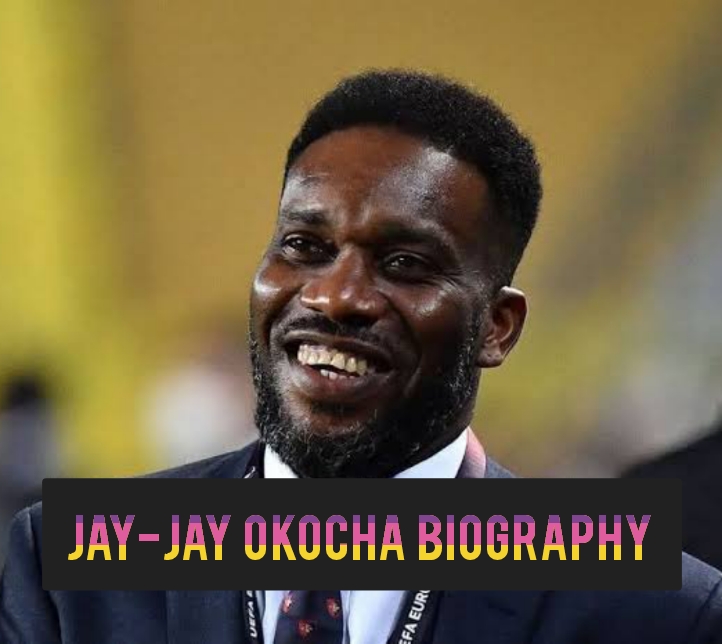
Jay-Jay Okocha Biography
Jay Jay Okocha remains one of the most gifted and entertaining footballers Africa has ever produced. His name still brings smiles to fans who remember the joy of watching a player who turned matches into displays of pure skill and imagination. From the dusty streets of Enugu to the biggest stadiums in Europe and the world stage, Okocha showed that football could be both effective and beautiful. This biography traces the full path of a man whose dribbling, vision, and quiet leadership left a lasting mark on the game and on Nigerian football history.
An interesting fact that continues to capture attention is the moment in 1993 when Jay Jay Okocha scored a goal that many still call one of the finest in Bundesliga history. Playing for Eintracht Frankfurt against Karlsruher SC, he received the ball near the edge of the penalty area, danced past several defenders, including going past some of them more than once, and calmly rolled the ball past goalkeeper Oliver Kahn. The goal was later named Goal of the Year in Germany and remains a perfect example of the creativity that defined his entire career.
Jay Jay Okocha Early Life
Augustine Azuka Okocha was born on 14 August 1973 in Enugu, the capital of Enugu State in southeastern Nigeria. His parents originally came from Ogwashi Uku in Delta State and belonged to the Anioma subgroup of the Igbo people. The family lived a modest life in Enugu, a city known for its coal mining history and strong love of football. Okocha grew up with several siblings, including older brothers James and Emmanuel. James was the first in the family to play football seriously and carried the nickname Jay Jay. In time the name passed to Augustine and became the one the world would know him by. Emmanuel also played for the Nigerian national team, showing that football ran deep in the family.
As a boy Okocha spent countless hours on the streets of Enugu kicking anything that could serve as a ball. Friends and neighbours recall him using rolled up socks, empty cans, or plastic bottles when proper balls were hard to find. These informal games developed his close control, balance, and confidence on the ball. He later joined the youth ranks of local club Enugu Rangers, the team that represented the city and held a special place in Nigerian football. There he began to stand out for his ability to beat opponents with unexpected moves and quick changes of direction.
Education remained important to the family, yet football soon took centre stage. Okocha did not follow the path of formal European academies at a very young age. Instead he learned through street play and local matches. In 1990, while still a teenager, he travelled to Germany on what was meant to be a short visit. He trained with third division side Borussia Neunkirchen and impressed the coaches so much that they offered him a place. That unexpected opportunity marked the true beginning of his professional journey and took him far from the streets of Enugu into a new culture and language.
Jay Jay Okocha Personal Life
Jay Jay Okocha has always placed family at the heart of his life. He met Nkechi during a Christmas holiday in Enugu in December 1994. Both were staying at the same hotel while she attended a wedding. They began a relationship that grew steadily. After three years of dating they married on 3 January 1998. The couple have remained together for more than two decades and have built a stable home. They are the parents of two children, daughter Daniella and son A Jay. Daniella has pursued higher education and later married in a private ceremony in Spain. A Jay has shown interest in football and continues to develop his own path.
Okocha describes himself as an introvert who prefers quiet time at home over constant public appearances. He enjoys simple pleasures such as good food, watching films, and spending time with his wife and children. He has spoken openly about the importance of mutual understanding and commitment in marriage. Friends and those close to the family note that Nkechi has provided steady support throughout the demands of a long professional career and the years that followed. The family maintains a relatively private life in Lagos while remaining connected to their roots in both Enugu and Delta State.
A lesser known fact is that Okocha is the uncle of current Nigerian international Alex Iwobi. The family connection links two generations of Super Eagles players. Okocha has also shown a quiet interest in business and community work. He keeps a low profile regarding personal hobbies beyond family and football related activities, preferring to let his public contributions speak for themselves. His Christian faith has guided many of his decisions, including the choice to remain grounded despite global fame.
Jay Jay Okocha Rise to Prominence
The rise of Jay Jay Okocha began with that unexpected move to Germany in 1990. At Borussia Neunkirchen he adapted quickly to a new environment despite language barriers and cultural differences. His performances earned a transfer to Bundesliga club Eintracht Frankfurt in late 1991. There he shared the pitch with established players and continued to refine his skills. The famous goal against Oliver Kahn in 1993 brought him wider attention across Europe. Fans and journalists began to take notice of the young Nigerian who could turn a match with a single piece of skill.
In 1996 Okocha moved to Turkish club Fenerbahçe. The transfer allowed him greater freedom to express himself. He scored regularly, many of his goals coming from free kicks that became a trademark. Turkish supporters embraced his style, and he even received citizenship during his time there, briefly using a Turkish name. Two strong seasons in Istanbul prepared him for a larger stage.
The breakthrough to true global prominence arrived in 1998 when Paris Saint Germain paid a then record fee for an African player, reported around fourteen million pounds, to bring him to France. At PSG he played alongside talented teammates and continued to dazzle with his close control and vision. Although the club did not always challenge for the biggest trophies during his years there, Okocha’s individual displays kept him in the spotlight. He also formed a positive relationship with a young Brazilian named Ronaldinho, offering guidance that the later star would remember.
A move to the English Premier League with Bolton Wanderers in 2002 completed his rise. Under manager Sam Allardyce, Okocha became the creative heart of a side that punched above its weight. His free kicks, step overs, and ability to unlock defences made him a favourite with the fans and a respected figure across the league. Bolton’s survival and occasional European qualification owed much to his influence. That period confirmed him as one of the most skillful players of his generation and a true entertainer on the English stage.
Jay Jay Okocha Major Achievements
Jay Jay Okocha collected significant honours at both club and international level while earning widespread individual recognition. With Nigeria he helped win the Africa Cup of Nations in 1994 in Tunisia, a landmark victory for the Super Eagles. Two years later he played a central role in the team that won Olympic gold at the 1996 Atlanta Games. That success, achieved against strong opposition including Brazil and Argentina, remains one of the proudest moments in African football history. He represented Nigeria at three FIFA World Cups in 1994, 1998, and 2002, reaching the knockout stages in the first two tournaments. In the 1994 World Cup match against Italy he completed a record fifteen successful dribbles in a single game.
At club level he won the Trophée des Champions with Paris Saint Germain and later helped Hull City gain promotion to the Premier League through the Championship play offs. Individual awards reflected his consistent excellence. He was named Nigerian Footballer of the Year on multiple occasions between 1995 and 2005. He claimed the BBC African Footballer of the Year award in both 2003 and 2004, becoming the only player to win it twice. He finished as runner up for the CAF African Footballer of the Year and earned selection in the FIFA World Cup All Star Team reserve list in 1998. Pelé included him in the FIFA 100 list of the greatest living players in 2004. At Bolton he was named club player of the year and regularly featured among the Premier League’s most entertaining performers.
Beyond trophies, Okocha’s greatest contribution was the joy he brought to spectators. He proved that African players could dominate the technical side of the game and inspire young footballers across the continent. His style influenced a generation that valued skill and creativity alongside physical strength.
Jay Jay Okocha Challenges and Setbacks
The path was never completely smooth. When Okocha first arrived in Germany he faced serious difficulties. He knew little of the language, struggled with the food and culture, and had limited money. He worked morning jobs before training sessions just to survive. Those early months tested his resolve and taught him independence. Later, relegation with Eintracht Frankfurt in 1996 brought disappointment after seasons of competing near the top of the Bundesliga. He accepted the setback and moved on to new opportunities in Turkey.
With the Nigerian national team he experienced the frustration of administrative problems. During the 1996 Olympic campaign the players faced unpaid bills for food and accommodation. They ate the same meal for days and some had to use personal funds to keep the camp running. Despite those hardships the team still won gold, showing remarkable character. Okocha later spoke of the disappointment of missing the 2006 World Cup after Nigeria failed to qualify, a tournament that would have been his fourth and one held in the country where his professional career began.
He also faced the reality that politics sometimes influenced individual awards. Despite his skill and consistency he never claimed the CAF African Footballer of the Year title, finishing as runner up on two occasions. Some observers believed club status and other factors played a part. Injuries interrupted certain seasons, including a calf problem in the late 1990s and fitness issues later at Hull City. Each time Okocha responded by focusing on recovery and adapting his game. His ability to overcome these obstacles without public complaint strengthened the respect he earned from teammates and fans.
Jay Jay Okocha Legacy and Current Status
Jay Jay Okocha’s legacy rests on the beauty he brought to football and the example he set for future African players. He is widely regarded as one of the greatest dribblers the game has seen and a symbol of Nigerian creativity on the pitch. Young players still study his clips for inspiration. At Bolton Wanderers he remains a cult hero whose free kicks and skillful runs are remembered with affection. In Nigeria he stands as a bridge between the successful teams of the 1990s and later generations.
Since retiring from playing in 2008 after a final spell in Qatar, Okocha has remained active. He has served as chairman of the Delta State Football Association and offered thoughtful commentary on SuperSport and other platforms. He built a business portfolio through the Jay Jay Okocha Group that includes real estate, hospitality, financial services, and brand ambassadorships. He also supports education and sports development for young people through his foundation. In recent years he has continued to speak about the need for better structures in Nigerian football while enjoying family life and selective public appearances.
His influence continues through the players he inspired and the standard of skill he set. Fans still refer to him as the Magician, a nickname that captures the sense of wonder he created whenever he had the ball at his feet.
Conclusion
Jay Jay Okocha showed the world that football can be an art form as well as a competition. From the streets of Enugu to the grand arenas of Europe, he proved that creativity, hard work, and quiet determination can carry a player to lasting greatness. His story encourages young athletes to develop their unique gifts while remaining grounded in family and values. The joy he brought to millions remains his most enduring gift, a reminder that the beautiful game is at its best when played with imagination and heart.
FAQs
What is Jay Jay Okocha’s full name and where was he born?
Augustine Azuka Okocha was born in Enugu, Nigeria, and is widely known by the nickname Jay Jay that came from his older brother.
Which major trophies did Jay Jay Okocha win with Nigeria?
He helped Nigeria win the 1994 Africa Cup of Nations and the gold medal at the 1996 Olympic Games in Atlanta.
How many times did Jay Jay Okocha play in the FIFA World Cup?
He represented Nigeria at three World Cups in 1994, 1998, and 2002.
Who is Jay Jay Okocha married to and how many children do they have?
He has been married to Nkechi Okocha since 1998 and they have two children, Daniella and A Jay.
What is Jay Jay Okocha known for most in his playing style?
He is celebrated for his exceptional dribbling, close control, free kicks, and ability to create moments of magic that entertained fans around the world.
What has Jay Jay Okocha done since retiring from football?
He has worked as a football commentator, served in football administration, built business interests, and supported youth development through his foundation.
Why is Jay Jay Okocha considered one of the greatest African players?
His combination of technical skill, international success with Nigeria, and lasting influence on how the game can be played with creativity and joy have secured his place among the continent’s finest.