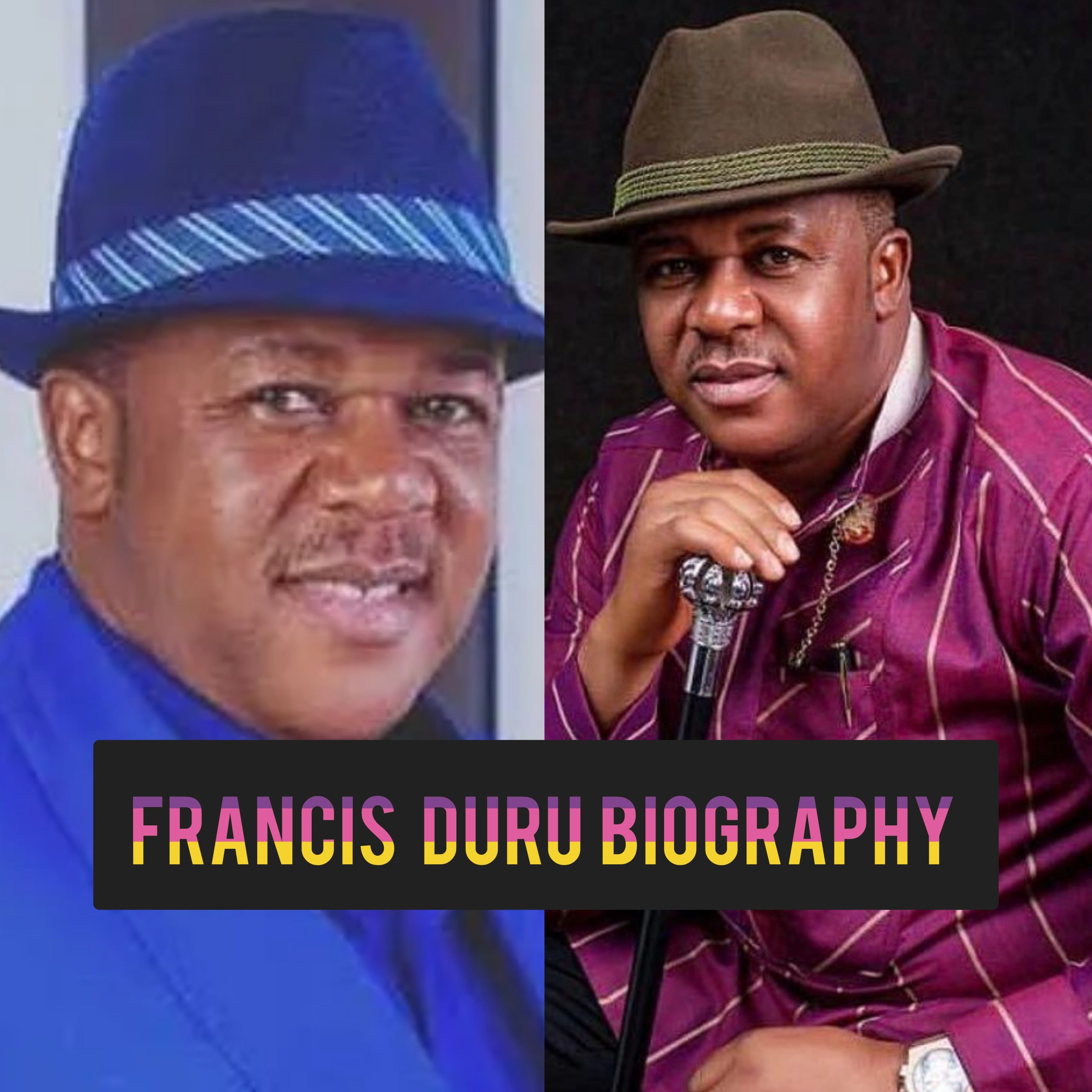
Francis Duru Biography
Francis Duru stood as one of Nollywood’s most enduring and versatile figures, a performer whose career stretched across more than three decades and left an unmistakable mark on Nigerian cinema. Born in Cameroon to Nigerian parents and shaped by both formal theatre training and the rough practical demands of the early home video era, he brought authenticity, range, and quiet authority to dozens of roles. From his breakthrough as the conflicted Ahanna in the landmark action film Rattlesnake to later award winning performances in Igbo language cinema, Duru combined craft with a deep sense of purpose that extended far beyond the screen.
His life was defined by persistence, faith, and service. He rose from uncertain beginnings and early struggles for admission into university to become an interim leader of the Actors Guild of Nigeria, a United Nations Ambassador of Peace, and a mentor to younger artists. Even after personal tragedy and the challenges that accompany a long career in a rapidly changing industry, he remained committed to storytelling, youth development, and community. His passing in October 2026 closed a significant chapter in Nollywood history, yet the body of work and the example he set continue to speak for him.
Francis Duru Early Life
Francis Ogide Duru was born on July 27 1969 in Cameroon. His parents were Nigerians who traced their roots to Imo State in the southeastern part of the country, specifically the area around Eziama in Isiala Mbano Local Government Area. Growing up outside Nigeria gave the young Francis an early experience of life across borders. He completed both his primary and secondary education in Cameroon, absorbing the cultural mix of the region while remaining firmly connected to his Igbo heritage through family stories, language, and values.
The decision to pursue higher education brought him back to Nigeria. He had originally hoped to study Law or Mass Communication and sat the Joint Admissions and Matriculation Board examination three times without securing a place in those courses. Eventually he accepted an opportunity at the University of Port Harcourt in Rivers State. He began with a certificate programme and later moved into the degree track in Theatre Arts. The department at Port Harcourt was known for its rigorous training and for the presence of influential teachers and practitioners. Among those who shaped him were figures such as the late Amatu Braide, Columbus Irosoanga, Dr Emma Ogah, and the celebrated playwright Ola Rotimi.
University life was not only academic. Duru discovered that his talent for performance could also help meet practical needs. He took part in stage productions and campus events, some paid and some unpaid. The income from these engagements contributed toward his school fees and living expenses. He also developed a reputation for comedy, performing at gatherings and becoming involved in the early days of the popular comedy platform Night of a Thousand Laughs. These experiences taught him that creative work could sustain a person when approached with seriousness and discipline.
One formative incident occurred in 1992 during a stage production titled Spokesman for the Oracle. While performing, Duru broke a glass with his hand and began to bleed. He continued the scene without stopping. Ola Rotimi, who was present, later reprimanded him for risking his safety yet also recognised the commitment the young actor had shown. Rotimi took him home, prepared a meal of yam and stew, and offered both praise and caution about the dangers of arrogance that can follow early success. Duru later described the encounter as more meaningful than many formal awards he would eventually receive. He graduated in 1996 with a degree in Theatre Arts, carrying with him both technical skill and a clear sense of the responsibilities that come with the craft.
Francis Duru Personal Life
Francis Duru met his future wife Adokiye while both were students at the University of Port Harcourt. Their relationship grew from friendship into marriage, and they wed in 2003. The wedding day itself provided one of the lighter stories he enjoyed telling. His best man, the entertainer Basorge Tariah Junior, arrived late at the church carrying the groom’s shoes. With the ceremony about to begin, Duru borrowed another pair of shoes so that the event would not be delayed. The best man eventually appeared and the service proceeded. The couple went on to have four children and built a family life grounded in mutual support and shared Christian faith.
That faith was central to Duru’s private world. For approximately twenty four years he served in the youth department of Family Worship Centre in Abuja, teaching Sunday school and helping to oversee church drama activities. He described himself as a caretaker of the family rather than its ultimate owner, a perspective that deepened after the loss of his second son Ifeanyi in August 2024. Ifeanyi was fifteen years old. In the days that followed the burial, Duru returned to church the very next day and conducted a service. He later explained that the act was a deliberate affirmation of trust in God. The grief remained real. He spoke of moments when he still looked for his son among the congregation during youth programmes, only to remember that the boy was no longer there. Yet he insisted that the experience had amplified rather than diminished his faith.
Beyond family and church, Duru cultivated interests that kept him connected to ordinary life. He worked as a master of ceremonies, a voice over artist, and a consultant. He taught master classes for younger performers and maintained an interest in academic study even while acting full time. He later earned a master’s degree in Development Communication from Nasarawa State University and was engaged in doctoral research at the University of Port Harcourt. These pursuits reflected a consistent belief that storytelling and communication could serve broader social purposes. Friends and colleagues often noted his humble manner and willingness to mentor without seeking the spotlight.
Francis Duru Rise to Prominence
Duru entered the Nigerian film industry in 1989 with a role in Missing Mark, directed by the late Ndubuisi Oko. The film did not immediately transform his prospects. At the time he was still regarded as an emerging talent, and opportunities came slowly. He continued to audition and accept smaller parts while sharpening his skills through stage work and campus performances.
The turning point arrived in the mid 1990s with Rattlesnake, written and directed by the late Amaka Igwe. The film was an action comedy that told the story of a young man named Ahanna who loses his father under suspicious circumstances and drifts into a double life of crime and respectability. Duru played the younger Ahanna. He had auditioned alongside the comedian Julius Agwu, and both were selected on the strength of their performances rather than personal connections. The role demanded emotional range, physical presence, and the ability to convey the gradual hardening of a character under social pressure. Audiences responded strongly. Rattlesnake became one of the notable productions of its era and is often remembered as an early example of Nollywood action storytelling with serious thematic weight. From that point Duru’s name carried greater recognition, and producers began to cast him in more substantial parts.
Throughout the late 1990s and 2000s he appeared in a steady stream of films. Blood Money in 1997 gave him another memorable role. He worked across English and Igbo language productions, moving between drama, comedy, and social commentary. His training in theatre allowed him to approach characters with preparation and discipline at a time when many performers relied largely on instinct. He also began to take on responsibilities behind the camera as a director and producer, and he remained active as a master of ceremonies and television personality. By the time he was appointed interim president of the Actors Guild of Nigeria in 2010, he had already established himself as a reliable and respected presence within the industry.
Francis Duru Major Achievements
Recognition came in several forms. In 2007 Duru received the United Nations Ambassador of Peace award for his positive influence on young people. The honour acknowledged both his on screen work and his off screen engagement with youth development. He collaborated with organisations including UNICEF, USAID, LEAP Africa, and COMPASS, using his platform to support education and improved living standards for African children. These efforts reflected a consistent interest in the social role of the arts.
In 2010 he was named interim president of the Actors Guild of Nigeria. The same year he received a nomination for Best Actor in a Supporting Role at the Africa Movie Academy Awards. A decade later, in 2020, he won Best Actor in a Leading Role in the Igbo category at the Best of Nollywood Awards for his performance in Mboputa. The film allowed him to work in his mother tongue and to explore character with the depth that language can provide. Other notable titles across his career include Home in Exile, Stigma, The Good Husband, Blood Vessel, Eagle Wings, and later works such as Ugly Bird and Abigail’s Memoir. His filmography eventually numbered well over one hundred titles, spanning the home video boom, the rise of cinema releases, and the expansion into streaming platforms.
Beyond awards, his influence appeared in the quieter work of mentoring. He taught master classes, advised younger actors on craft and professionalism, and spoke publicly about the need for organisation and collective investment within the industry. In interviews he urged Igbo filmmakers to learn from the organisational strengths he observed among Yoruba colleagues, arguing that cultural storytelling requires deliberate structure and mutual support if it is to thrive on global platforms. His own career demonstrated that longevity in Nollywood depends on adaptability, continuous learning, and a willingness to serve the larger community of practitioners.
Francis Duru Challenges and Setbacks
The path was never entirely smooth. Early in his career he faced the common obstacles of limited roles, uncertain payment, and the difficulty of being taken seriously as a newcomer. The failure to gain admission into his preferred university courses forced a redirection that ultimately proved fruitful, yet it required humility and openness to an unexpected path. Once established, he still navigated the structural weaknesses of an industry that was itself evolving rapidly, from cassette distribution to digital platforms, and from informal production methods to more professional standards.
Personal loss tested him most severely. The death of his teenage son Ifeanyi in 2024 brought profound grief. Duru spoke openly about the pain, the moments of searching for his child in familiar settings, and the daily effort required to continue. He chose to meet that sorrow with active faith, returning to church duties almost immediately and framing the experience as a reminder of life’s temporary nature. Health rumours also surfaced in the months before his own death. In June 2026 videos circulated online suggesting he was seriously ill. He responded directly, denying the claims and describing some of the footage as fabricated. The episode illustrated the pressures that public figures face in an age of rapid social media speculation.
Industry politics and debates over representation added further complexity. Duru did not shy away from expressing views on the relative organisational strength of different cultural groups within Nollywood. Such comments sometimes sparked discussion, yet they also underscored his investment in the long term health of the profession. Through each of these challenges he maintained a reputation for professionalism and personal integrity.
Francis Duru Legacy and Current Status
Francis Duru passed away on October 23 2026 at the age of fifty seven following a brief illness. His family confirmed the news in a statement that asked for prayers and understanding. The National President of the Actors Guild of Nigeria, Alhaji Abubakar Sanusi Yakubu, publicly mourned the loss of another great thespian. Tributes from colleagues and fans highlighted both his body of work and the example he set as a family man, church worker, and mentor.
His legacy rests on several pillars. On screen he helped define a generation of Nollywood storytelling through roles that balanced entertainment with social observation. Off screen he modelled the possibility of combining artistic success with humanitarian service and personal faith. The United Nations award, the leadership role in the Actors Guild, the teaching of Sunday school, and the quiet support of younger artists all form part of that record. Films such as Rattlesnake continue to be referenced as early landmarks, while later works like Mboputa demonstrate his continued relevance across changing tastes and formats.
In the years before his death he remained active, appearing in new productions and speaking about the need for cultural confidence and organisational discipline within Nigerian cinema. His academic pursuits and master classes suggested a desire to leave behind not only performances but also knowledge. For many who worked with him or watched his films, he represented the possibility of a career sustained by craft, character, and contribution rather than fleeting celebrity.
Conclusion
Francis Duru’s story is one of steady purpose. From a childhood in Cameroon to the stages and screens of Nigeria, from early uncertainty about his academic path to recognition as both actor and peacemaker, he moved with quiet determination. The roles he played, the students he taught, the family he loved, and the faith he practised all formed a coherent whole. In an industry often defined by rapid change and intense competition, he offered an example of longevity rooted in preparation, humility, and service. His absence is felt, yet the work remains, ready to be discovered by new audiences and remembered by those who already know its value.
FAQs
Who was Francis Duru?
Francis Duru was a Nigerian actor, director, producer, and humanitarian known for his long career in Nollywood. He gained prominence through the 1995 film Rattlesnake and later received the United Nations Ambassador of Peace award.
When and where was Francis Duru born?
He was born on July 27 1969 in Cameroon to Nigerian parents from Imo State.
What was Francis Duru’s breakthrough role?
His breakthrough came with the role of Ahanna in Amaka Igwe’s 1995 action comedy Rattlesnake.
Was Francis Duru married?
Yes. He married Adokiye in 2003. The couple had four children.
What awards did Francis Duru receive?
He received the United Nations Ambassador of Peace award in 2007 and won Best Actor in a Leading Role (Igbo) at the 2020 Best of Nollywood Awards for Mboputa. He was also nominated for Best Actor in a Supporting Role at the 2010 Africa Movie Academy Awards.
When did Francis Duru die?
Francis Duru died on October 23 2026 at the age of fifty seven following a brief illness.