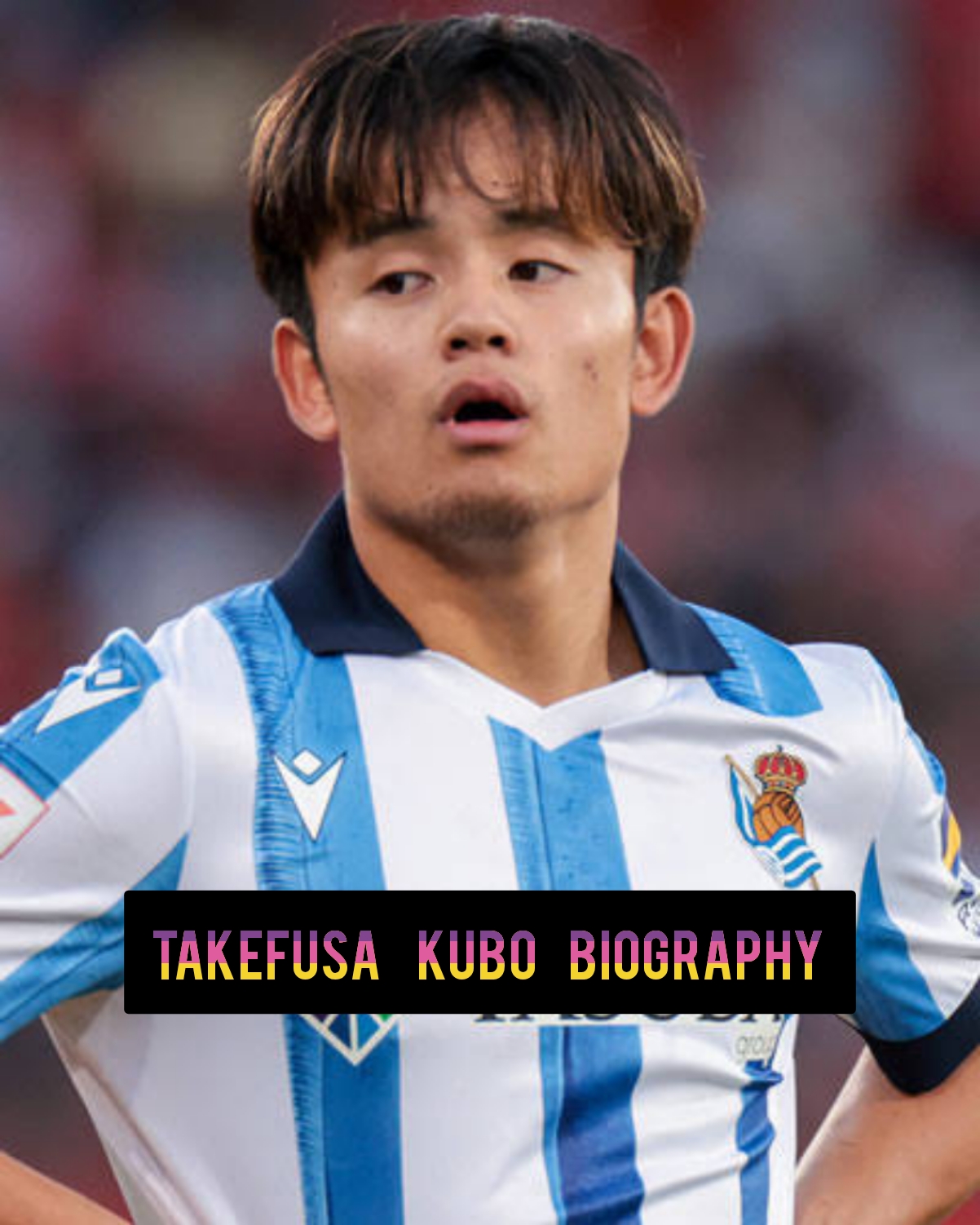
Takefusa Kubo Biography
Takefusa Kubo stands as one of the most gifted footballers of his generation, a player whose quick feet, sharp vision, and fearless style have earned him the lasting nickname Japanese Messi among fans across Asia and Europe. Born in Japan and shaped by both Japanese discipline and Spanish football culture, he has built a career that bridges two continents while remaining true to his roots. At just twenty five years old, Kubo has already appeared in major tournaments for his country, claimed domestic silverware in Spain, and established himself as a key figure at Real Sociedad. His story is one of early promise, sudden setbacks, patient growth, and quiet determination.
An interesting fact that draws the reader in is that by the age of twelve Takefusa Kubo had already scored seventy four goals in thirty matches for one of Barcelona’s youth teams, a scoring rate so extraordinary that coaches and scouts began comparing him to the greatest left footed playmakers in the modern game long before he turned professional.
Takefusa Kubo Early Life
Takefusa Kubo was born on 4 June 2001 in the Asao ward of Kawasaki, a city in Kanagawa Prefecture just outside Tokyo. His father Takefumi Kubo had played football through high school and college and worked for a time as a coach with local youth sides, including Sakahama SC. From the time Takefusa was only three or four years old his father took him to parks and small pitches, teaching him the basics of control, balance, and movement. The family lived a modest middle class life, and football became the central shared activity rather than a distant dream.
His mother Tamiko provided steady emotional support and later moved with the family to Spain to help maintain a sense of home during the long years abroad. Takefusa has a younger brother named Eiji, born in 2007, who also pursued football and eventually joined the youth ranks of Real Sociedad. The brothers grew up kicking a ball together in the streets and parks of Kawasaki, with their father watching and correcting technique. Education followed a normal path at first. Kubo attended Asahizawa Elementary School and later Kawasaki Municipal Asahizawa Junior High School, where teachers noted both his focus in class and his unusual talent on the sports field.
At seven he joined FC Persimmon, a local club, and soon moved through the ranks of Tokyo Verdy and Kawasaki Frontale junior sides. In August 2009, at only eight years old, he attended an FC Barcelona soccer camp held in Japan and was named most valuable player. The following year he was selected for the Barcelona School team that competed in the Sodexo European Rusas Cup in Belgium, where he again earned the MVP award even though the side finished third. Those performances opened the door to a permanent invitation from La Masia, Barcelona’s famous youth academy. In August 2011, at the age of ten, Kubo left Japan with his family and settled in Catalonia. He began with the Aleví C under eleven group and quickly rose. In the 2012 to 2013 season he scored seventy four goals in thirty matches and topped the league scoring charts. By his third full season he had been promoted to the Infantil A under fourteen team. The experience gave him a deep understanding of Spanish technical training, possession play, and the high expectations that come with wearing the Barcelona badge. Yet the idyllic chapter ended abruptly in 2015 when FIFA ruled that Barcelona had violated regulations governing the international transfer of minors. Kubo was forced to return to Japan, a decision that tested his young resolve but also taught him resilience at an early age.
Back in his home country he joined the FC Tokyo youth system. The club recognized his quality at once and registered him with the senior squad while he was still fifteen. On 5 November 2016 he made his debut for the reserve side in the J3 League. Months later, on 15 April 2017, he became the youngest player ever to score in the J League at fifteen years and ten months. That same spring he appeared for the first team in the J League Cup. The combination of early European schooling and rapid domestic exposure created a player who already possessed both technical polish and competitive maturity before most of his peers had finished secondary school.
Takefusa Kubo Personal Life
Away from the pitch Takefusa Kubo has always preferred a low profile. He speaks Spanish fluently after years spent in Spain and manages conversational English with ease, skills that have helped him settle into dressing rooms across La Liga. Friends and teammates describe him as talkative once comfortable, fond of jokes, and more outgoing than his quiet public image suggests. He has said he enjoys speaking about almost any subject and values simple daily routines. In interviews he has mentioned a preference for reading and watching series in his free time, a love of Japanese udon and Spanish jamón serrano, and a dislike of alcohol. He once answered that if stranded on a desert island he would take a fishing rod, water, and a lighter. Spider Man is his favorite superhero, and he has expressed admiration for players such as Ronaldinho while insisting he would rather attempt a spectacular bicycle kick than a cheeky Panenka penalty.
Family remains central. His parents and younger brother have followed his career closely. His mother has lived with him in San Sebastián since his move to Real Sociedad, creating a stable household that also supports Eiji’s development in the club’s youth teams. In October 2026 Kubo announced his marriage to Japanese actress Haruka Fukuhara. The announcement came as a surprise to the public because the couple had kept their relationship private. Fukuhara, three years older, began her career as a child actress and later became known for television dramas, voice work, and modeling. In their joint statement the couple spoke of mutual support since childhood, gratitude to those who helped them grow, and a desire to build a warm family filled with smiles. Kubo has also mentioned his cousin Rin Kubo, a middle distance runner, as another athletic relative whose achievements he respects. These personal anchors help him stay grounded amid the constant travel and attention that professional football demands.
Takefusa Kubo Rise to Prominence
The turning point that lifted Kubo from promising youth to national talking point arrived in 2019. After strong performances with FC Tokyo and a short loan spell at Yokohama F Marinos, where he scored on debut, European clubs intensified their interest. Real Madrid moved decisively and signed him on a five year contract in June 2019. Although he never made a competitive first team appearance for the Spanish giants, the move itself announced his arrival on the world stage. Real Madrid immediately sent him on loan to Mallorca so he could gain regular La Liga minutes. On 1 September 2019 he became the youngest Japanese player ever to appear in one of Europe’s top four leagues at eighteen years two months and twenty eight days. He scored four league goals that season and showed the same fearless dribbling that had first caught Barcelona’s eye.
Subsequent loans to Villarreal and Getafe tested his adaptability. Minutes were harder to come by under Unai Emery at Villarreal, and the loan was cut short in January 2021 so he could join Getafe. A return to Mallorca for the 2021 to 2022 campaign restored his confidence. He scored a stoppage time winner against Atlético Madrid at the Wanda Metropolitano, a moment that reminded observers of his capacity to decide big matches. The permanent transfer to Real Sociedad in July 2022 proved the decisive step. He scored on his league debut in a one nil victory at Cádiz and never looked back. Under coach Imanol Alguacil he found a tactical system that valued his ability to receive between the lines, combine in tight spaces, and attack the final third with both goals and assists. By the end of his first season he had been named Real Sociedad Player of the Season and helped the club finish fourth, securing Champions League football for the first time in a decade.
International recognition followed a parallel path. Kubo represented Japan at every youth level from under fifteen upward. He played at the 2017 FIFA Under Twenty World Cup while still fifteen and later featured at the 2020 Tokyo Olympics, scoring Japan’s first goal of the tournament against South Africa. His senior debut came in June 2019 against El Salvador. He was included in the 2022 World Cup squad and started in the memorable group stage wins over Germany and Spain. Selection for the 2026 World Cup squad confirmed his status as a regular and often influential member of the Samurai Blue.
Takefusa Kubo Major Achievements
At club level the most tangible team honors arrived with Villarreal’s 2021 Europa League triumph, even though Kubo’s playing time that season was limited, and with Real Sociedad’s 2026 Copa del Rey victory. In the final against Atlético Madrid he entered as a late substitute and helped the side hold their nerve through the penalty shootout. Individually he has been recognized multiple times. He earned a place in the UEFA La Liga Revelation Team of the Year for 2019 to 2020, appeared in the IFFHS Asian Men’s Team of the Year in 2021, 2024 and 2025, and was selected in the Japan Pro Footballers Association Best Eleven in 2022 and 2023. At Real Sociedad he claimed the Player of the Season award for 2022 to 2023 after contributing nine league goals and four assists in thirty five appearances. Across more than one hundred thirty league matches for the Basque club he has scored twenty three goals and provided twelve assists, figures that understate his influence on build up play and chance creation.
For Japan he has earned fifty four senior caps and scored seven goals by late 2026. His international contributions include goals in World Cup qualifying, the Asian Cup, and friendly tournaments. The combination of consistent club performances and national team appearances has made him one of the most visible Asian players in European football and a role model for the next generation of Japanese talents who dream of succeeding abroad.
Takefusa Kubo Challenges Setbacks
The first major obstacle came at thirteen when FIFA’s ruling forced him out of Barcelona. Leaving La Masia felt like the end of a dream he had chased since childhood. Instead of becoming bitter he returned to Japan determined to play as much as possible. The early professional years in Tokyo demanded mental strength because expectations were already high and physical maturity still incomplete. The series of loans after joining Real Madrid brought further tests. Limited minutes at Villarreal and the need to adapt quickly at Getafe and Mallorca required patience and self belief. Each temporary move taught him different tactical demands and the reality that talent alone does not guarantee a starting place.
More recently injuries have interrupted his rhythm. A hamstring problem in early 2026 kept him out for nearly ten weeks, and a subsequent knee issue caused further absence. Form fluctuations and a lengthy goal drought at home also tested his confidence. Through these periods he has spoken of focusing on daily work rather than external noise, relying on family support, and trusting the process that has carried him this far. The ability to recover and contribute again after each setback has become one of the defining traits of his career.
Takefusa Kubo Legacy Current Status
As of October 2026 Takefusa Kubo remains a core member of Real Sociedad and a first choice option for Japan. His contract with the Basque club runs until 2029, giving both parties stability. He continues to train and compete while managing the physical demands of a long season that includes domestic and European fixtures. Recent activity has included appearances in La Liga and the Europa League, along with international duty. Beyond statistics his influence is visible in the growing number of Japanese players who now view Spain as a realistic destination and in the respect he receives from teammates and opponents for his technical quality and work rate.
The legacy he is building rests on more than trophies. He has shown that a player of relatively small stature can thrive through intelligence, close control, and relentless effort. Young footballers in Japan study his movement and decision making, while Spanish supporters appreciate the joy he brings to the game. Whether he remains at Real Sociedad for many more years or eventually moves to another major club, the foundation of a significant career is already secure.
Conclusion
Takefusa Kubo’s path from the parks of Kawasaki to the stadiums of La Liga demonstrates that early talent must be paired with resilience, humility, and continuous learning. His story reminds readers that setbacks are temporary when the will to improve remains constant. In an era when football often celebrates only the most spectacular moments, Kubo offers a quieter example of steady excellence and quiet determination that continues to inspire.
FAQs
What is Takefusa Kubo’s full name and date of birth?
Takefusa Kubo was born on 4 June 2001 in Kawasaki, Japan.
Which clubs has Takefusa Kubo played for?
He began with local Japanese sides and Barcelona’s academy before turning professional with FC Tokyo. After a loan at Yokohama F Marinos he joined Real Madrid and spent time on loan at Mallorca, Villarreal and Getafe. Since 2022 he has played for Real Sociedad.
Why is Takefusa Kubo called the Japanese Messi?
Fans and media use the nickname because of his left footed dribbling, close control, vision, and ability to create and score goals from the right wing or attacking midfield positions in a manner reminiscent of Lionel Messi.
Is Takefusa Kubo married?
Yes. In October 2026 he announced his marriage to Japanese actress Haruka Fukuhara.
What major trophies has Takefusa Kubo won?
He was part of the Villarreal squad that won the Europa League in 2021 and contributed to Real Sociedad’s Copa del Rey triumph in 2026.
How many caps does Takefusa Kubo have for Japan?
As of October 2026 he has earned fifty four senior international appearances and scored seven goals.
Does Takefusa Kubo speak Spanish?
Yes. Years spent in Spain from childhood have made him fluent in Spanish, and he also speaks conversational English.